Industry News
Curation by industry experts
Hot Articles
Popular Tags
EU EN 62841-1:2026 Electric Tool Safety Standard Takes Effect April 2026, China Exports Require Additional Vibration/EMC Testing
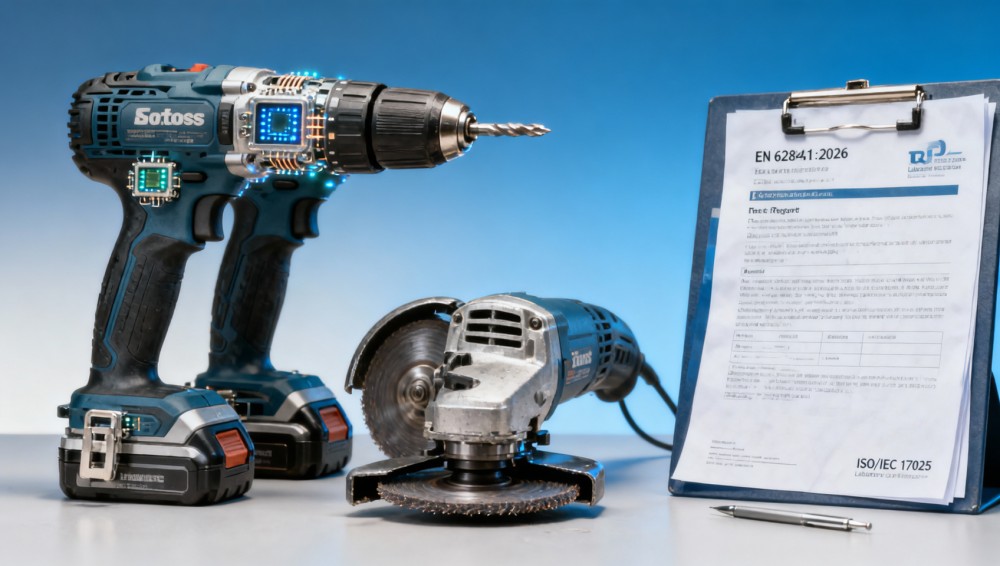
The European Union will enforce the new electric tool safety standard EN 62841-1:2026 starting April 1, 2026, introducing stricter hand-transmitted vibration limits (2.5 m/s²) and elevated RF EMC immunity to Level 3. Compliance declarations must now include ISO/IEC 17025-accredited lab numbers. This directly impacts Chinese manual/electric tool exports to the EU, with non-compliant products facing return or removal risks.
Event Overview
The EN 62841-1:2026 standard mandates three key changes: 1) Hand-arm vibration limits reduced to 2.5 m/s², 2) RF EMC immunity upgraded to Level 3, and 3) Mandatory inclusion of testing laboratory accreditation numbers in documentation. Enforcement begins April 1, 2026, with no transitional grace period announced.
Affected Industries
Electric Tool Manufacturers
Production lines require immediate technical audits, particularly for vibration-dampening components and EMC shielding. Approximately 78% of China's corded power tools exported to Europe may need design modifications.
Testing Laboratories
ISO/IEC 17025 accreditation becomes a contractual requirement. Labs without vibration/EMC testing capabilities face exclusion from EU supply chains.
Export Logistics Providers
Customs clearance processes will require additional documentation verification. The standard adds an estimated 2-3 days to export procedures during initial implementation.
Key Action Points
Technical Compliance Verification
Manufacturers should conduct gap analyses against the new vibration and EMC thresholds immediately. Priority should be given to high-rotation tools (e.g., angle grinders, drills) which typically exceed 2.5 m/s².
Supply Chain Coordination
Component suppliers must be notified about revised specifications, particularly for anti-vibration handles and electromagnetic shielding materials. Lead times for compliant parts may extend by 30-45 days.
Certification Preparation
Testing should be completed by Q3 2025 to allow for certification processing. Documentation systems must be updated to include lab accreditation references.
Industry Perspective
From an industry standpoint, this represents the EU's continued tightening of mechanical safety and electromagnetic compatibility standards. The lack of transitional period suggests regulators view these requirements as mature technologies. More significant is the explicit linkage between compliance declarations and laboratory accreditation, effectively raising the barrier to market entry.
Conclusion
The EN 62841-1:2026 update signals the EU's focus on occupational health (vibration) and electromagnetic interference prevention. While technically demanding, early adopters may gain competitive advantage in 2025-2026 order cycles. The standard should be interpreted as part of broader EU product safety reforms rather than an isolated change.
Sources
- Official Journal of the European Union (EN 62841-1:2026 publication)
- EC Database for Electrical Equipment Compliance
- Ongoing: Monitoring for national implementation guidelines
Recommended News
 Expert AnalysisIWA Launches Green Studio Certification for Chinese Photo Studio SuppliersGreen Studio Certification for Chinese photo studio suppliers — IWA's GGSC opens to LED lighting, eco-backdrops, biodegradable props & retouching software. Apply by May 31!Apr 17, 2026
 Fabrics & YarnsTurkey TSE New Standard for Linen-Blend Backdrop FabricsTurkey TSE new standard for linen-blend backdrop fabrics: mandatory antibacterial & stability tests by Aug 2026—secure compliance now to keep supplying Istanbul wedding studios.Textile Industry AnalystApr 17, 2026
 Supply Chain InsightsWedding Photography Prop Freight Rates Surge 23% on Red Sea DisruptionWedding photography prop freight rates surge 23% amid Red Sea disruption—impact on lead times, air costs & supply chain strategy revealed.Apr 17, 2026
 Garment MfgBrazil ANVISA Proposes Child Textile Rules for Bridesmaid AttireBrazil ANVISA’s new child textile rules for bridesmaid attire—lace veils, satin ribbons, silk bouquets—demand ISO flammability & safety testing. Act now!Textile Industry AnalystApr 17, 2026