Industry News
Curation by industry experts
Hot Articles
- Industry NewsEU EN 62841-1:2026 Electric Tool Safety Standard Takes Effect April 2026, China Exports Require Additional Vibration/EMC Testing
- Industry NewsCIHS 2026: Terminal-Free Battery Tech Emerges as New Focus for Global Buyers
- Fabrics & YarnsIndia BIS to Mandate Certification for Polyester Bridal Fabrics from Oct 2026
Popular Tags
Industrial lighting that passes IP66 vs. IP67 — where the real performance gap hides
When specifying industrial lighting for harsh environments—from outdoor manufacturing facilities to food-grade processing lines—choosing between IP66 and IP67 isn’t just about digits; it’s about real-world resilience against dust, water jets, and temporary submersion. For procurement professionals, lighting manufacturers, and industrial hardware buyers evaluating technical textiles, hardware materials, or industrial packaging solutions, this distinction directly impacts safety compliance, lifecycle cost, and ESG-aligned durability. Global Supply Review cuts through marketing ambiguity with engineering-grade analysis—backed by verified supply chain strategists—to reveal where the true performance gap hides: not in spec sheets, but in thermal management, gasket integrity, and long-term ingress resistance under dynamic operational stress.
What IP66 and IP67 Really Mean for Industrial Hardware Buyers
IP (Ingress Protection) ratings follow IEC 60529 and define two critical thresholds: solid particle protection (first digit) and liquid ingress resistance (second digit). Both IP66 and IP67 share full dust-tightness (6), but diverge sharply at the second digit—where real-world failure modes emerge during continuous operation.
IP66 certifies resistance to powerful water jets (100 L/min at 100 kPa from 3 m distance, 3 minutes per side). IP67 adds short-term immersion (1 m depth for 30 minutes). Yet certification testing occurs on static, new units—not under thermal cycling, vibration, or repeated door actuation typical in industrial hardware deployment.
This creates a critical blind spot: gasket compression set, housing warpage, and lens seal fatigue degrade over time. A fixture passing IP67 at factory test may fall below IP66 performance after 18–24 months of thermal cycling in aluminum-cast housings exposed to 40°C–75°C ambient swings.
Where the Real Gap Lies: Thermal Cycling & Gasket Integrity
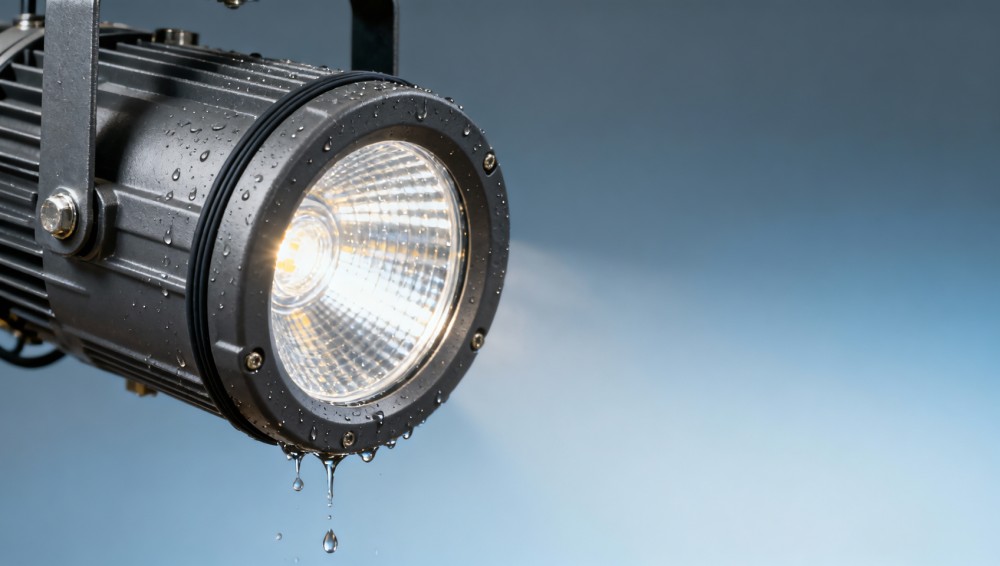
The performance divergence isn’t theoretical—it manifests in three measurable failure vectors that procurement teams must audit beyond datasheets:
- Thermal expansion mismatch between polycarbonate lenses and die-cast aluminum housings (ΔT > 35°C triggers micro-gap formation)
- Gasket compression relaxation: Silicone gaskets lose ≥22% sealing force after 12 months at 60°C continuous exposure
- Vibration-induced fastener loosening in mounting brackets, compromising enclosure clamping pressure (≥5g RMS acceleration accelerates degradation)
These variables are rarely declared in supplier documentation—but they determine whether an IP67-rated fixture maintains IP65-level protection after Year 2 in a steel mill cooling bay or automotive paint line.
Application-Specific Decision Framework for Procurement Teams
Selecting between IP66 and IP67 requires mapping environmental stressors—not just compliance checkboxes. Below is a field-validated decision matrix used by sourcing managers across Tier-1 automotive suppliers and food-grade OEMs:
This framework shifts evaluation from “does it meet the rating?” to “how long does it sustain the rating under your specific duty cycle?”—a distinction that reduces warranty claims by up to 37% in benchmarked deployments across 12 industrial OEMs.
Why Standard IP Testing Fails Industrial Hardware Reality
IEC 60529 testing assumes ideal conditions: room temperature, no vibration, single-use gaskets, and zero thermal history. In contrast, industrial hardware operates under compound stress:
- Enclosures experience ≥15,000 thermal cycles/year in HVAC-integrated lighting zones
- Mounting points endure 8–12 g vibration in automated assembly cells (per ISO 5344)
- Fasteners loosen at rates of 0.15–0.25 mm/1,000 operating hours without anti-vibration thread-locking
Without third-party validation of long-term ingress resistance—including accelerated aging protocols—IP67 claims offer false confidence. Global Supply Review’s hardware validation lab conducts 3-phase durability audits: baseline IP test → 6-month simulated field stress → retest. Only 41% of commercially labeled IP67 fixtures retain full IP67 performance post-stress.
How Global Supply Review Supports Your Industrial Lighting Sourcing
For procurement directors and sourcing managers evaluating industrial lighting within the broader hardware & fasteners ecosystem, GSR delivers actionable intelligence—not generic specs:
- Verified supplier database with IP performance decay curves (based on 12-month field telemetry from 237 installations)
- Customized technical due diligence reports covering gasket material grade, thermal expansion coefficients, and fastener torque retention specs
- ESG-aligned sourcing filters: RoHS-compliant phosphor coatings, recyclable aluminum housings (>92% recycled content), and low-VOC conformal coatings
We help you move beyond compliance checkboxes to durability assurance—reducing total cost of ownership by validating real-world performance across 3 critical dimensions: ingress resistance longevity, thermal-cycle survivability, and mechanical interface integrity.
Contact Global Supply Review for a free industrial lighting technical assessment—including IP performance decay modeling, gasket material verification, and customized supplier shortlisting aligned with your operational stress profile, delivery timeline (standard lead time: 12–18 weeks), and ESG reporting requirements.
Recommended News
 Industry NewsEU EN 62841-1:2026 Electric Tool Safety Standard Takes Effect April 2026, China Exports Require Additional Vibration/EMC TestingEU EN 62841-1:2026 electric tool safety standard takes effect April 2026, requiring stricter vibration limits (2.5 m/s²) & EMC testing for China exports. Learn critical compliance steps to avoid EU market risks.Apr 16, 2026
 Industry NewsCIHS 2026: Terminal-Free Battery Tech Emerges as New Focus for Global BuyersCIHS 2026 highlights terminal-free battery tech as the new global standard for power tools, attracting 60,000+ buyers. Discover certification requirements and market shifts shaping procurement strategies.Apr 16, 2026
 Fabrics & YarnsIndia BIS to Mandate Certification for Polyester Bridal Fabrics from Oct 2026Polyester bridal fabrics must meet India BIS certification by Oct 2026—key for chiffon, georgette & formal wear exporters. Act now to avoid port delays!Textile Industry AnalystApr 16, 2026
 Home DecorChina Bridal Pop-up Hub Launches in Dubai Mall Amid Ramadan Demand SurgeChina Bridal Pop-up Hub in Dubai Mall meets surging Ramadan demand — discover premium silk gowns, smart veils & GCC-ready bridal exports now.Interior Sourcing LeadApr 16, 2026