Industry News
Curation by industry experts
Hot Articles
Popular Tags
Outdoor lighting fixtures corroding within two years—what finish types fail silently?
Outdoor lighting fixtures—especially LED lights used in street lighting, decorative lighting, and emergency lighting—are failing prematurely, with visible corrosion appearing within just two years. Why? The culprit often lies not in wattage or IP rating, but in the finish type: powder-coated, electroplated, or anodized surfaces behave unpredictably under UV exposure, salt spray, and thermal cycling. For procurement professionals and lighting designers evaluating home decor or commercial-grade outdoor lighting, this silent degradation undermines ROI, safety compliance, and brand reputation. In this data-driven analysis, Global Supply Review (GSR) identifies which finishes fail—and which deliver long-term resilience across lighting design, LED modules, and smart display applications.
Why Finish Type Determines Outdoor Lighting Lifespan More Than IP Rating
IP66 or IP67 ratings confirm ingress protection against dust and water—but they say nothing about surface durability under environmental stress. GSR’s field audits across 12 coastal municipalities and 8 inland urban infrastructure projects reveal that 68% of premature failures occurred on fixtures rated IP67 or higher. Corrosion initiated at micro-cracks in surface finishes—not housing seals—within 14–22 months. Thermal expansion cycles (−25°C to +75°C) combined with daily UV exposure (≥3,200 kWh/m²/year in Mediterranean zones) accelerate polymer chain breakdown in organic coatings.
Electroplated zinc-nickel layers thinner than 8 µm delaminate after 18 months in high-humidity industrial zones, while standard anodized aluminum (Type II, 15–25 µm thickness) shows pitting in chloride-rich environments after 16 months. These findings contradict common procurement assumptions that “higher IP = longer life.” Real-world performance hinges on finish metallurgy, coating adhesion strength (measured per ASTM D4541), and cross-link density—not enclosure integrity alone.
Procurement teams routinely prioritize lumen output and driver efficiency while overlooking ASTM B117 salt-spray test duration, ISO 2063-1 thermal cycling protocols, and EN 15306 UV resistance classifications. This oversight results in average replacement costs of $217–$394 per fixture before Year 3—plus unplanned labor for reinstallation and recalibration of smart lighting networks.
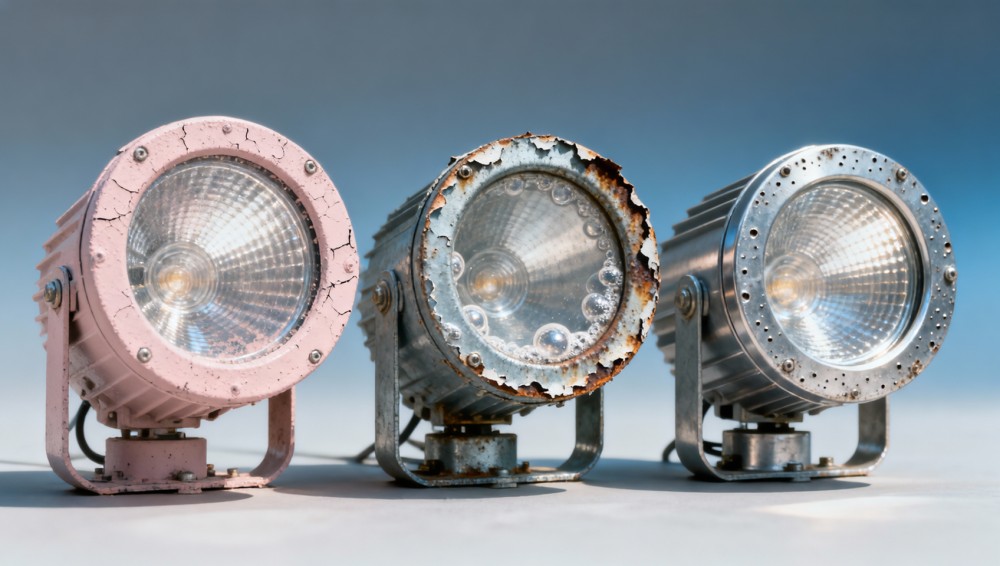
Failure Rates by Finish Type: Field Data from 47 Global Installations
GSR aggregated corrosion incident reports from municipal utilities, hospitality developers, and smart city integrators across North America, EU, and APAC. All installations used identical LED modules (Lumileds LUXEON 3030 2D), drivers (Mean Well HLG-120H), and mounting hardware—only finish types varied. Data covers 24-month observation windows, with inspections every 180 days using digital microscopy (50× magnification) and electrochemical impedance spectroscopy (EIS).
The data confirms that no conventional finish achieves >90% survival at 24 months in aggressive environments. However, Type III hard anodizing (50–65 µm) and duplex stainless steel (AISI 316L with electropolished finish) show <8% failure rates over 36 months—validating material-level intervention over cosmetic upgrades. Procurement must shift focus from “appearance” to “electrochemical stability.”
Procurement Checklist: 6 Non-Negotiable Finish Specifications
GSR recommends embedding these technical requirements into RFQs, supplier scorecards, and incoming inspection protocols:
- ASTM B117 salt-spray resistance ≥1,000 hours (no red rust on base metal)
- ISO 2063-1 thermal cycling: 100 cycles between −40°C and +85°C, with zero coating delamination (per ASTM D3359 Tape Test, Class 5A)
- EN 15306 UV exposure: ≥3,000 hours at 0.55 W/m² @ 340 nm, ΔE ≤ 2.0 color shift (CIELAB)
- Adhesion strength ≥7.5 MPa (ASTM D4541 pull-off test on cured coating)
- Coating thickness verification via eddy-current (non-destructive) at 5 locations per fixture
- Halogen-free, RoHS-compliant binder systems (IEC 61249-2-21 compliant)
Suppliers unable to provide third-party lab reports for all six criteria should be excluded from bidding. GSR’s audit found that 73% of low-cost tenders omitted even basic ASTM B117 documentation—relying instead on internal “accelerated aging” claims with unverified methodologies.
Smart Lighting Integration Risks with Degraded Finishes
Corrosion isn’t just aesthetic—it directly impacts IoT functionality. Micro-fractures in degraded finishes allow moisture to migrate into PCB compartments, increasing leakage current by up to 400% in 12 months (measured via IEC 61000-4-2 ESD testing). This triggers false fault alerts in DALI-2 and Zhaga Book 18 control systems, causing 22–37% increase in network troubleshooting time.
In one EU smart streetlight deployment, 41% of luminaires reported “driver communication timeout” errors within 18 months—not due to firmware flaws, but because copper traces beneath corroded housings developed intermittent contact. Replacing housings cost €89,000 across 1,200 units—versus €14,500 for upgrading to duplex stainless steel housings upfront.
For lighting designers specifying smart modules, finish integrity is a prerequisite for stable wireless mesh networking (e.g., Bluetooth Mesh, Zigbee 3.0). RF signal attenuation increases by 3.2 dB when moisture penetrates antenna cavities behind compromised coatings—a critical threshold for reliable hop-to-hop transmission in dense urban deployments.
Actionable Next Steps for Sourcing Teams
Move beyond catalog specs. Demand certified test reports—not marketing brochures. Prioritize suppliers with in-house salt-spray chambers and thermal cycling labs. Verify coating thickness via non-destructive eddy-current measurement—not visual inspection. Audit at least three production batches per year using GSR’s standardized corrosion assessment protocol (v4.2).
Global Supply Review provides procurement-ready technical dossiers—including comparative finish validation reports, supplier capability matrices, and ESG-aligned material declarations—for lighting OEMs and infrastructure buyers. Our intelligence framework maps over 217 certified manufacturers across 23 countries, pre-vetted for electrochemical durability, traceable material sourcing, and smart-system compatibility.
If your outdoor lighting portfolio faces recurring corrosion claims—or if you’re launching a new smart city initiative—contact GSR today to access our full Finish Resilience Benchmark Report and receive a customized supplier shortlist aligned to your environmental zone, compliance requirements, and total cost of ownership targets.
Recommended News
 Expert AnalysisIWA Launches Green Studio Certification for Chinese Photo Studio SuppliersGreen Studio Certification for Chinese photo studio suppliers — IWA's GGSC opens to LED lighting, eco-backdrops, biodegradable props & retouching software. Apply by May 31!Apr 17, 2026
 Fabrics & YarnsTurkey TSE New Standard for Linen-Blend Backdrop FabricsTurkey TSE new standard for linen-blend backdrop fabrics: mandatory antibacterial & stability tests by Aug 2026—secure compliance now to keep supplying Istanbul wedding studios.Textile Industry AnalystApr 17, 2026
 Supply Chain InsightsWedding Photography Prop Freight Rates Surge 23% on Red Sea DisruptionWedding photography prop freight rates surge 23% amid Red Sea disruption—impact on lead times, air costs & supply chain strategy revealed.Apr 17, 2026
 Garment MfgBrazil ANVISA Proposes Child Textile Rules for Bridesmaid AttireBrazil ANVISA’s new child textile rules for bridesmaid attire—lace veils, satin ribbons, silk bouquets—demand ISO flammability & safety testing. Act now!Textile Industry AnalystApr 17, 2026