Industry News
Curation by industry experts
Hot Articles
Popular Tags
India BIS Enforces IS 15871:2026 for LED Photography Lights
On 29 April 2026, the Bureau of Indian Standards (BIS) formally implemented IS 15871:2026 — Safety Requirements for Photographic Lighting Equipment. This regulation directly affects manufacturers, importers, and distributors of LED photography lighting equipment targeting the Indian market — particularly those supplying wedding and studio photography applications.
Event Overview
The Bureau of Indian Standards (BIS) announced on 29 April 2026 that IS 15871:2026 is now in force. Under this standard, all imported LED photographic lighting equipment must comply with two mandatory physical safety tests: IP65 ingress protection rating and a 1.2-meter drop test onto concrete. Additionally, each compliant product must display its BIS registration number (CR Number) both on the device body and on its packaging. Non-registered products are prohibited from import into India. BIS has introduced an expedited registration pathway with a turnaround time of seven working days.
Industries Affected by the Regulation
Direct Importers and Exporters
Companies importing LED photography lights into India are now subject to mandatory pre-market conformity assessment. Non-compliance results in customs rejection; therefore, import clearance timelines and documentation workflows must be updated to include verified BIS CR Number verification and test reports.
LED Lighting Manufacturers (OEM/ODM)
Manufacturers supplying to Indian importers must redesign or verify existing models for IP65 sealing integrity and structural resilience against 1.2 m drops. Product labeling — including permanent marking of the CR Number on housing — becomes a production-line requirement, not just packaging-level compliance.
Distribution and Branding Entities
Brands marketing LED studio lights in India must ensure all SKUs carry valid BIS registration. Inventory without CR Number markings — even if technically compliant — may be deemed non-conforming during market surveillance. Channel partners and e-commerce listings now require visible CR Number references as part of product detail pages.
Testing and Certification Service Providers
Laboratories accredited for BIS scheme testing face increased demand for IP65 validation and controlled drop testing per IS 15871:2026 Annexes. Capacity planning and alignment with BIS’s updated test report templates are now critical for service delivery.
What Enterprises and Practitioners Should Focus On Now
Verify current product registrations against BIS’s updated portal
Confirm whether existing CR Numbers reference IS 15871:2026 explicitly — earlier registrations under other standards (e.g., IS 13252 or IS 10322) do not automatically satisfy this new requirement.
Prioritize IP65 and drop-test validation for high-volume wedding/studio light SKUs
Given the emphasis on bridal photography applications in the official notice, models marketed for indoor studio or event use should be prioritized for retesting and re-registration over general-purpose lighting.
Update labeling specifications across manufacturing and packaging lines
Ensure CR Number engraving or durable printing is integrated into product assembly — not added post-production — to avoid non-conformance during BIS field inspections.
Engage with BIS-accredited labs early for expedited registration
While BIS offers a 7-working-day registration track, lab capacity and report review cycles may extend total lead time; initiating test scheduling ahead of formal application submission is advisable.
Editorial Perspective / Industry Observation
Observably, IS 15871:2026 signals a shift toward application-specific safety enforcement in India’s lighting regulatory framework — moving beyond generic electrical safety to performance-based environmental and mechanical durability criteria. Analysis shows this is less a transitional policy and more an operational checkpoint: the immediate import ban and mandatory on-product labeling indicate enforceable outcomes, not merely consultative guidance. From an industry perspective, this reflects growing alignment between India’s conformity infrastructure and international expectations for professional-grade photovoltaic and lighting equipment — though harmonization with IEC 62471 or IEC 60598 remains unconfirmed. Continued monitoring of BIS circulars regarding scope clarifications (e.g., exemptions for battery-powered units or accessories) is warranted.
This regulation underscores that regulatory readiness — not just technical compliance — is now a prerequisite for market access in India’s professional imaging equipment segment. It is best understood not as an isolated update, but as an indicator of tightening integration between safety certification, physical product design, and supply chain traceability.
Source Attribution
Primary source: Bureau of Indian Standards (BIS), Official Gazette Notification No. F. No. 1-14/2025-BIS, dated 29 April 2026. Pending clarification: BIS has not yet published interpretive guidance on applicability to retrofit kits, control modules, or bundled systems containing non-lighting components.
Recommended News
 Eco PackagingCanton Fair Wedding Photo Props Zone Sees 37% YoY GrowthWedding photo props at Canton Fair surge 37% YoY—biodegradable packaging & magnetic modular backdrops lead global demand. Discover key trends now!Packaging Supply ExpertApr 24, 2026
 Export UpdatesChina Customs Launches Beta 'Wedding Photo Props Export Compliance Self-Check Platform'Wedding photo props exporters: Use China Customs’ new beta Self-Check Platform for real-time export compliance guidance on HS codes like 9405.40, 4202.92 & 6307.90 — avoid delays in US, EU, ASEAN & Middle East markets.Apr 24, 2026
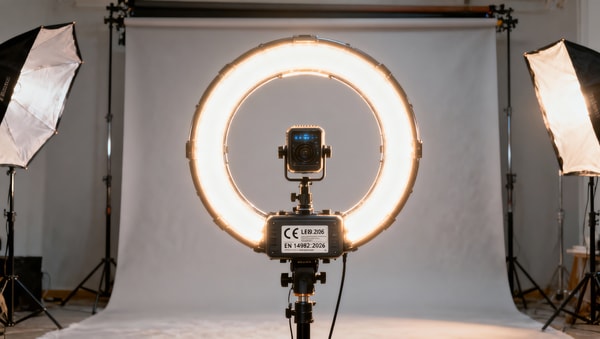
 Commercial LEDEN 14982:2026 Effective: LED Softlight Devices for Wedding Photography Must Pass Enhanced EMC Immunity TestsLED softlight devices for wedding photography must now pass enhanced EMC immunity tests per EN 14982:2026 — ensure CE compliance before EU market entry!Commercial Tech EditorApr 24, 2026
 Carton & PlasticsUS CPSC Recalls 7 Chinese Wedding Backdrop Makers for FormaldehydeUS CPSC recalls 7 Chinese wedding backdrop makers for formaldehyde—critical alert for婚纱摄影 exporters, MDF suppliers & US importers. Act now to avoid detention & liability.Packaging Supply ExpertApr 24, 2026