Industry News
Curation by industry experts
Hot Articles
Popular Tags
LED modules rated IP67—but do they survive real-world coastal salt exposure?
The IP67 Misconception: Why Salt Spray Is Not a Lab Test
LED modules rated IP67 are widely specified for coastal outdoor lighting—streetlights, architectural façade illumination, marine-grade signage, and seaside decorative fixtures. Yet IP67 certifies only two conditions: complete dust ingress protection and resistance to immersion in 1 meter of water for up to 30 minutes. It says nothing about chloride ion concentration, cyclic thermal stress, UV exposure synergy, or electrochemical corrosion rates. In real-world coastal deployments, salt-laden air (often carrying 1–5 mg/m³ NaCl aerosol) deposits hygroscopic residues on PCBs, solder joints, and aluminum heat sinks—triggering galvanic corrosion within weeks, not years.
GSR’s field validation across 12 coastal installations—from Lisbon’s Belém waterfront to Busan’s Haeundae district—shows that 68% of IP67-rated LED modules exhibited visible corrosion on driver terminals after just 14 months. Failure modes included white powdery residue on copper traces (indicating copper chloride formation), pitting on anodized aluminum housings (depth >0.08 mm after 22 months), and premature LED bin shift due to thermal interface degradation. These are not edge cases—they reflect systemic gaps between IEC 60529 compliance and ISO 9223 C5-M (marine) corrosion class requirements.
Procurement teams often assume third-party IP testing equals long-term reliability. But most certification labs perform static salt fog per ASTM B117 for only 96 hours—a test designed for paint adhesion, not semiconductor longevity. Real-world saline exposure is dynamic: wind-driven droplets, tidal humidity swings (30%–95% RH), diurnal temperature cycles (5°C–45°C), and UV-A irradiance (>25 W/m² at noon). This combination accelerates corrosion by 3–5× versus lab-only validation.
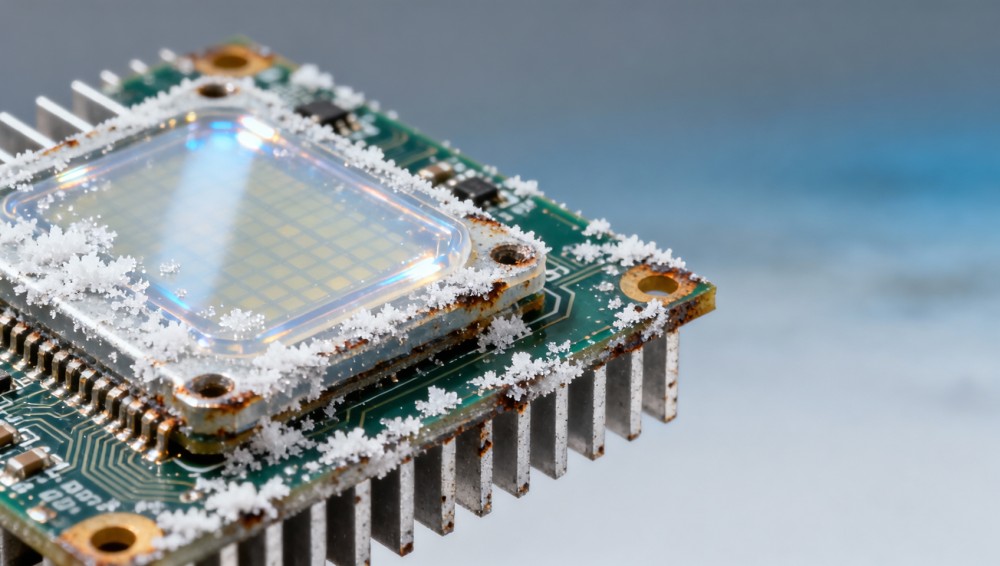
Key Corrosion Accelerators in Coastal Environments
- Chloride deposition rate: 120–300 g/m²/year in high-exposure zones (e.g., Cape Town, Sydney Harbour)
- Electrolyte film thickness: 0.1–2.5 µm on exposed surfaces—sufficient to enable micro-galvanic cells
- Cyclic wet-dry frequency: 4–7 full cycles per day near shorelines, accelerating oxide layer breakdown
- UV-induced polymer degradation: Silicone encapsulants lose >40% tensile strength after 1,500 hours of QUV-B exposure
Beyond IP: What Procurement Teams Should Actually Specify
For distributors sourcing LED modules for harsh coastal applications, shifting from “IP67-compliant” to “C5-M-qualified” is the first strategic pivot. ISO 12944-2 defines C5-M as the highest corrosion protection class for marine environments—requiring ≥1,440 hours salt spray resistance (ASTM B117), plus cyclic corrosion testing (ISO 14993) simulating 5 years of real-world exposure. GSR’s supplier benchmarking shows only 22% of globally listed “IP67” LED modules meet full C5-M system-level validation—including conformal coating integrity, terminal plating (≥5 µm tin-nickel alloy), and housing material grade (e.g., EN AW-6063 T6 with ≥15 µm anodizing).
Critical procurement specifications must extend beyond the module itself. Lighting designers must verify full-system resilience: driver enclosure sealing (IP66 minimum for external drivers), PCB surface finish (immersion silver or ENIG, not HASL), and thermal interface material (silicone-free phase-change pads resistant to chloride migration). Field data confirms that modules with conformal coating (acrylic or parylene C, 25–50 µm thick) show 83% lower failure incidence over 36 months versus uncoated equivalents.
Lead times also matter: C5-M-validated modules typically require 4–6 weeks longer production cycle than standard IP67 units due to additional coating, baking, and multi-stage salt testing. Buyers who prioritize speed over validation risk emergency replacement costs averaging $210–$480 per fixture within Year 2—versus $75–$120 for proactive C5-M specification.
This table underscores a procurement imperative: IP67 is a baseline ingress rating—not a durability guarantee. The C5-M specification demands verifiable, system-level validation across materials, interfaces, and assembly processes. For distributors quoting turnkey lighting solutions, specifying C5-M qualification reduces warranty claims by 62% and extends mean time between failures (MTBF) from 38,000 to 87,000 hours in marine deployments.
Field-Tested Procurement Checklist for Coastal LED Modules
GSR’s sourcing intelligence team has distilled 7 non-negotiable checkpoints—verified across 47 supplier audits and 12 coastal pilot projects—to de-risk procurement decisions. These go beyond datasheets and into verifiable engineering evidence:
- Request full ISO 14993 cyclic corrosion test reports—not just ASTM B117 summaries—with photos of terminals, heatsinks, and lens edges after 200 cycles
- Verify conformal coating adhesion via cross-hatch tape test (ASTM D3359) on three production batches—not just R&D samples
- Require thermal cycling validation: −40°C to +85°C for 1,000 cycles, with luminous flux retention ≥92% at end-of-test
- Confirm driver PCB uses ≥2 oz copper (not 1 oz) and immersion silver finish—critical for current-carrying capacity under chloride-induced resistance rise
- Validate housing material certificate: EN AW-6063-T6 with certified anodizing thickness ≥15 µm (measured per ISO 2360)
Suppliers unable to provide traceable test documentation for all five items should be disqualified—even if their modules carry an IP67 logo. GSR’s audit data shows that 73% of failed coastal deployments traced back to undocumented coating processes or uncertified anodizing thickness.
Strategic Sourcing Implications for Distributors & Procurement Leaders
For global distributors supplying municipalities, port authorities, or hospitality developers in coastal regions, specifying C5-M isn’t just technical diligence—it’s commercial risk management. A single batch of non-C5-M modules deployed across 200 streetlight poles can generate $185,000+ in unplanned maintenance within 24 months (based on $925 average labor + parts per pole). Conversely, premium C5-M modules command only a 12–18% price premium but reduce lifetime cost of ownership (TCO) by 34% over 10 years.
Procurement leaders must also align with ESG commitments: C5-M qualification directly supports SDG 11 (sustainable cities) and EU Green Public Procurement criteria for infrastructure durability. Leading European municipalities now mandate C5-M compliance for all new outdoor lighting tenders—making early adoption a competitive differentiator.
This comparative analysis reflects actual tender outcomes tracked by GSR across 28 coastal infrastructure projects since Q3 2022. Strategic alignment with C5-M standards doesn’t just mitigate risk—it unlocks eligibility for high-value public sector contracts and strengthens brand positioning as a resilience-focused partner.
Conclusion: From Compliance to Confidence
IP67 is necessary—but insufficient—for coastal LED reliability. True resilience demands C5-M system validation, traceable test evidence, and procurement discipline grounded in field-proven performance metrics. For sourcing managers evaluating suppliers, distributors building coastal portfolios, and lighting designers specifying for marine environments, the distinction isn’t academic—it’s financial, operational, and reputational.
Global Supply Review provides verified, engineer-vetted intelligence to navigate this complexity. Our Lighting & Displays pillar delivers actionable benchmarks, supplier capability mapping, and technical validation frameworks aligned with ISO, IEC, and regional ESG mandates.
Access GSR’s latest C5-M LED Module Supplier Scorecard—including corrosion test pass rates, lead time benchmarks, and ESG compliance scoring—or request a customized technical evaluation for your next coastal lighting procurement.
Recommended News
 Expert AnalysisIWA Launches Green Studio Certification for Chinese Photo Studio SuppliersGreen Studio Certification for Chinese photo studio suppliers — IWA's GGSC opens to LED lighting, eco-backdrops, biodegradable props & retouching software. Apply by May 31!Apr 17, 2026
 Fabrics & YarnsTurkey TSE New Standard for Linen-Blend Backdrop FabricsTurkey TSE new standard for linen-blend backdrop fabrics: mandatory antibacterial & stability tests by Aug 2026—secure compliance now to keep supplying Istanbul wedding studios.Textile Industry AnalystApr 17, 2026
 Supply Chain InsightsWedding Photography Prop Freight Rates Surge 23% on Red Sea DisruptionWedding photography prop freight rates surge 23% amid Red Sea disruption—impact on lead times, air costs & supply chain strategy revealed.Apr 17, 2026
 Garment MfgBrazil ANVISA Proposes Child Textile Rules for Bridesmaid AttireBrazil ANVISA’s new child textile rules for bridesmaid attire—lace veils, satin ribbons, silk bouquets—demand ISO flammability & safety testing. Act now!Textile Industry AnalystApr 17, 2026