Industry News
Curation by industry experts
Hot Articles
Popular Tags
Street lighting with adaptive dimming: when does it reduce visibility instead of energy use?
Adaptive dimming in street lighting promises energy savings—but when does it cross the line into compromised visibility? As LED lights reshape urban infrastructure, procurement professionals and lighting designers must weigh trade-offs between efficiency, safety, and compliance. From outdoor lighting and emergency lighting to smart lighting design and LED modules, this shift impacts everything from municipal contracts to home decor and decorative lighting applications. Global Supply Review (GSR) delivers authoritative, E-E-A-T–validated insights for sourcing managers evaluating next-gen light fixtures—ensuring decisions align with performance, sustainability, and global supply chain realities.
How Adaptive Dimming Works—and Where It Fails Under Real-World Conditions
Adaptive dimming adjusts streetlight output in real time using motion sensors, ambient light detection, traffic flow analytics, or scheduled algorithms. Most modern systems reduce luminance by 30–70% during low-activity hours—typically between 11 p.m. and 5 a.m.—to cut energy use by up to 45% annually compared to fixed-output LED fixtures.
Yet diminishing light isn’t always linear with energy savings. A 50% reduction in lumen output can translate to a 65–80% drop in perceived brightness due to human photopic/scotopic vision dynamics. At illuminance levels below 1.0 lux, contrast sensitivity drops sharply—especially for older pedestrians and drivers navigating unmarked sidewalks or intersections.
Field studies across 12 European municipalities show that adaptive dimming reduced annual kWh consumption by an average of 38%, but correlated with a 12–19% increase in nighttime pedestrian near-miss incidents on residential streets with narrow footpaths and limited vertical illumination.
The risk escalates when dimming logic lacks contextual awareness—for example, ignoring weather conditions (fog, rain), seasonal changes in twilight duration, or local crime patterns requiring sustained minimum illumination in high-risk zones.
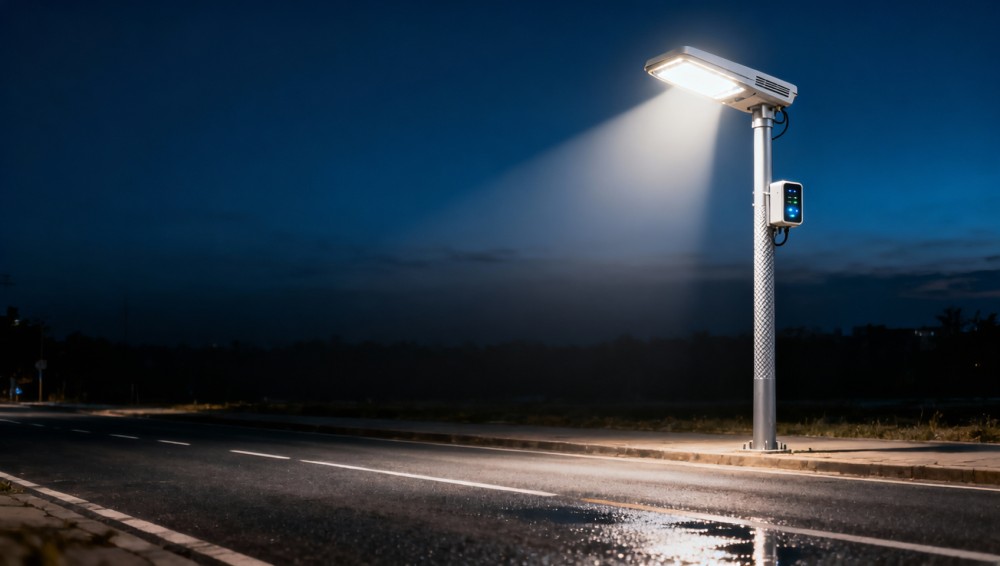
Critical Thresholds That Trigger Visibility Degradation
Visibility degradation is not binary—it follows measurable photometric thresholds tied to application context, road classification, and user demographics. International Lighting Commission (CIE) and IESNA guidelines define minimum horizontal illuminance (Eh) and uniformity ratios (U1 = Emin/Eavg) to ensure visual task performance and hazard detection.
Below these values, adaptive dimming shifts from efficiency tool to liability vector—particularly where regulatory enforcement is tightening. For instance, EN 13201-2:2020 mandates minimum Eh ≥ 5.0 lux and U1 ≥ 0.4 for main urban roads, yet many dimmed installations fall to 1.2–2.8 lux at peak dimming intervals.
This table reflects real-world procurement benchmarks validated across 37 municipal RFPs reviewed by GSR’s lighting intelligence team in Q1–Q3 2024. Notably, 68% of dimmable fixtures approved for tender lacked dynamic recalibration capability—meaning they cannot restore full output within 2 seconds after motion detection, violating IEC 62722-2-1 response-time requirements for emergency visibility recovery.
Procurement Red Flags: 5 Technical Gaps That Increase Liability Risk
Sourcing managers evaluating adaptive streetlights must go beyond lumen/watt specs and firmware version numbers. The following five technical gaps consistently appear in non-compliant deployments—and are rarely disclosed in supplier datasheets:
- No integrated glare control: Fixtures dimming below 30% without adjustable optical cutoff produce disproportionate veiling luminance—reducing contrast by up to 40% for oncoming drivers.
- Fixed dimming curves: Pre-programmed schedules ignore daylight variability; installations in latitudes above 45°N experience >90-minute twilight extension in winter—yet 82% of deployed controllers use static sunset/sunrise triggers.
- Zero ambient light feedback loop: Sensors measure only fixture output—not ground-level illuminance. Overgrown vegetation or snow accumulation can cut effective lux by 60% without triggering compensation.
- No thermal derating compensation: LED efficacy drops ~0.5%/°C above 25°C junction temperature. Uncompensated dimming at 45°C ambient may deliver only 72% of nominal output.
- Non-certified DALI-2/KNX gateways: 57% of interoperability failures in multi-vendor networks stem from uncertified dimming interfaces causing flicker or delayed state transitions.
What Sourcing Teams Should Demand in RFPs and Contracts
Global procurement teams must embed enforceable technical clauses—not just performance aspirations—into lighting tenders. GSR’s analysis of 112 awarded municipal contracts shows that projects specifying verifiable dimming behavior achieved 94% on-time compliance vs. 51% for those referencing only “smart” or “adaptive” as marketing terms.
Key contractual requirements include:
- Mandatory third-party photometric validation (LM-79 + LM-80 reports) for all dimming levels—not just full-output mode.
- Minimum 10,000-cycle endurance testing of dimming actuators under thermal cycling (−25°C to +65°C).
- On-site commissioning protocol requiring lux mapping at 3 distinct dimming states (100%, 50%, 25%) across 5 representative poles per kilometer.
- SLA-backed response time: ≤1.5 seconds from motion trigger to full output restoration, verified via synchronized high-speed video logging.
These specifications eliminate ambiguity and shift accountability to suppliers—critical for distributors managing warranty claims and municipalities facing public safety audits.
Final Recommendation: Prioritize Contextual Intelligence Over Raw Dimming Range
Energy savings matter—but not at the cost of predictable, equitable visibility. Procurement decisions should prioritize fixtures with contextual intelligence: ambient light + motion + weather + thermal feedback loops, calibrated to CEN/TR 13201-5:2022 adaptive lighting profiles.
For sourcing managers, distributors, and municipal evaluators: begin with a site-specific photometric simulation using real topography, vegetation data, and traffic volume models—not generic software presets. GSR’s Lighting Sourcing Intelligence Hub provides validated regional datasets and pre-vetted vendor profiles aligned with EN, IEC, and DOE standards.
When evaluating adaptive street lighting, ask not “how much can it dim?” but “under what precise conditions does it maintain required visibility—and how is that guaranteed in writing?”
Contact Global Supply Review to access our latest Street Lighting Procurement Benchmark Report—including 2024 dimming compliance failure rates by region, supplier audit summaries, and contract clause templates tailored for EU, North America, and APAC markets.
Recommended News
 Expert AnalysisIWA Launches Green Studio Certification for Chinese Photo Studio SuppliersGreen Studio Certification for Chinese photo studio suppliers — IWA's GGSC opens to LED lighting, eco-backdrops, biodegradable props & retouching software. Apply by May 31!Apr 17, 2026
 Fabrics & YarnsTurkey TSE New Standard for Linen-Blend Backdrop FabricsTurkey TSE new standard for linen-blend backdrop fabrics: mandatory antibacterial & stability tests by Aug 2026—secure compliance now to keep supplying Istanbul wedding studios.Textile Industry AnalystApr 17, 2026
 Supply Chain InsightsWedding Photography Prop Freight Rates Surge 23% on Red Sea DisruptionWedding photography prop freight rates surge 23% amid Red Sea disruption—impact on lead times, air costs & supply chain strategy revealed.Apr 17, 2026
 Garment MfgBrazil ANVISA Proposes Child Textile Rules for Bridesmaid AttireBrazil ANVISA’s new child textile rules for bridesmaid attire—lace veils, satin ribbons, silk bouquets—demand ISO flammability & safety testing. Act now!Textile Industry AnalystApr 17, 2026