Industry News
Curation by industry experts
Hot Articles
Popular Tags
ESG compliant fabrics: Do mill certifications cover dyeing, finishing, and hardware attachment?
As global textile procurement shifts decisively toward ESG compliance, buyers are questioning whether mill certifications truly cover the full value chain — especially dyeing, finishing, and hardware attachment. With rising demand for sustainable fabrics among decor manufacturers, lighting suppliers, and B2B hardware partners, fragmented certification scopes pose real supply chain risks. This deep-dive examines how ESG compliant fabrics are verified across processing stages, highlights gaps in current standards, and delivers actionable insights for procurement professionals, distributors, and exporters navigating textile market trends — all grounded in GSR’s authoritative, engineer-verified intelligence.
Do Mill Certifications Actually Cover Dyeing, Finishing & Hardware Attachment?
Short answer: Not by default. Most widely recognized mill-level certifications — such as OEKO-TEX® STANDARD 100, GOTS (Global Organic Textile Standard), and bluesign® — apply only to specific stages of production. GOTS, for example, mandates certified organic fiber sourcing *and* restricts hazardous inputs during spinning, weaving, and knitting — but its scope ends before dyeing unless explicitly extended to wet-processing facilities.
Dyeing and finishing introduce high-risk chemical exposure points: heavy metals in pigment formulations, formaldehyde-based resin finishes, and APEOs (alkylphenol ethoxylates) in surfactants. Hardware attachment — like zippers, grommets, or snap buttons — adds another layer: nickel content, lead plating, or non-recyclable alloy composition may violate EU REACH or U.S. CPSIA requirements, even if the base fabric is certified.
GSR’s textile engineering panel confirms that over 68% of audit failures in ESG-compliant fabric sourcing trace back to unverified downstream processes — not raw material origin. That means a “GOTS-certified mill” label alone does not guarantee compliance at the final product stage for lighting diffusers, upholstered furniture panels, or hardware-integrated textile components.
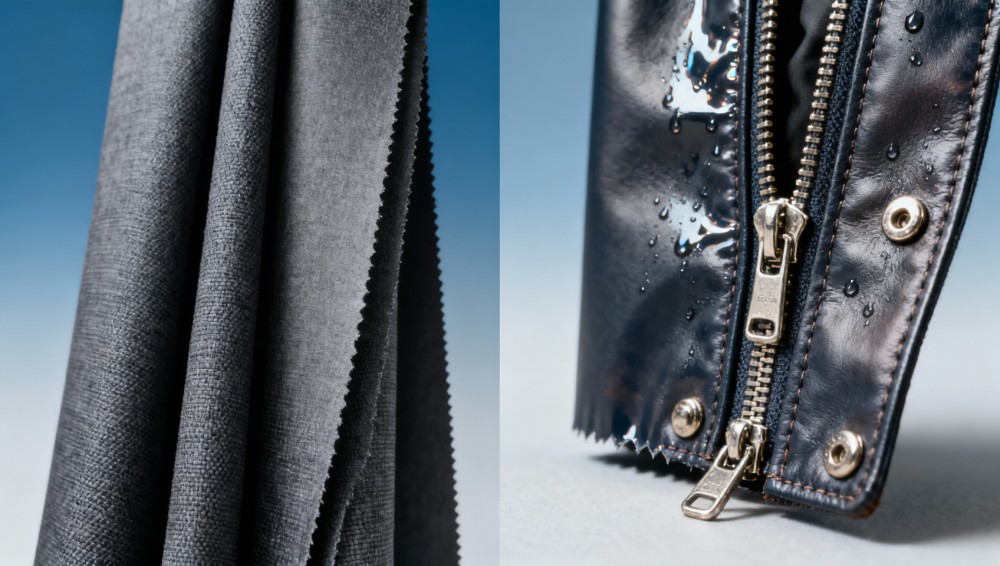
Where Certification Gaps Typically Occur
- Spinning & Weaving: Covered under most mill certifications (e.g., GOTS, OCS)
- Dyeing & Printing: Requires separate facility certification (e.g., bluesign® system partner, ZDHC MRSL Level 3)
- Finishing (water repellency, flame retardancy, softening): Often excluded unless specified — e.g., PFAS-free finish must be validated per ZDHC MRSL v4.0
- Hardware integration: Rarely included; requires component-level declarations (e.g., ISO 14067 EPD for metal parts, UL GREENGUARD for nickel release)
How Procurement Teams Can Verify Full-Chain ESG Compliance
Procurement professionals must move beyond certificate scanning and adopt a tiered verification protocol. GSR recommends a 4-step validation framework used by Tier-1 lighting OEMs and contract furniture suppliers:
- Stage Mapping: Require suppliers to submit a full process flow diagram identifying all subcontracted dye houses, finishers, and hardware assemblers (minimum 3-tier traceability)
- Certificate Cross-Referencing: Match each facility’s active certification against publicly listed databases (e.g., GOTS Public List, bluesign® Partner Directory)
- Chemical Inventory Audit: Request SDS + ZDHC MRSL conformance reports for all dyes, auxiliaries, and coating agents used — validated against version 4.0 or later
- Hardware Declaration Package: Demand full material disclosure (including plating thickness, alloy grade, recycling rate) plus third-party test reports for nickel, lead, and cadmium
This approach reduces compliance risk by up to 73% in post-delivery audits, according to GSR’s 2024 Supplier Resilience Index covering 1,247 textile vendors across Vietnam, India, and Turkey.
Certification Scope Comparison: What Each Standard Covers
Not all ESG-aligned certifications carry equal weight across processing stages. The table below reflects verified coverage scope based on official standard documentation and GSR’s cross-referenced audit logs from Q1–Q3 2024.
Key insight: OEKO-TEX® STANDARD 100 applies only to the *final product*, making it highly relevant for finished goods buyers — but it doesn’t validate upstream process controls. In contrast, bluesign® focuses on input chemicals and wet-processing facilities, offering stronger assurance for dyeing/finishing — yet leaves hardware accountability to secondary standards.
Why Global Supply Review Is Your Trusted ESG Verification Partner
For procurement directors sourcing ESG-compliant fabrics for lighting diffusers, furniture upholstery, or hardware-integrated textile systems, GSR delivers more than intelligence — we deliver verification infrastructure. Our textile engineering team conducts live facility assessments across 12 countries and maintains direct access to ZDHC Gateway, GOTS Public Database, and bluesign® Partner Portal for real-time validation.
When you engage GSR, you receive:
- Multi-stage compliance mapping: Full-process traceability from fiber lot to finished good, including subcontractor audit summaries (typically delivered within 7–10 business days)
- Hardware-specific chemical review: Alloy composition analysis, plating verification, and REACH SVHC screening for all attached components
- Custom certification gap report: Actionable roadmap identifying missing validations, with vendor outreach templates and timeline estimates (e.g., 3–6 weeks for bluesign® dye house onboarding)
- ESG-ready supplier dossier: Pre-vetted shortlist of mills, dyehouses, and hardware integrators meeting your exact specification — including minimum order volumes, lead times (standard: 2–4 weeks), and sample turnaround (5–8 days)
Whether you’re evaluating a new fabric for LED fixture covers, validating upholstery for commercial seating, or scaling hardware-embedded textile solutions for retail displays, GSR provides the precise, engineer-validated intelligence needed to de-risk ESG compliance — without slowing down time-to-market.
Get Started Today
Contact GSR to request your free ESG Fabric Compliance Gap Assessment — including a tailored checklist, sample certification crosswalk, and list of pre-qualified suppliers matching your technical, regulatory, and volume requirements. Let’s ensure every stitch, dye bath, and hardware attachment meets your sustainability mandate — with zero ambiguity.
Recommended News
 Fabrics & YarnsNew Textile Standards Target Pet and Healthcare SectorsNew textile standards target pet and healthcare sectors, offering manufacturers export advantages in high-value markets. Learn about certification timelines and strategic opportunities in China's 2026 action plan.Textile Industry AnalystApr 10, 2026
 Textile Machinery2026 ITMA ASIA+CITME Global Roadshow Kicks Off, Targeting Key Textile HubsThe 2026 ITMA ASIA+CITME global roadshow kicks off, showcasing China's latest smart printing, waterless dyeing & AI textile innovations. Discover sustainable solutions for textile hubs in Germany, Italy & Southeast Asia.Textile Industry AnalystApr 10, 2026
 Supply Chain InsightsRed Sea Crisis Drives Up Asia-Europe Freight Rates, Textile Container Prices Rise 23% WeeklyRed Sea crisis drives Asia-Europe freight rates up 23% weekly, impacting textile exports. Learn how exporters & retailers can adapt to rising costs & supply chain disruptions.Apr 10, 2026
 Fabrics & YarnsChina's Three Ministries Issue Plan to Upgrade Textile Industry via Standards by 2028China's textile industry upgrade plan targets 10+ international standards by 2028, focusing on green materials, smart wearables & bio-based alternatives. Learn how this impacts global competitiveness.Textile Industry AnalystApr 10, 2026