Industry News
Curation by industry experts
Hot Articles
Popular Tags
India BIS Enforces 20ppm Formaldehyde Limit on Bridal Wear
On April 26, 2026, the Bureau of Indian Standards (BIS) and the Directorate General of Foreign Trade (DGFT), in coordination with India’s Customs Department, launched immediate enforcement of a new formaldehyde limit—20 ppm—for all imported bridal wear, including wedding gowns and lace-trimmed ceremonial attire. This development directly affects exporters, manufacturers, and supply chain actors engaged in the bridal apparel trade with India, particularly those sourcing from high-volume production hubs such as Guangdong, China.
Event Overview
On April 25, 2026, BIS published the revised standard IS 15620:2026. The following day, April 26, BIS and India’s Customs Department jointly issued an enforcement notice mandating immediate, unannounced formaldehyde testing for all incoming bridal wear shipments. Products exceeding 20 ppm are subject to on-site destruction; non-compliant consignments are also reported to China’s General Administration of Customs. On the first day of enforcement, three batches of lace bridal gowns originating from Guangdong were detained at Mumbai Port.
Industries Affected by Segment
Direct Exporters & Trading Companies
These entities face immediate customs clearance risk and financial loss due to detention or destruction. Impact manifests as shipment delays, increased inspection time, and potential reputational exposure when non-compliance is formally reported to Chinese authorities.
Textile & Trim Manufacturers (e.g., lace, embroidery, fabric mills)
Manufacturers supplying finished or semi-finished components—including lace appliqués, embroidered panels, or pre-dyed fabrics used in bridal gowns—may be held indirectly liable if downstream products fail testing. Their impact lies in upstream audit pressure, tighter material specifications, and possible rework or rejection requests from garment assemblers.
Garment Assembly & Contract Manufacturers
Firms assembling final bridal wear for export must now verify formaldehyde levels across all input materials—not just main fabrics but trims, interlinings, and finishing agents. Non-certified inputs carry direct compliance risk, especially where chemical finishing (e.g., anti-wrinkle, flame-retardant, or resin-based treatments) is applied.
Logistics & Customs Brokerage Service Providers
These service providers encounter heightened documentation scrutiny and operational complexity. They must now advise clients on pre-shipment testing protocols, assist with BIS-aligned test reports (e.g., ISO 14184-1 or AATCC 112), and manage escalation pathways for detained cargo—tasks not previously standardized for this product category.
What Enterprises Should Monitor and Do Now
Track official updates to IS 15620:2026 implementation guidance
The current notice specifies enforcement “effective immediately” but does not yet clarify whether third-party lab accreditation requirements (e.g., BIS-recognized labs), sampling frequency, or appeal mechanisms will follow. Monitoring BIS circulars and DGFT advisories over the next 30 days is essential.
Identify and prioritize high-risk categories for pre-shipment verification
Lace, satin, taffeta, and resin-finished fabrics are historically associated with elevated formaldehyde residues. Shipments containing these materials—especially those incorporating durable press or wrinkle-resistant finishes—should undergo formaldehyde testing prior to dispatch.
Distinguish between policy signal and enforceable procedure
This action reflects an urgent regulatory signal rather than a fully codified compliance framework. While the 20 ppm limit is binding, supporting procedures (e.g., acceptable test methods, tolerance thresholds for lab variance, or grace periods for transitional stock) remain unconfirmed. Avoid assuming uniform global lab interpretation until further guidance issues.
Prepare documentation and communication protocols with Indian importers
Exporters should proactively share formaldehyde test reports (with full method details and accredited lab credentials) with their Indian partners. Concurrently, internal SOPs should assign responsibility for test report generation, retention, and rapid retrieval during customs queries.
Editorial Perspective / Industry Observation
From industry perspective, this enforcement move signals a tightening of chemical safety oversight in India’s textile import regime—not merely a one-off campaign. It follows broader regional trends toward stricter formaldehyde controls in apparel (e.g., EU REACH Annex XVII, Japan JIS L 1041), but differs in its abrupt, zero-tolerance rollout without phased transition. Analysis来看, it is less about detecting widespread non-compliance and more about establishing deterrence and vertical accountability across the bridal wear value chain. Current enforcement appears focused on port-level interception rather than post-clearance market surveillance—meaning the initial risk window remains concentrated at entry points. That said, sustained enforcement beyond Q2 2026 would likely expand to domestic distributors and e-commerce platforms, warranting longer-term adaptation.
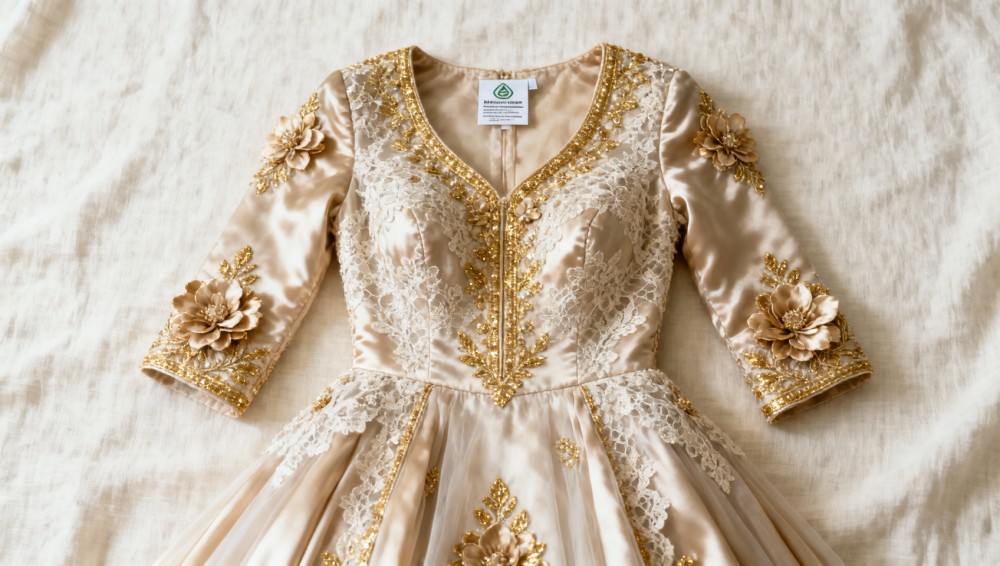
Concluding, this measure marks a material shift in regulatory expectations for bridal apparel exports to India—not a temporary adjustment but an operational benchmark now embedded in customs clearance. It is better understood as a structural recalibration of compliance responsibility, moving upstream from brand importers to raw material suppliers and finishers. For stakeholders, proactive verification—not reactive remediation—is the most operationally viable response at present.
Source: Bureau of Indian Standards (BIS) Notification IS 15620:2026 (April 25, 2026); Joint Enforcement Notice by BIS and India Customs (April 26, 2026); Public detention record from Mumbai Port Authority (April 26, 2026).
Noted for ongoing observation: Further clarification on lab accreditation criteria, sampling methodology, and potential appeals process remains pending.
Recommended News
 Eco PackagingCanton Fair Wedding Photo Props Zone Sees 37% YoY GrowthWedding photo props at Canton Fair surge 37% YoY—biodegradable packaging & magnetic modular backdrops lead global demand. Discover key trends now!Packaging Supply ExpertApr 24, 2026
 Export UpdatesChina Customs Launches Beta 'Wedding Photo Props Export Compliance Self-Check Platform'Wedding photo props exporters: Use China Customs’ new beta Self-Check Platform for real-time export compliance guidance on HS codes like 9405.40, 4202.92 & 6307.90 — avoid delays in US, EU, ASEAN & Middle East markets.Apr 24, 2026
 Commercial LEDEN 14982:2026 Effective: LED Softlight Devices for Wedding Photography Must Pass Enhanced EMC Immunity TestsLED softlight devices for wedding photography must now pass enhanced EMC immunity tests per EN 14982:2026 — ensure CE compliance before EU market entry!Commercial Tech EditorApr 24, 2026
 Carton & PlasticsUS CPSC Recalls 7 Chinese Wedding Backdrop Makers for FormaldehydeUS CPSC recalls 7 Chinese wedding backdrop makers for formaldehyde—critical alert for婚纱摄影 exporters, MDF suppliers & US importers. Act now to avoid detention & liability.Packaging Supply ExpertApr 24, 2026