Industry News
Curation by industry experts
Hot Articles
Popular Tags
India BIS Mandatory Registration for Wedding Attire: IS 15620:2026 Effective July 2026
India’s Bureau of Indian Standards (BIS) has confirmed the mandatory enforcement of IS 15620:2026 — Safety and Labeling Requirements for Wedding and Formal Wear Textiles — effective 1 July 2026. This regulation directly affects exporters, manufacturers, and distributors of bridal and formal wear entering the Indian market, particularly those based in China and other non-BIS-registered jurisdictions.
Event Overview
The Indian Standard IS 15620:2026, titled Wedding and Formal Wear Textiles — Safety and Labeling Requirements, was published by the Bureau of Indian Standards (BIS). BIS has officially designated 1 July 2026 as the date on which compliance becomes mandatory for all imported wedding and formal attire, including garments made from polyester, silk, lace blends, and other textile compositions. Products falling under this scope must bear valid BIS registration before customs clearance and entry into mainstream Indian wedding retail channels or e-commerce platforms.
Industries Affected by the Regulation
Direct Exporters and Importers
Companies exporting bridal gowns, bridesmaid dresses, and formal wear from China (and other non-BIS-registered countries) to India will face customs rejection or delayed clearance if their products lack BIS registration. Impact manifests as halted shipments, increased lead times, and potential loss of shelf space on platforms like Nykaa Fashion, Myntra, or regional wedding portals.
Manufacturing Enterprises (OEM/ODM)
Chinese and Southeast Asian garment manufacturers producing for international brands or Indian buyers must now secure BIS registration under their own name or via an authorized Indian representative. Without it, they cannot be listed as compliant suppliers in buyer audits or tender processes tied to Indian distribution.
Supply Chain and Logistics Providers
Fulfillment centers, freight forwarders, and customs brokers handling apparel consignments destined for India will need to verify BIS registration status prior to documentation submission. Non-compliant consignments may trigger additional scrutiny, storage fees, or re-export requirements — increasing operational overhead.
Brand Owners and E-commerce Sellers
Brands selling directly to Indian consumers via D2C websites or marketplace storefronts must ensure product-level compliance — including correct labeling per IS 15620:2026 (e.g., fiber composition, care instructions, safety warnings). Absence of BIS certification may result in delisting or account suspension by platform operators.
Key Focus Areas and Practical Response Steps
Monitor official BIS updates and application guidelines
While the effective date is confirmed, BIS has not yet published detailed procedural documents — such as application forms, testing lab accreditation lists, or fee structures — for IS 15620:2026. Stakeholders should track announcements via the official BIS portal (bis.gov.in) and registered Indian representatives.
Identify high-priority SKUs and sourcing partners
Analysis来看, not all formal wear categories carry equal risk. Garments with direct skin contact (e.g., satin-lined gowns, lace bodices), synthetic-heavy blends, or items marketed explicitly for Indian weddings should be prioritized for registration. Concurrently, verify whether current manufacturing partners are already BIS-registered or capable of supporting registration under their own license.
Distinguish between policy announcement and operational readiness
From industry角度看, the 2026 deadline signals a phased transition — not immediate enforcement. However, BIS typically requires 3–6 months for application processing and test report validation. Starting preparation before Q4 2025 is advisable to avoid bottlenecks ahead of the July 2026 cutoff.
Prepare documentation and labeling workflows
Current more suitable than waiting for full implementation is to audit existing product labels against IS 15620:2026’s labeling clauses (e.g., bilingual English-Hindi content, fiber percentage thresholds, flammability disclaimers). Update internal SOPs for packaging, QA checklists, and supplier communication templates accordingly.
Editorial Perspective / Industry Observation
This mandate is better understood as a structural alignment move — integrating wedding apparel into India’s broader textile safety framework, alongside existing standards like IS 15597 (children’s clothing) and IS 15518 (general apparel). Observation来看, it reflects growing regulatory emphasis on post-import traceability and consumer protection in high-visibility, high-value segments. It is not yet a market-access barrier in practice — but rather a signal that India’s formal wear import channel is shifting toward pre-market authorization. Continued attention is warranted because BIS enforcement intensity, third-party lab capacity, and interpretation of ‘formal wear’ scope remain subject to clarification.
Conclusion: The IS 15620:2026 requirement does not represent an abrupt disruption, but rather a defined inflection point in India’s apparel import governance. Its significance lies less in technical novelty and more in its binding timeline — making proactive alignment essential for any enterprise engaged in cross-border bridal or formal wear trade with India. Currently, it is more appropriate to treat this as a compliance milestone requiring staged preparation, rather than an immediate operational crisis.
Source: Bureau of Indian Standards (BIS) official notification on IS 15620:2026; public enforcement schedule dated 2025 (confirmed via BIS press release archive).
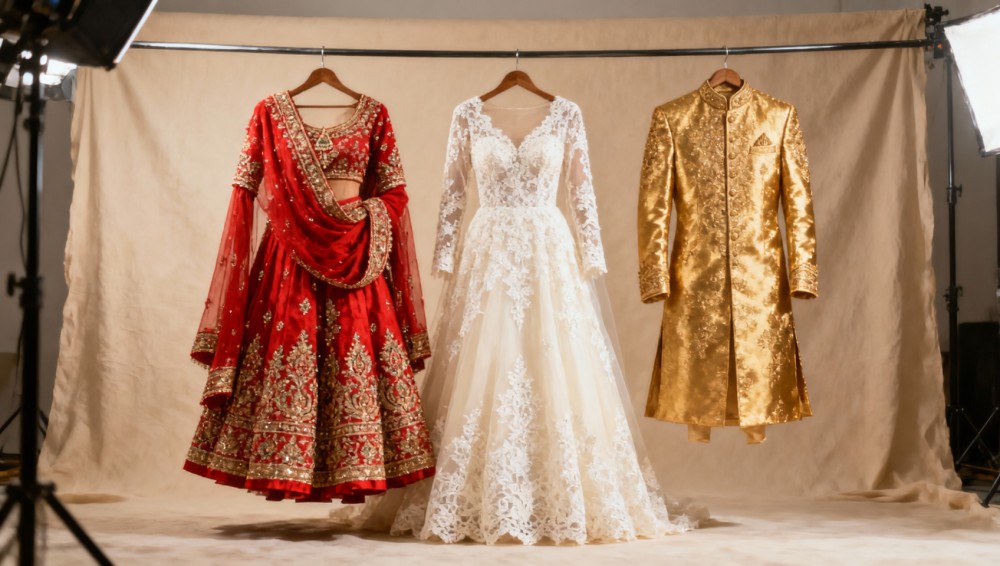
Noted for ongoing observation: Final application procedure, accredited testing laboratories list, and BIS’s definition of ‘formal wear’ scope relative to ethnic Indian attire (e.g., lehengas, sherwanis).
Recommended News
 Eco PackagingCanton Fair Wedding Photo Props Zone Sees 37% YoY GrowthWedding photo props at Canton Fair surge 37% YoY—biodegradable packaging & magnetic modular backdrops lead global demand. Discover key trends now!Packaging Supply ExpertApr 24, 2026
 Export UpdatesChina Customs Launches Beta 'Wedding Photo Props Export Compliance Self-Check Platform'Wedding photo props exporters: Use China Customs’ new beta Self-Check Platform for real-time export compliance guidance on HS codes like 9405.40, 4202.92 & 6307.90 — avoid delays in US, EU, ASEAN & Middle East markets.Apr 24, 2026
 Commercial LEDEN 14982:2026 Effective: LED Softlight Devices for Wedding Photography Must Pass Enhanced EMC Immunity TestsLED softlight devices for wedding photography must now pass enhanced EMC immunity tests per EN 14982:2026 — ensure CE compliance before EU market entry!Commercial Tech EditorApr 24, 2026
 Carton & PlasticsUS CPSC Recalls 7 Chinese Wedding Backdrop Makers for FormaldehydeUS CPSC recalls 7 Chinese wedding backdrop makers for formaldehyde—critical alert for婚纱摄影 exporters, MDF suppliers & US importers. Act now to avoid detention & liability.Packaging Supply ExpertApr 24, 2026