Industry News
Curation by industry experts
Hot Articles
- Industry NewsUS CPSC Updates Safety Guidelines for Wedding Prop Fabrics: Glitter Coatings Must Pass EN71-3 Migration Test
- Industry NewsWEPACK 2026 Shenzhen Show Highlights PHA-Based Barrier System for Global Markets
- Industry NewsRed Sea Crisis Escalates: Dubai Port Imposes High-Risk Surcharge on Packaging Goods
Popular Tags
India BIS Opens Public Consultation on IS 15620:2026 for Wedding Attire
India’s Bureau of Indian Standards (BIS) has initiated a 30-day public consultation on the draft standard IS 15620:2026, Textiles for Wedding and Formal Wear, effective 21 April 2026. This development signals the imminent inclusion of bridal gowns, bridesmaid dresses, groom’s formal attire, and accompanying veils in India’s mandatory BIS certification regime — a move with direct implications for textile exporters, garment manufacturers, and compliance service providers serving the Indian market.
Event Overview
The Bureau of Indian Standards (BIS) launched the draft standard IS 15620:2026 on 21 April 2026 for a 30-day public consultation period. The draft proposes mandatory BIS certification for all imported wedding and formal wear garments, including bridal gowns, bridesmaid dresses, groom’s formal attire, and matching veils. Key technical requirements include mandatory labeling of fabric composition, and full compliance with specified test methods for colour fastness (ISO 105-X12), formaldehyde content (ISO 14184-1), and azo dyes (ISO 17234-1). The regulation is expected to enter into force in Q4 2026, with a minimum 90-day lead time required for certification processing.
Industries Affected by the Draft Standard
Direct Exporters to India
Exporters of finished wedding and formal wear garments to India — particularly those based in China — will face new regulatory entry barriers. Certification will be mandatory prior to customs clearance, meaning non-compliant shipments may be detained or rejected. The requirement applies regardless of shipment size or frequency, affecting both bulk consignments and sample deliveries.
Apparel Manufacturers & Contract Producers
Manufacturers producing garments for export under private labels or OEM arrangements must now align production processes with IS 15620:2026’s testing and labeling mandates. This includes revising quality control checkpoints for formaldehyde and azo dye screening, updating labelling templates to reflect BIS-required composition disclosures, and ensuring traceability of certified fabric lots across production batches.
Textile Raw Material Suppliers
Suppliers of fabrics, trims, and interlinings used in certified garments will need to provide supporting documentation — such as test reports from BIS-recognized labs — verifying compliance with formaldehyde and azo dye limits. While the standard applies to finished goods, upstream suppliers may face increased due diligence requests from garment exporters seeking to streamline certification applications.
Compliance & Certification Service Providers
Third-party testing laboratories and BIS registration consultants will see rising demand for pre-submission verification, documentation support, and factory audit coordination. However, capacity constraints may emerge given the anticipated surge in applications ahead of the Q4 2026 enforcement date — especially among firms without existing BIS-accredited lab partnerships.
What Relevant Enterprises Should Monitor and Do Now
Track official updates through BIS’s e-Certification portal
The draft remains subject to revision following public feedback. Stakeholders should monitor the BIS website for the final version of IS 15620:2026, any amendments to scope (e.g., exclusions for certain fabric types or garment categories), and official confirmation of the enforcement timeline — which may shift beyond Q4 2026 depending on consultation outcomes.
Identify high-priority SKUs for early certification preparation
Given the 90-day minimum certification cycle, exporters should prioritize top-selling or high-volume wedding attire items — especially those using synthetic blends or dark-dyed fabrics, which carry higher risk for formaldehyde or restricted azo dye nonconformity. Early submission of samples for pre-testing can help identify remediation needs before formal application.
Distinguish between policy signal and operational readiness
While the draft signals clear regulatory intent, it does not yet constitute enforceable law. Current actions should focus on internal alignment (e.g., updating QC protocols, training staff on label requirements) rather than committing to full certification until the final standard and implementation schedule are published.
Review supplier documentation workflows and lab accreditation status
Exporters should verify whether their current testing partners are accredited by BIS for ISO 105-X12, ISO 14184-1, and ISO 17234-1. If not, initiate engagement with BIS-recognized labs now to avoid bottlenecks later. Concurrently, update internal documentation systems to capture and retain test reports, batch records, and composition declarations per garment style.
Editorial Observation / Industry Perspective
This draft standard is best understood as a regulatory signal — not yet an operational mandate. Analysis来看, its significance lies less in immediate compliance pressure and more in its indication of BIS’s expanding scope beyond basic safety items (e.g., children’s clothing, infant textiles) toward high-value fashion segments. From industry角度看, the inclusion of wedding attire reflects growing emphasis on post-import consumer protection in premium apparel categories, where perceived quality and chemical safety increasingly influence purchasing decisions. Observation来看, the timing — coinciding with India’s broader push to strengthen domestic quality infrastructure — suggests this may be part of a wider pattern of textile-related conformity assessments under review. It is therefore more appropriate to view IS 15620:2026 as an early marker of tightening regulatory expectations, rather than an isolated compliance event.
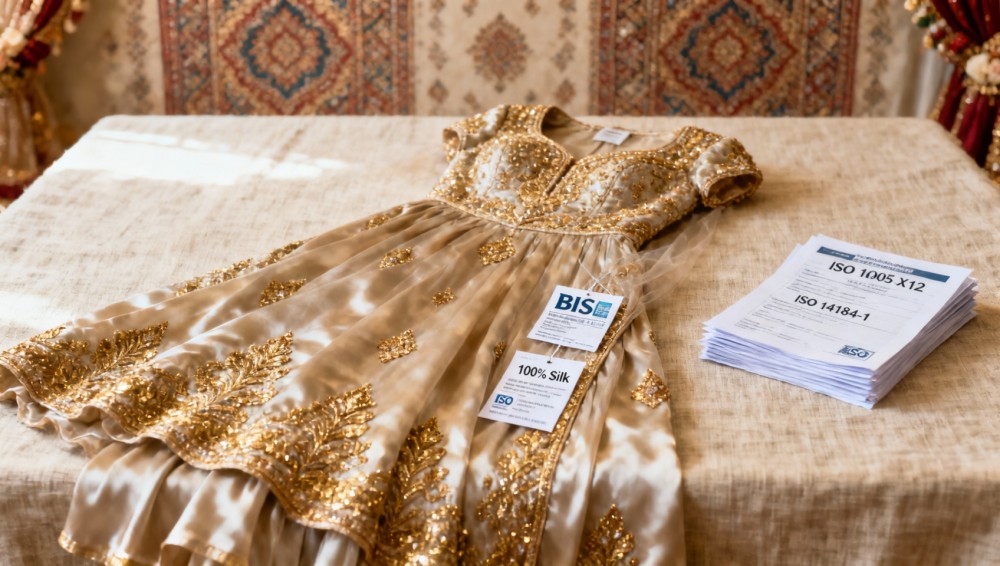
In summary, the IS 15620:2026 draft represents a targeted regulatory expansion affecting specific apparel export flows into India. Its practical impact hinges on final scope definition and enforcement clarity — making close monitoring of BIS’s next official communication essential. For now, it serves primarily as a planning trigger: prompting stakeholders to assess readiness, map dependencies, and prepare documentation systems — not to rush certification, but to avoid last-minute delays when the final rule takes effect.
Source: Bureau of Indian Standards (BIS) public consultation notice for IS 15620:2026, issued 21 April 2026. Note: Final standard text, enforcement date, and scope details remain pending official publication and are subject to change based on consultation outcomes.
Recommended News
 Industry NewsUS CPSC Updates Safety Guidelines for Wedding Prop Fabrics: Glitter Coatings Must Pass EN71-3 Migration TestUS CPSC now requires EN71-3 migration testing for glitter coatings on wedding props & cosmetic packaging. Exporters must comply to avoid customs delays. Learn key action steps for 2026 regulations.Apr 21, 2026
 Industry NewsWEPACK 2026 Shenzhen Show Highlights PHA-Based Barrier System for Global MarketsDiscover BoCarbon's PHA-based barrier system at WEPACK 2026 Shenzhen, a game-changing sustainable packaging solution with FDA/EFSA certification. Learn how global brands like KHS and Indofood are adopting this plastic alternative for paper-based packaging.Apr 21, 2026
 Industry NewsRed Sea Crisis Escalates: Dubai Port Imposes High-Risk Surcharge on Packaging GoodsDubai's new High-Risk Surcharge on packaging goods via Red Sea routes ($850-$1,420/container) plus 18% Suez toll hike forces businesses to rethink logistics strategies. Learn cost impacts & mitigation tactics.Apr 21, 2026
 Industry NewsEU REACH Annex XVII Adds Glitter Coating Restrictions, Requiring SVHC Declarations for Chinese Exporters from July 2026EU REACH Annex XVII now restricts glitter coatings in packaging, requiring SVHC declarations from Chinese exporters by July 2026. Learn how this impacts packaging, cosmetics & luxury goods sectors and key compliance steps to avoid trade disruptions.Apr 21, 2026