Industry News
Curation by industry experts
Hot Articles
Popular Tags
India to Mandate BIS Certification for Wedding Gowns from Q3 2026
India’s Bureau of Indian Standards (BIS) has proposed mandatory certification under IS 15620:2026 for wedding gowns—including bridesmaid dresses and flower girl dresses—effective from 30 September 2026. This regulatory shift affects apparel exporters, textile manufacturers, and supply chain stakeholders serving the Indian market, particularly those based in China, which supplies 64% of India’s imported wedding wear.
Event Overview
On 18 April 2026, BIS published Draft Amendment No. 2 to IS 15620:2026, proposing to upgrade wedding gowns from voluntary to mandatory BIS certification. The draft specifies new technical requirements: prohibition of azo dyes above 30 mg/kg, pH range of 4.0–7.5, colour fastness ≥ Grade 4, and traceable stitching process codes applied to the entire garment. The implementation date is set for Q3 2026 (30 September 2026). No final version of the standard or official notification has been issued as of the publication date of this update.
Which Subsectors Are Affected
Direct Exporters (Apparel Trading Companies)
Exporters supplying wedding gowns to India will face mandatory pre-market conformity assessment. Since China accounts for 64% of India’s wedding gown imports, Chinese trading firms are disproportionately impacted. Compliance will require product-specific BIS registration, test reports from BIS-recognized labs, and documentation linking traceability codes to production batches—increasing lead time and administrative overhead.
Garment Manufacturing Units
Factories producing wedding gowns for export must adapt production workflows to embed full-garment traceability (e.g., QR-coded labels on linings or care tags) and ensure raw materials meet revised chemical and physical criteria. Process validation—especially for dyeing, finishing, and stitching—will need formal documentation aligned with IS 15620:2026’s draft clauses.
Textile & Trim Suppliers
Suppliers of fabrics, threads, trims, and embellishments used in certified garments must provide compliant material declarations and batch-level test data (e.g., azo dye content, pH, colour fastness). Downstream certification depends on upstream material traceability; therefore, suppliers may be asked to issue BIS-aligned supplier declarations or co-sign test reports.
Logistics & Certification Support Providers
Third-party testing labs, BIS liaison agents, and customs documentation specialists will see increased demand for services related to IS 15620:2026. However, only BIS-recognized labs—and those accredited for textile chemical testing—can issue valid reports. Service providers must verify their scope of recognition before engaging clients on this standard.
What Enterprises and Practitioners Should Monitor and Do Now
Track official BIS communications for final amendment status
The current text remains a draft (Amendment No. 2). Final adoption, effective date confirmation, transition period provisions, and potential exclusions (e.g., handcrafted or vintage items) are pending. Stakeholders should monitor BIS’s official portal and gazette notifications—not third-party summaries—for authoritative updates.
Identify high-volume SKUs and assess gap against draft requirements
Exporters and manufacturers should map current best-selling wedding gown styles against the four new requirements: azo dye limits, pH, colour fastness, and traceability coding. Prioritize samples for pre-testing at BIS-recognized labs—especially for dyed lace, satin, and organza components where non-compliance risk is higher.
Distinguish between policy signal and operational readiness
This proposal signals tightening regulation for fashion textiles in India—but it is not yet law. Businesses should avoid premature capital expenditure (e.g., full-line traceability hardware rollout) until the final standard confirms scope, enforcement thresholds, and audit frequency. Instead, pilot traceability on 2–3 top SKUs and document internal SOPs for future scaling.
Initiate cross-supplier alignment on material compliance
Since fabric and trim suppliers influence certification outcomes, initiate technical dialogues now. Request existing test reports for azo dyes and pH; jointly review whether current finishing processes meet the 4.0–7.5 pH window. Early alignment reduces rework risk post-finalization.
Editorial Observation / Industry Perspective
From industry perspective, this move reflects BIS’s broader strategy to extend mandatory certification beyond safety-critical categories (e.g., electronics, toys) into lifestyle textiles—particularly high-value, low-volume segments with strong import dependence. Analysis来看, the inclusion of traceability coding suggests intent to strengthen post-market surveillance, not just pre-market approval. Observation来看, the timing—just two years before the 2028 national textile policy review—implies this may be a precursor to wider textile certification mandates. Current more appropriate interpretation is that IS 15620:2026 Amendment No. 2 is a strong regulatory signal, not yet an enforceable requirement; its real-world impact hinges on how strictly BIS enforces transition timelines and whether exemptions apply to small-batch or artisanal producers.
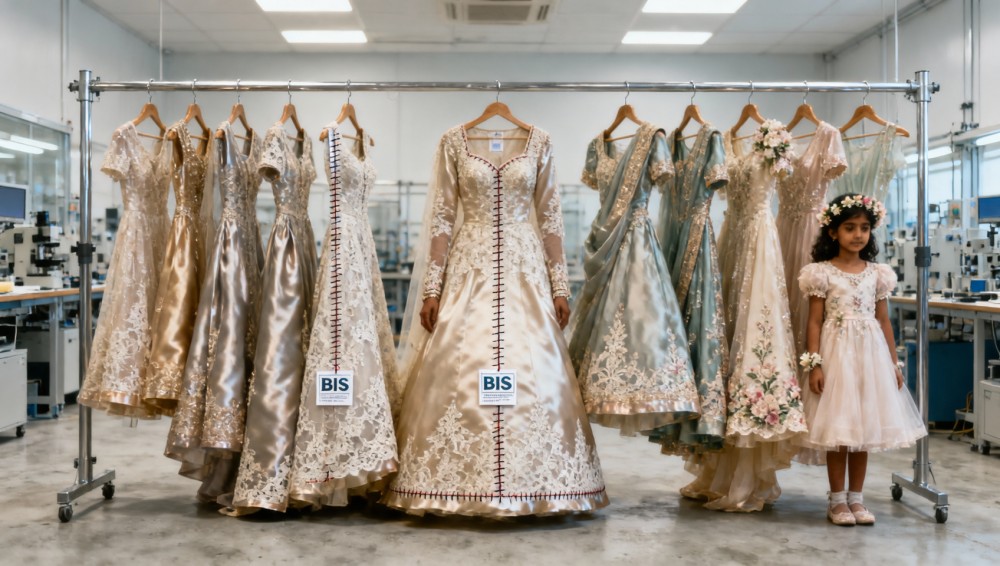
In summary, the proposed BIS mandate for wedding gowns marks a material shift in India’s textile import compliance landscape—not merely a procedural update, but a structural recalibration affecting sourcing, testing, labeling, and documentation workflows. It is best understood today as a high-priority preparatory trigger: one requiring targeted technical review and stakeholder coordination, rather than immediate system-wide overhaul.
Source: Bureau of Indian Standards (BIS), Draft Amendment No. 2 to IS 15620:2026, published 18 April 2026. Note: Final version, enforcement guidelines, and transition rules remain pending and require ongoing observation.
Recommended News
 Expert AnalysisIWA Launches Green Studio Certification for Chinese Photo Studio SuppliersGreen Studio Certification for Chinese photo studio suppliers — IWA's GGSC opens to LED lighting, eco-backdrops, biodegradable props & retouching software. Apply by May 31!Apr 17, 2026
 Fabrics & YarnsTurkey TSE New Standard for Linen-Blend Backdrop FabricsTurkey TSE new standard for linen-blend backdrop fabrics: mandatory antibacterial & stability tests by Aug 2026—secure compliance now to keep supplying Istanbul wedding studios.Textile Industry AnalystApr 17, 2026
 Supply Chain InsightsWedding Photography Prop Freight Rates Surge 23% on Red Sea DisruptionWedding photography prop freight rates surge 23% amid Red Sea disruption—impact on lead times, air costs & supply chain strategy revealed.Apr 17, 2026
 Garment MfgBrazil ANVISA Proposes Child Textile Rules for Bridesmaid AttireBrazil ANVISA’s new child textile rules for bridesmaid attire—lace veils, satin ribbons, silk bouquets—demand ISO flammability & safety testing. Act now!Textile Industry AnalystApr 17, 2026