Industry News
Curation by industry experts
Hot Articles
Popular Tags
Stainless Steel Carriage Bolts: Where They Work Better Than Hex Bolts
When strength, safety, and surface protection matter, stainless steel carriage bolts often outperform standard hex bolts in ways buyers and specifiers should not overlook. From wood assemblies to exposed outdoor structures, their smooth domed head and corrosion resistance make them a practical choice for specific fastening challenges. This article explains where they work better, why the difference matters, and how to evaluate the right option for your application.
Why a checklist approach works better than a simple product comparison
For information researchers, comparing stainless steel carriage bolts with hex bolts is rarely a matter of asking which fastener is “stronger” in general. The better question is where one design solves a practical fastening problem more efficiently, safely, or economically. A checklist-based review helps buyers, sourcing teams, and engineering evaluators avoid broad assumptions and focus on the conditions that actually affect performance.
This is especially important in the hardware and fasteners sector, where installation surface, corrosion exposure, tamper resistance, load path, and maintenance access can all change the right choice. In many projects, stainless steel carriage bolts are not a universal substitute for hex bolts, but they are often the better option in wood-to-wood, wood-to-metal, public-facing, and weather-exposed assemblies. The key is knowing what to check first.
Start with these five decision points before selecting a bolt type
Before comparing price, size, or availability, prioritize the following screening questions. These points quickly reveal whether stainless steel carriage bolts are likely to work better than standard hex bolts in your application.
- Will the bolt pass through wood or another softer material that can capture the square neck under the head?
- Does the exposed side need a smooth, low-profile, finished appearance rather than a protruding hex head?
- Will the assembly be exposed to rain, washdown, humidity, marine air, or outdoor temperature cycles?
- Is there a benefit in limiting tool access on one side for tamper reduction or simplified installation?
- Does the joint rely more on clamp-up through connected materials than on repeated wrench tightening at the head side?
If the answer is yes to several of these questions, stainless steel carriage bolts deserve serious consideration. If the application requires frequent tightening from both sides, high-torque head engagement, or direct wrenching at the head, hex bolts may still be the better fit.
Where stainless steel carriage bolts clearly work better
1. Wood assemblies that benefit from a flush, snag-free surface
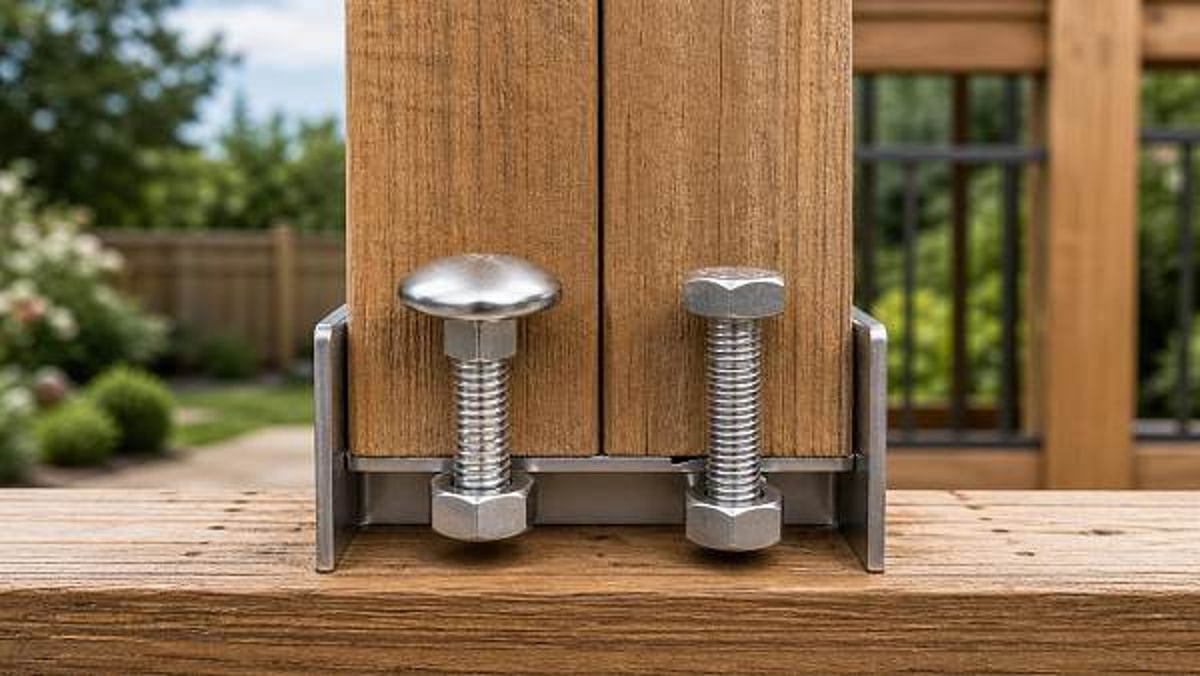
One of the strongest use cases for stainless steel carriage bolts is structural or semi-structural wood assembly. The domed head sits neatly on the visible side, reducing snag points on fences, decks, playgrounds, benches, gates, pergolas, and agricultural enclosures. The square neck under the head bites into the wood during tightening, helping prevent head rotation without requiring a wrench on both sides.
A hex bolt can clamp wood effectively, but the exposed hex head is bulkier, easier to catch on clothing or equipment, and less attractive in visible installations. In pedestrian or consumer-facing environments, the head profile alone can justify the switch to stainless steel carriage bolts.
2. Outdoor structures where corrosion resistance affects life-cycle cost
When fasteners are used in exterior furniture, sign frames, landscaping structures, farm equipment housings, waterfront fixtures, or light industrial supports, corrosion is not a minor detail. Stainless steel carriage bolts offer the combined advantage of rust resistance and surface-friendly geometry. This matters where stained runoff, seized threads, and difficult replacement can increase maintenance cost over time.
Compared with coated carbon steel hex bolts, stainless steel carriage bolts can reduce dependence on protective finishes that may chip, wear, or become damaged during installation. Buyers should still check stainless grade selection, but in many outdoor applications, the stainless option better supports durability and appearance retention.
3. Public-facing equipment where safety and appearance both matter
In schools, parks, retail displays, seating systems, hospitality fixtures, and transport-adjacent installations, a smooth head can be a practical safety feature. Stainless steel carriage bolts reduce the number of sharp or wrenchable edges exposed to users. This does not make them tamper-proof by itself, but it can make casual interference less convenient than with an exposed hex head.
For procurement teams balancing function with visual finish, this is a valuable detail. Clean lines and reduced projection can improve the final look of assembled products without adding secondary caps or cover hardware.
4. One-sided installation scenarios with limited head access
Where the head side is difficult to reach after insertion, stainless steel carriage bolts can save installation time. Once the square neck seats properly in wood or a prepared square hole, the installer can tighten from the nut side only. Hex bolts often require a tool at the head during tightening, especially if there is no head restraint.
This makes carriage bolts useful in assembled frames, enclosure panels, outdoor furniture kits, and modular products where access is restricted after parts are aligned.
Core evaluation checklist: how to judge if carriage bolts are the better choice
Use the following checklist to compare stainless steel carriage bolts against hex bolts in a structured way.
Application-specific notes buyers should not skip
For outdoor furniture and decor products
If the product is visible, touched frequently, or exposed to weather, stainless steel carriage bolts often support better customer satisfaction. They help reduce rust staining, preserve the product’s finish, and deliver a cleaner look. In sourcing reviews, confirm the stainless grade, nut and washer compatibility, and whether the wood species or composite board will hold the square neck securely during tightening.
For packaging machinery guards, utility frames, and light industrial structures
In these applications, the decision depends on maintenance patterns. If panels or guards are assembled into softer backing materials or where a rounded external face reduces interference, stainless steel carriage bolts may be preferable. If technicians need frequent removal with standard tools from either side, hex bolts may remain more convenient.
For agricultural and marine-adjacent use
Corrosion exposure becomes the main filter. Stainless steel carriage bolts perform well where mud, irrigation, animal washdown, salt air, or moisture exposure would shorten the service life of plated hex bolts. However, buyers should verify grade suitability, as not all stainless options perform equally in chloride-rich environments.
Common oversights that lead to poor fastener selection
- Assuming all stainless steel carriage bolts are the same. Grade, thread quality, and dimensional consistency affect real performance.
- Ignoring the seating requirement of the square neck. Without proper bite or square-hole engagement, the bolt may spin during tightening.
- Comparing only unit price instead of installed cost and replacement frequency. Stainless may cost more upfront but less over the service life.
- Overlooking washer choice. In wood or soft materials, washers influence load distribution and surface protection.
- Failing to assess galvanic compatibility with adjacent metals in wet conditions.
- Using carriage bolts in applications that truly require head-driven torque control, where hex bolts are more practical.
Practical sourcing and specification advice
If your team is evaluating stainless steel carriage bolts for procurement, prepare a short specification checklist before requesting quotations. Include bolt diameter, length under head, thread type, stainless grade, required standards, washer and nut requirements, estimated exposure conditions, and the material stack being joined. This reduces back-and-forth and improves quote accuracy across suppliers.
It is also useful to ask suppliers whether the application is primarily decorative, structural, safety-related, or corrosion-driven. That context helps determine whether a polished finish, tighter tolerances, or specific packaging and labeling are needed. For B2B buyers working across regions, request documentation on material traceability, testing practices, and consistency of batch supply.
Quick rule of thumb for faster decision-making
Choose stainless steel carriage bolts first when the joint includes wood, the visible side should remain smooth, corrosion exposure is meaningful, and one-sided tightening is helpful. Choose hex bolts first when the assembly needs strong wrench engagement at the head, repeated servicing, or steel-to-steel fastening without a suitable seating feature for a carriage bolt neck.
FAQ: key questions researchers often ask
Are stainless steel carriage bolts stronger than hex bolts?
Not automatically. Strength depends on grade, size, and specification. The advantage of stainless steel carriage bolts is often application fit, corrosion resistance, and head design rather than a universal strength benefit.
Can carriage bolts replace hex bolts in metal structures?
Sometimes, but only if the design allows proper anti-rotation seating. In many metal-to-metal joints, hex bolts are easier to install and torque reliably.
Why do buyers choose stainless steel carriage bolts for outdoor products?
Because they combine corrosion resistance, a clean visible finish, and reduced snag risk. For exposed assemblies, that combination often improves both durability and user experience.
Final decision guide and next step
For researchers and sourcing professionals, the smartest way to assess stainless steel carriage bolts is not by treating them as a generic alternative to hex bolts. Instead, match the fastener to the joint conditions: substrate, exposure, visible finish, service access, and safety expectations. In the right environments, stainless steel carriage bolts work better because they solve multiple problems at once rather than addressing only clamping force.
If your organization needs to move from comparison to procurement, the most useful next discussion points are bolt grade, installation environment, mating materials, dimensions, expected life cycle, compliance standards, packaging requirements, and supply consistency. Clarifying those items early will help determine whether stainless steel carriage bolts are the most practical, durable, and commercially efficient option for your project.
Recommended News
 Home DecorLuxury Watch Packaging: Details That Shape the Unboxing ExperienceLuxury watch packaging defines first impressions, perceived value, and brand prestige. Discover the key details that elevate unboxing, protection, and sustainable appeal.Interior Sourcing LeadMay 05, 2026
 Eco PackagingAluminum Beverage Cans: Cost Factors Behind Lightweight Can FormatsAluminum beverage cans cost more than unit price alone—explore how lightweight formats impact material spend, freight, efficiency, and ESG value to support smarter sourcing decisions.Packaging Supply ExpertMay 05, 2026
 Printing EquipmentContinuous Inkjet Printer Selection Tips for High-Speed Packaging LinesContinuous inkjet printer selection tips for high-speed packaging lines: compare uptime, ink adhesion, integration, maintenance, and total cost to choose the right coding solution.Packaging Supply ExpertMay 05, 2026
 Industrial FastenersStainless Steel Carriage Bolts: Where They Work Better Than Hex BoltsStainless steel carriage bolts work better than hex bolts in wood, outdoor, and public-facing projects. Learn when they improve safety, appearance, and corrosion resistance.Tooling & Hardware LeadMay 05, 2026