Industry News
Curation by industry experts
Hot Articles
Popular Tags
Canton Fair Phase II: 68% Wedding Prop Orders Use Green Packaging
On April 24, 2026, the second phase of the 139th Canton Fair opened, revealing a notable shift in procurement behavior for wedding photography props — with green packaging orders accounting for 68% of total orders. This development signals material implications for exporters, packaging suppliers, and downstream logistics providers serving Western markets, particularly those targeting EU and North American buyers where sustainability compliance is increasingly non-negotiable.
Event Overview
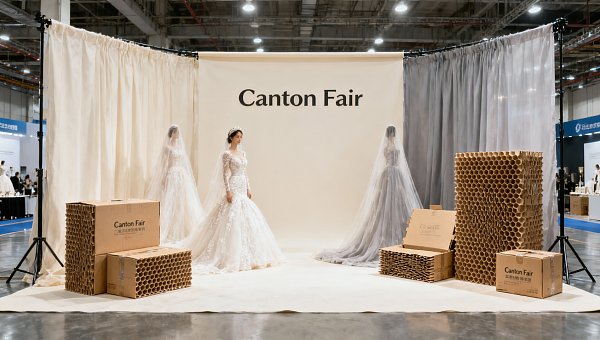
On April 24, 2026, the second phase of the 139th Canton Fair commenced. In the wedding photography props section, orders specifying FSC-certified corrugated cardboard, sugarcane fiber molded trays, and PLA-laminated backdrop bags accounted for 68% of total orders. Demand for compostable honeycomb paper cushioning materials rose 120% year-on-year and has become a mandatory verification item during factory audits by European and U.S. buyers. As a result, Chinese green packaging suppliers report surging order volumes, with production lead times extended to July.
Which Subsectors Are Affected
Direct Exporters (Wedding Prop Manufacturers)
These enterprises face heightened compliance pressure as overseas buyers now require verified green packaging across quotations and shipments. The 68% adoption rate reflects not voluntary preference but operational necessity — especially when supplying retailers or rental studios in environmentally regulated markets.
Raw Material Procurement Firms
Firms sourcing substrates such as FSC-certified paperboard, PLA film, or molded sugarcane pulp must adapt to tighter traceability requirements. The 120% growth in honeycomb paper inquiry volume suggests rising demand for certified biodegradable alternatives to EPS and EPE foam — requiring updated supplier vetting and documentation systems.
Contract Packaging & Assembly Service Providers
Third-party packagers handling final assembly and kitting for wedding props are seeing revised scope-of-work requests — including on-site validation of packaging material certifications and batch-level documentation. The rise in audit-driven specifications implies greater accountability in packaging line management.
Supply Chain & Logistics Intermediaries
Freight forwarders and customs brokers supporting this segment now encounter more frequent requests for sustainability-related export documentation — e.g., FSC chain-of-custody certificates, EN13432 test reports for compostable materials — adding complexity to documentation workflows and transit time planning.
What Relevant Enterprises or Practitioners Should Focus On
Monitor evolving buyer audit checklists — not just policy announcements
From industry perspective, the requirement for compostable honeycomb paper to be included in factory audits indicates that sustainability criteria are shifting from voluntary guidelines to contractual obligations. Enterprises should track actual audit protocols used by major EU/U.S. importers — rather than relying solely on public ESG statements.
Prioritize certification readiness for high-impact packaging components
Current more actionable focus lies on three items: FSC certification for corrugated board, EN13432 or ASTM D6400 validation for PLA-laminated bags, and industrial compostability verification for honeycomb paper. These are now prerequisites for quotation eligibility — not post-order add-ons.
Align production scheduling with extended green material lead times
Analysis shows Chinese green packaging suppliers’ delivery windows have stretched to July — meaning firms placing orders for Q3–Q4 2026 shipments need to initiate procurement by late May 2026 at the latest. Delayed material sourcing risks cascading into missed shipping deadlines.
Distinguish between ‘green packaging’ labeling and verifiable compliance
Observation indicates some buyers now reject self-declared eco-labels without third-party test reports or chain-of-custody records. Enterprises should verify whether their current packaging suppliers hold active, transferable certifications — rather than accepting marketing claims alone.
Editorial Perspective / Industry Observation
This data point — 68% green packaging order share in a single product category at a major trade fair — is better understood as an early-stage market signal than a fully matured standard. From industry angle, it reflects tightening de facto requirements among lead buyers in mature markets, rather than broad-based regulatory mandates. It also signals growing alignment between upstream packaging innovation and downstream retail expectations — but remains highly concentrated in specific buyer cohorts (e.g., EU-based studio chains, U.S. rental platforms). Sustained tracking is warranted, as further shifts may emerge in Phase III (consumer electronics/home goods) or future editions — particularly if similar patterns appear outside niche categories.
Conclusion: This development underscores how sustainability criteria are migrating from CSR reporting into core procurement logic — especially in visually intensive, returnable, or reusable product segments like wedding photography props. It is not yet universal, but it is operationally binding for targeted markets. Current more appropriate interpretation is that green packaging compliance has transitioned from competitive differentiator to baseline commercial prerequisite for certain export channels — requiring structured, documentation-led implementation rather than ad hoc substitution.
Information Source: Official statistics released by the China Foreign Trade Centre (Canton Fair Organiser), reported during the Phase II opening press briefing on April 24, 2026. Note: Ongoing observation is recommended for Phase III (May 1–5, 2026) to assess whether similar green packaging uptake extends to adjacent categories such as home décor or giftware.
Recommended News
 Eco PackagingCanton Fair Wedding Photo Props Zone Sees 37% YoY GrowthWedding photo props at Canton Fair surge 37% YoY—biodegradable packaging & magnetic modular backdrops lead global demand. Discover key trends now!Packaging Supply ExpertApr 24, 2026
 Export UpdatesChina Customs Launches Beta 'Wedding Photo Props Export Compliance Self-Check Platform'Wedding photo props exporters: Use China Customs’ new beta Self-Check Platform for real-time export compliance guidance on HS codes like 9405.40, 4202.92 & 6307.90 — avoid delays in US, EU, ASEAN & Middle East markets.Apr 24, 2026
 Commercial LEDEN 14982:2026 Effective: LED Softlight Devices for Wedding Photography Must Pass Enhanced EMC Immunity TestsLED softlight devices for wedding photography must now pass enhanced EMC immunity tests per EN 14982:2026 — ensure CE compliance before EU market entry!Commercial Tech EditorApr 24, 2026
 Carton & PlasticsUS CPSC Recalls 7 Chinese Wedding Backdrop Makers for FormaldehydeUS CPSC recalls 7 Chinese wedding backdrop makers for formaldehyde—critical alert for婚纱摄影 exporters, MDF suppliers & US importers. Act now to avoid detention & liability.Packaging Supply ExpertApr 24, 2026