Industry News
Curation by industry experts
Hot Articles
Popular Tags
Canton Fair Phase II: Green Packaging Orders Hit 73% for Wedding Photo Products
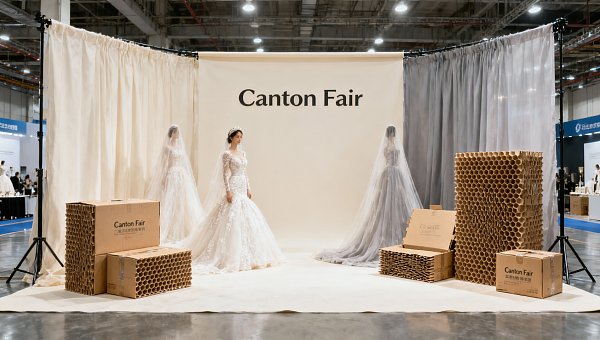
At the China Import and Export Fair (Canton Fair) Phase II, held April 2026, green packaging orders for wedding photography props and配套 apparel packaging reached 73% in the first week — a notable shift with implications for export-oriented manufacturers, packaging suppliers, and logistics service providers serving Western markets.
Event Overview
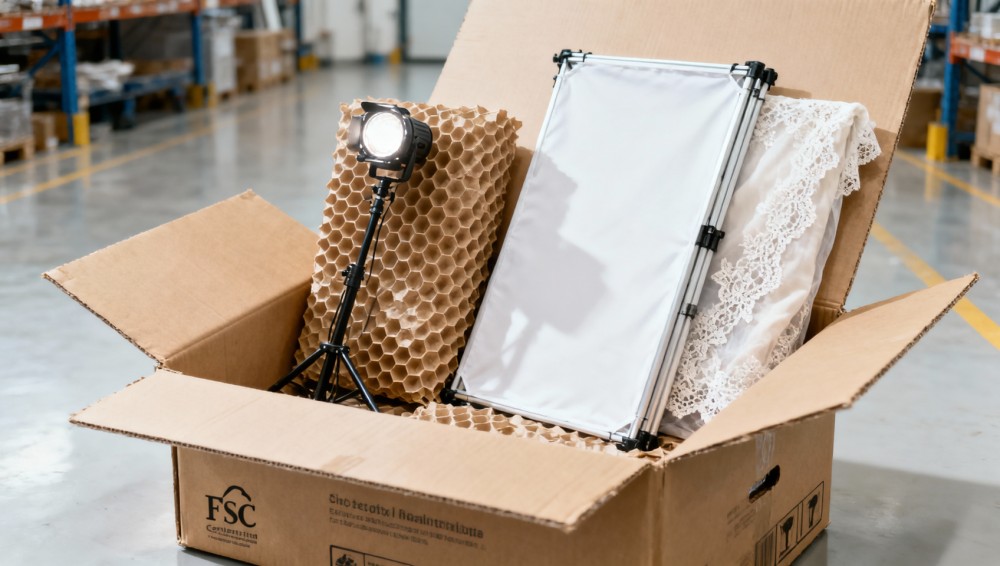
According to the Canton Fair Organizing Committee’s statistical brief released on April 25, 2026, green packaging orders — defined as those using biodegradable honeycomb paper, FSC-certified corrugated board, or plant-starch-based cushioning materials — accounted for 73% of all orders for wedding photography props and coordinated attire packaging during the first week of Phase II. This represents a 12-percentage-point increase year-on-year. Within this segment, honeycomb paper achieved a 48% substitution rate in interior lining for backdrop panels and shock-absorbing packaging for lighting equipment, and has become a specified preference among European and U.S. buyers.
Industries Affected
Direct Exporters (Wedding Photography Equipment & Prop Suppliers)
Exporters supplying props, backdrops, lighting rigs, and coordinated bridal wear face direct procurement pressure from overseas buyers specifying green packaging standards. The 48% honeycomb paper adoption rate signals a de facto requirement for certain high-value product categories — especially where structural integrity and environmental compliance are jointly evaluated.
Packaging Material Suppliers & Converters
Suppliers of protective and structural packaging materials are seeing accelerated demand for certified honeycomb paper and FSC-compliant corrugated variants. The 73% overall green packaging order share reflects not just niche adoption but broad-based commercial traction — particularly where certification documentation (e.g., FSC chain-of-custody, compostability test reports) is required at order placement.
Contract Manufacturers & Assembly Facilities
Factories handling final assembly, kitting, or drop-shipping for international brands must now accommodate revised packaging specifications mid-production cycle. The rise in honeycomb paper use for lighting equipment packaging implies stricter dimensional tolerances and new handling protocols — impacting line layout, labor training, and QA checkpoints.
Logistics & Fulfillment Service Providers
Third-party logistics operators managing consolidated shipments for wedding photography exporters may need to adjust palletization rules and damage liability assessments. Honeycomb paper’s lower density and higher compressibility versus traditional foam or molded pulp require updated stacking guidelines and carrier communication — especially for air freight where volume weight calculations apply.
What Relevant Enterprises or Practitioners Should Focus On
Monitor official updates on green packaging verification requirements
The current 73% figure reflects buyer-driven specification adherence, not mandatory regulation. However, analysis来看, rising buyer mandates may precede formalized sustainability clauses in future tender documents — particularly under EU Ecodesign for Sustainable Products Regulation (ESPR) implementation timelines.
Track category-specific substitution patterns, not just aggregate figures
The 48% honeycomb paper replacement rate applies specifically to backdrop panel linings and lighting equipment packaging — not general-purpose boxes. From industry perspective, this indicates selective technical suitability rather than universal applicability; enterprises should map material substitution by product function, not assume blanket scalability.
Distinguish between specification compliance and cost absorption capacity
Green packaging materials currently carry a 12–18% average unit cost premium over conventional alternatives. Current more suitable understanding is that the 73% order share reflects buyer willingness to absorb part of the cost — but only where packaging serves both protective and branding functions (e.g., unboxing experience for premium wedding kits). Cost-sensitive SKUs may lag adoption.
Prepare documentation and supplier qualification workflows now
Buyers requesting FSC certification or EN13432-compliant compostability reports are increasingly requiring evidence before order confirmation. Enterprises should audit existing packaging suppliers’ certifications, initiate chain-of-custody audits where gaps exist, and standardize material declarations across BOMs — beginning with high-volume export lines.
Editorial Observation / Industry Insight
This data point is better understood as an early-stage market signal — not yet a fully consolidated standard. Observation来看, the jump in green packaging share reflects tightening buyer-level sustainability criteria in a specific, high-visibility export segment (wedding photography), rather than broad regulatory enforcement. Analysis来看, the concentration of honeycomb paper use in structural applications (backdrop linings, lighting isolation) suggests functional performance — not just eco-labeling — is driving adoption. For the industry, sustained attention is warranted because this pattern aligns with broader procurement trends observed in EU and North American B2B channels, where packaging sustainability is increasingly embedded in technical evaluation, not just CSR reporting.
It is not yet a regulatory threshold, but it is becoming a competitive prerequisite in select export categories — particularly where end consumers associate brand values with tangible sustainability attributes (e.g., wedding services emphasizing ‘conscious celebration’).
Conclusion
The 73% green packaging order share at Canton Fair Phase II signals growing operational integration of sustainable packaging in export supply chains — but remains concentrated in functionally justified, buyer-specified applications. It is more accurately interpreted as an emerging commercial norm in targeted segments, rather than a generalized industry-wide transition. Enterprises should treat it as a forward-looking indicator requiring selective adaptation — not wholesale reengineering — at this stage.
Source Attribution
Main source: Canton Fair Organizing Committee — Statistical Brief for Phase II, Week 1 (released April 25, 2026).
Points requiring ongoing observation: Future updates on buyer-mandated documentation thresholds (e.g., third-party verification depth), regional divergence in green packaging preferences beyond EU/U.S., and potential extension of honeycomb paper adoption to non-structural applications.
Recommended News
 Eco PackagingCanton Fair Wedding Photo Props Zone Sees 37% YoY GrowthWedding photo props at Canton Fair surge 37% YoY—biodegradable packaging & magnetic modular backdrops lead global demand. Discover key trends now!Packaging Supply ExpertApr 24, 2026
 Export UpdatesChina Customs Launches Beta 'Wedding Photo Props Export Compliance Self-Check Platform'Wedding photo props exporters: Use China Customs’ new beta Self-Check Platform for real-time export compliance guidance on HS codes like 9405.40, 4202.92 & 6307.90 — avoid delays in US, EU, ASEAN & Middle East markets.Apr 24, 2026
 Commercial LEDEN 14982:2026 Effective: LED Softlight Devices for Wedding Photography Must Pass Enhanced EMC Immunity TestsLED softlight devices for wedding photography must now pass enhanced EMC immunity tests per EN 14982:2026 — ensure CE compliance before EU market entry!Commercial Tech EditorApr 24, 2026
 Carton & PlasticsUS CPSC Recalls 7 Chinese Wedding Backdrop Makers for FormaldehydeUS CPSC recalls 7 Chinese wedding backdrop makers for formaldehyde—critical alert for婚纱摄影 exporters, MDF suppliers & US importers. Act now to avoid detention & liability.Packaging Supply ExpertApr 24, 2026