Industry News
Curation by industry experts
Hot Articles
Popular Tags
Wholesale Kraft Paper Bags: How to Balance Cost, Size, and Load Capacity
Sourcing wholesale kraft paper bags is not just about finding the lowest unit price. For procurement teams, the real challenge is balancing cost, bag dimensions, and load capacity to protect margins, product safety, and supply consistency. This guide explains how to evaluate these factors together so buyers can make smarter, scalable packaging decisions in competitive global markets.
Why scenario differences matter when buying wholesale kraft paper bags
For procurement professionals, the same bag specification rarely works across every product line. A kraft bag for takeaway bakery items, for example, is evaluated differently from one used for hardware accessories, fashion retail packaging, or agricultural dry goods. In one scenario, appearance and print quality may drive value. In another, burst strength, handle reinforcement, and stacking performance matter more than branding. That is why sourcing wholesale kraft paper bags should begin with use-case mapping rather than unit-cost comparison alone.
The practical issue is that cost, size, and load capacity are tightly linked. Larger bags consume more paper, often require stronger basis weight, and may need upgraded handles or gussets. Higher load capacity improves safety, but if the bag is over-specified, buyers end up paying for strength they do not need. Under-specification creates even bigger risks: product damage, customer complaints, fulfillment inefficiency, and hidden replacement costs. In global sourcing, those mistakes scale quickly across containers, regions, and seasons.
For companies operating across multiple SKUs and sales channels, the best procurement decision is usually not a single “best” bag. It is a portfolio strategy that aligns specific kraft bag formats with actual application scenarios, order volumes, and handling conditions.
Typical application scenarios and what buyers should prioritize
Below are the most common scenarios in which wholesale kraft paper bags are sourced. Each has a different decision logic, so procurement teams should define requirements by end use before contacting suppliers.
Scenario 1: Retail and branded packaging needs balance, not maximum strength
In apparel, cosmetics, gift shops, and specialty retail, wholesale kraft paper bags often function as both packaging and brand media. Procurement teams in this scenario usually focus on paper color consistency, handle quality, logo clarity, and the customer’s carrying experience. However, many buyers over-specify paper thickness because they assume a thicker bag always signals premium quality.
In reality, the correct specification depends on the average item weight and bag usage time. If customers typically carry lightweight purchases for a short distance, a moderate basis weight with strong handle attachment may outperform a heavier bag at lower total cost. Flat-handle bags may be suitable for quick-service retail, while twisted paper handles often support a more premium look. For luxury or fragile retail items, buyers should test bottom reinforcement and handle pull strength rather than just choosing the thickest paper grade.
The key lesson for this scenario is simple: visual quality matters, but load capacity should still be matched to realistic carrying conditions. Paying extra for unnecessary strength reduces packaging efficiency and weakens margin control.
Scenario 2: Food service and bakery buyers should focus on fit, hygiene, and handling speed
For restaurants, cafes, bakeries, and snack brands, bag dimensions usually have more operational impact than buyers first expect. A bag that is too tall wastes paper and slows packing. A bag that is too narrow may deform food packaging, while a weak gusset can reduce filling speed during peak hours. In this environment, sourcing wholesale kraft paper bags should be closely tied to menu formats, container shapes, and daily throughput.
Food procurement teams should ask practical questions: Will the bag carry boxed meals, cups, bread, or mixed orders? Is grease resistance needed? Will the bag be exposed to warmth, moisture, or short-distance delivery? A bakery bag for pastries may prioritize appearance and ventilation, while a takeaway bag for meal boxes needs stronger bottoms and more predictable dimensional stability.
In this scenario, cost control often comes from SKU rationalization. Instead of maintaining too many bag sizes, buyers can standardize around two or three optimized formats that fit most orders. This reduces complexity, improves forecasting, and strengthens negotiating power with suppliers.
Scenario 3: E-commerce and omnichannel operations require stronger real-world performance
When wholesale kraft paper bags are used in e-commerce, click-and-collect, or hybrid fulfillment models, procurement decisions should account for more handling stages. Bags may be packed in warehouses, transferred in carts, loaded into delivery vehicles, and carried by end users. This makes load capacity more important than in traditional over-the-counter retail.
For these applications, buyers should evaluate seam strength, bottom construction, and how the bag performs when partially filled. A bag may pass a simple weight test but still fail during movement if the load shifts or creates pressure points. Larger dimensions are not always better either. Oversized bags encourage void space, product movement, and wasted freight volume.
A good sourcing strategy here is to classify products by weight band and fragility. Lightweight apparel orders may require only standard kraft shopping bags, while home goods, accessories, or bundled promotional orders may need reinforced construction. Procurement managers should ask suppliers for sample testing under simulated fulfillment conditions rather than relying only on paper GSM or quoted load ratings.
Scenario 4: Hardware, industrial supplies, and dense products need load realism
Industrial and hardware buyers face one of the most common sourcing mistakes: assuming total product weight tells the full story. In reality, dense and irregular items such as fasteners, fittings, tools, and spare parts create localized stress. That means a bag carrying 5 kilograms of boxed textiles behaves very differently from a bag carrying 5 kilograms of metal components.
In this application, wholesale kraft paper bags must be evaluated for puncture resistance, seam integrity, and bottom structure. If products have sharp corners or concentrated edges, internal liners or secondary packaging may be required. Buyers should also consider how the bag will be lifted. Hand-carry retail movement differs from warehouse picking or contractor site transport.
The cost implication is important. A slightly higher unit price for stronger multi-ply bags may save significant money by reducing breakage, repacking labor, and return claims. In industrial procurement, the cheapest bag frequently becomes the most expensive option once operational risk is included.
How to balance cost, size, and load capacity in a practical sourcing model
Procurement teams can simplify decision-making by using a three-step model. First, define the real product payload, including shape, stacking behavior, and handling route. Second, choose dimensions that minimize excess space while preserving packing efficiency. Third, specify the lowest construction level that safely meets the application requirement. This approach prevents both overengineering and underperformance.
When comparing supplier quotations for wholesale kraft paper bags, do not review unit price in isolation. Buyers should compare total packaging value using these checkpoints:
- Paper grade and basis weight relative to actual load
- Bag dimensions and packing efficiency per SKU
- Handle type, reinforcement method, and seam construction
- Printing complexity and whether it drives commercial value
- Failure rate risk across storage, transport, and end use
- Lead time stability, MOQ, and replenishment flexibility
This framework is especially useful for global sourcing teams managing multiple factories or regional distributors. It creates a common language between procurement, packaging, operations, and brand stakeholders.
A quick comparison table for procurement decisions by scenario
Common sourcing mistakes buyers should avoid
One frequent mistake is using only paper GSM to judge suitability. While GSM matters, it does not fully capture bag design quality, adhesive performance, handle fixing, or seam strength. Another mistake is selecting dimensions based on visual preference rather than product fit. Larger wholesale kraft paper bags often look versatile, but they create material waste and can reduce carrying stability.
Buyers also sometimes ignore the relationship between MOQ and size variety. Ordering many custom sizes may seem customer-friendly, but it can weaken stock turnover and increase dead inventory. Finally, some teams approve samples only under showroom conditions. Real procurement validation should include load testing, transit simulation, humidity exposure when relevant, and feedback from the staff who actually pack and handle the bags.
How procurement teams can move from quote comparison to scenario-fit sourcing
The most effective buyers treat wholesale kraft paper bags as an operational tool, not a commodity line item. Start by grouping applications into clear scenarios: light retail, food takeaway, delivery handling, and heavy-duty carrying. Then define acceptable load thresholds, preferred dimensions, and commercial targets for each group. This allows suppliers to quote more accurately and helps internal stakeholders approve a packaging program based on evidence rather than assumptions.
For organizations sourcing internationally, supplier discussions should also cover consistency, compliance expectations, print tolerances, and replenishment reliability. A strong sourcing partner should be able to recommend construction options that fit the application instead of simply offering the lowest nominal price. That is especially important in competitive markets where packaging decisions influence customer experience, cost control, and brand trust at the same time.
If your team is reviewing packaging options across product categories or regions, the next step is to build a scenario-based specification sheet. By aligning size, strength, and budget with the actual use case, buyers can source smarter wholesale kraft paper bags, reduce avoidable cost, and create a more resilient procurement strategy.
Recommended News
 Commercial LEDSaudi SABER Adds Mandatory Registration for LED Ring LightsLED ring lights for photography now require mandatory Saudi SABER registration—essential for婚纱摄影 exporters, OEMs & e-commerce sellers targeting KSA. Act now to avoid port delays.Commercial Tech EditorMay 03, 2026
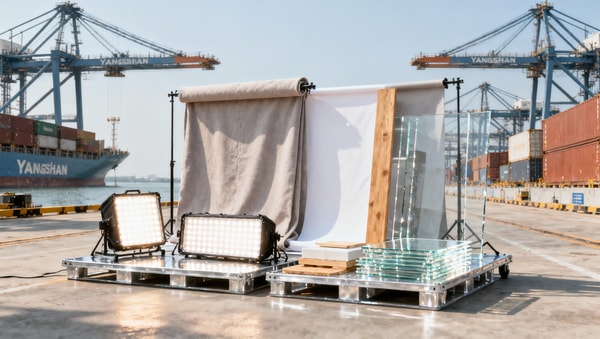
 Export UpdatesYangshan Port Launches Dedicated Photo Props Clearance ChannelYangshan Port's new wedding photography props clearance channel slashes customs time to 2.1 days—boosting speed & reliability for global photo service exporters.May 03, 2026
 Printing EquipmentECHA Adds NMP to SVHC Candidate List: Impact on UV Ink ExportersUV ink exporters: ECHA added NMP to SVHC list—impacting wedding photography inks (HS 3215.11). Act now to reformulate, comply & avoid 2027 EU market bans.Packaging Supply ExpertMay 03, 2026
 Fabrics & YarnsRCEP 2026 Origin Rules Update: Recycled Polyester Backdrops Gain Zero-Tariff AccessRecycled polyester backdrops now qualify for RCEP zero-tariff access under the 2026 Origin Rules — boosting margins and simplifying export for wedding photography studios and suppliers.Textile Industry AnalystMay 03, 2026