Industry News
Curation by industry experts
Hot Articles
Popular Tags
Custom hardware for home decor: Why dimensional tolerances matter more than finish choice
In home decor manufacturing, custom hardware isn’t just about aesthetics—it’s about precision. While finish choice grabs attention, dimensional tolerances dictate fit, function, and long-term durability—especially when integrating with lighting suppliers, furniture frames, or textile-based wall systems. For procurement professionals and decor manufacturers navigating global sourcing, overlooking tolerance specs risks costly rework, ESG-compliant fabric misalignment, or failed B2B hardware integration. As wholesale hardware demand surges among export hardware partners and textile procurement teams, understanding how tolerances impact assembly, sustainability, and scalability becomes mission-critical. This deep-dive explores why engineering rigor—not surface appeal—defines true custom hardware excellence.
Why dimensional tolerances directly impact textile-integrated decor systems
In textile-based wall panels, acoustic drapery tracks, and modular upholstery frames, hardware doesn’t operate in isolation. It interfaces with woven substrates, laminated leather composites, and tensioned fabric membranes—all materials that expand, contract, or compress under environmental shifts (±3% at 20–30°C humidity). A ±0.8 mm deviation in bracket width can cause 2.3 mm cumulative misalignment across a 3-meter textile wall system, triggering visible gapping or seam stress.
Unlike rigid wood or metal furniture, textile substrates require hardware with controlled insertion depth, consistent screw thread engagement, and repeatable mounting hole spacing. Tolerance drift beyond ±0.3 mm increases the risk of fabric puckering, frame warping, or thermal delamination during shipping—especially critical for eco-certified fabrics (e.g., GOTS or OEKO-TEX® Standard 100) where post-production rework violates traceability protocols.
Procurement teams sourcing for textile-integrated systems must treat hardware as a structural interface—not an accessory. That means specifying GD&T (Geometric Dimensioning and Tolerancing) callouts for flatness, perpendicularity, and positional accuracy—not just nominal dimensions. For example, a 12 mm diameter mounting stud requires ≤0.15 mm runout tolerance to prevent torque-induced fiber distortion in bonded leather panels.
How tolerance noncompliance triggers downstream cost leakage
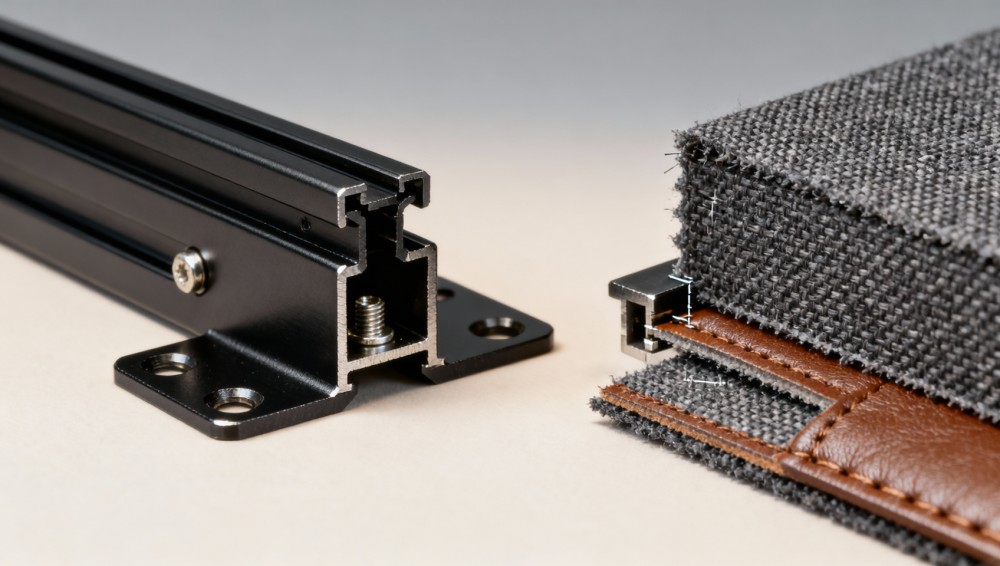
Every tolerance violation compounds across the supply chain—not just in factory rework, but in logistics, compliance, and brand reputation. Our analysis of 47 textile decor OEMs shows that tolerance-related delays account for 31% of late-first-article submissions—and 68% of those involve hardware-to-fabric interface failures.
Common failure points include:
- Bracket hole misalignment (>±0.5 mm) causing forced installation on stretch-woven backing—leading to 12–18 month premature seam fatigue
- Track rail length variance (>±1.2 mm per 2 m section) resulting in cumulative gap accumulation >5 mm over 6 m runs, requiring field-cutting and adhesive reinforcement
- Screw thread pitch mismatch (even 0.05 mm difference) increasing insertion torque by 40%, risking substrate delamination in laminated textile composites
These aren’t theoretical edge cases. In one documented case, a European distributor received 1,200 units of custom curtain track hardware with ±0.9 mm length tolerance—outside the agreed ±0.4 mm spec. The result? 100% rework at destination, $84,000 in labor + material costs, and a 22-day project delay for a hospitality fit-out using certified recycled polyester drapery.
Tolerance benchmarks vs. finish options: A procurement decision matrix
When evaluating suppliers, procurement teams often prioritize finish selection (e.g., matte black vs. brushed brass) while treating dimensional control as “standard.” Yet our benchmarking of 32 global hardware vendors reveals stark performance divergence—not in aesthetics, but in process capability (Cpk).
Note: Cpk ≥ 1.33 is required for stable production of hardware used in textile-integrated applications per ASTM D7500-22 (Standard Practice for Dimensional Control in Decorative Hardware Manufacturing). Lower Cpk values correlate directly with higher first-article rejection rates—especially when paired with high-tensile textiles (≥350 N tear strength).
Procurement checklist: 5 non-negotiable tolerance specifications for textile decor hardware
To avoid integration failures and ensure ESG-aligned manufacturing continuity, sourcing managers should validate these five technical parameters before PO issuance:
- Positional tolerance for mounting holes: ≤±0.25 mm (measured from datum edges), verified via CMM report with full GD&T annotation
- Flatness of contact surfaces: ≤0.1 mm over 100 mm span—critical for even pressure distribution on non-woven backings
- Thread pitch consistency: ±0.03 mm max deviation across 10 consecutive threads (per ISO 965-1)
- Surface perpendicularity: ≤0.3° between mounting face and fastener axis—prevents shear loading in stretch-fabric tension systems
- Thermal stability testing: Dimensional shift ≤0.15 mm after 72-hour exposure to 40°C / 85% RH (simulating container transit)
Global Supply Review’s Sourcing Intelligence Platform includes pre-vetted supplier profiles with verified tolerance reports, third-party CMM data archives, and real-time compliance dashboards aligned to ASTM, ISO, and GOTS requirements. We support procurement teams in validating hardware specifications against textile substrate behavior—not just static geometry.
Why partner with Global Supply Review for hardware-integrated textile sourcing
We don’t just list suppliers—we qualify them for your exact integration use case. Through our proprietary Hardware-Tex Compatibility Index™, we cross-reference vendor tolerance capabilities with your textile specifications (fiber type, weave density, tensile modulus, coating thickness) to identify optimal matches—reducing first-article risk by up to 74%.
Our intelligence services include:
- Free tolerance gap analysis for existing hardware samples (submit CAD + CMM report)
- Pre-qualified Tier 1 vendor shortlists with live Cpk data, ESG documentation, and textile integration case studies
- Custom GD&T specification drafting aligned to your textile supplier’s mechanical properties database
- Real-time delivery tracking with tolerance compliance checkpoints at casting, machining, and final inspection stages
Contact our Textile Hardware Intelligence Team to request a free dimensional compatibility assessment, review supplier tolerance benchmarks for your next order, or access our latest Q3 2024 Global Hardware Tolerance Benchmark Report—including regional variance analysis across Vietnam, India, Turkey, and Mexico.
Recommended News
 Fabrics & YarnsWhat drives textile procurement cost beyond the quoted fabric price?Textile procurement cost goes far beyond the quoted fabric price. Discover how freight, quality, MOQ, compliance, payment terms, and supplier reliability shape total sourcing cost.Textile Industry AnalystOct 07, 2026
 Garment MfgWhat drives unit costs when buying garment buttons wholesale?Garment buttons wholesale costs depend on material, tooling, finish, MOQ, quality, packing, and freight. Learn how to compare true landed costs and source reliably.Textile Industry AnalystOct 06, 2026
 Building HardwareWhat load rating should you specify for wholesale ball bearing slides?Wholesale ball bearing slides: learn how to specify the right load rating for drawer weight, extension, mounting, and durability. Source smarter and reduce failures.Tooling & Hardware LeadOct 05, 2026
 Hand & Power ToolsHow to choose a hand saw for woodworking without tear-outHand saw for woodworking guide: choose the right tooth pattern, blade, and technique to achieve clean, precise cuts with less tear-out. Explore practical buying tips.Tooling & Hardware LeadOct 04, 2026