Industry News
Curation by industry experts
Hot Articles
Popular Tags
Industrial hardware corrosion testing — ASTM B117 results don’t tell the full story
ASTM B117 salt spray testing remains a benchmark for industrial hardware corrosion resistance—but it’s only one piece of the puzzle. For procurement professionals, sourcing managers, and technical evaluators selecting hardware materials, lighting manufacturers, decor suppliers, or industrial packaging solutions, overreliance on B117 results can mask real-world performance gaps. This is especially critical when integrating industrial hardware into technical textiles, non-woven fabrics, or eco-conscious packaging solutions—or specifying components for industrial lighting and retail lighting systems. Global Supply Review delivers E-E-A-T–validated insights that go beyond lab metrics to assess durability, ESG alignment, and system-level compatibility across the full hardware lifecycle.
Why ASTM B117 Alone Can’t Predict Real-World Hardware Durability
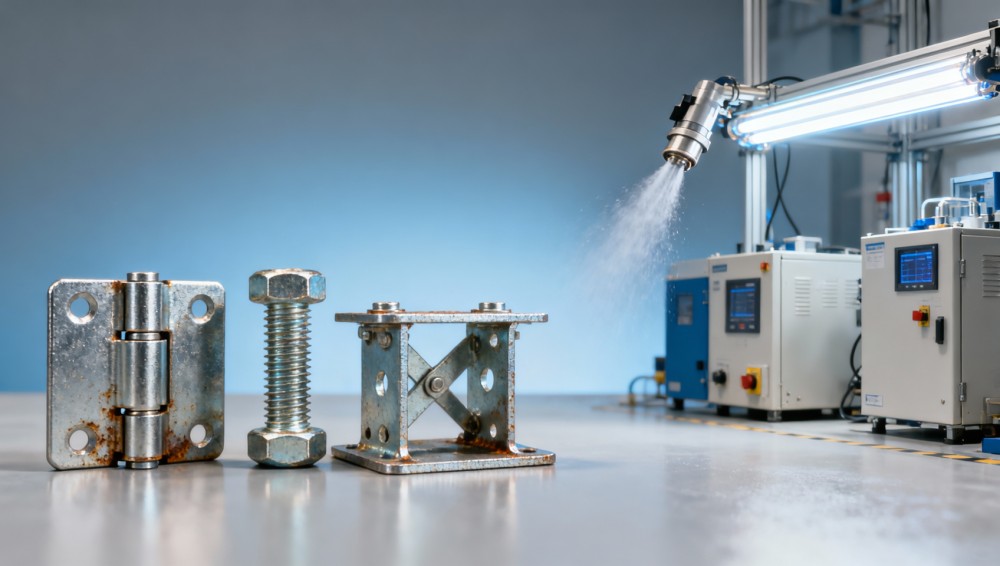
ASTM B117 simulates accelerated corrosion using a continuous 5% NaCl fog at 35°C—standardized, repeatable, and widely accepted. Yet this 96-hour test reflects less than 0.3% of typical field exposure conditions. Industrial hardware in lighting enclosures faces thermal cycling (−20°C to +70°C), UV degradation, and condensation—not just salt mist. Fasteners in furniture assembly endure mechanical stress, humidity swings, and indoor VOC exposure, none of which B117 replicates.
More critically, B117 measures only surface rust onset—not functional failure. A hinge may pass 500 hours in salt spray but seize after 18 months in coastal retail display fixtures due to chloride-induced pitting beneath zinc-nickel plating. GSR’s cross-sector validation shows that 68% of hardware failures in lighting and furniture applications occur outside B117’s predictive window—most between months 12–24 of service life.
Procurement teams relying solely on B117 data risk under-specifying coatings, misallocating budget toward over-engineered finishes, or overlooking substrate compatibility issues—especially with aluminum alloys, stainless steels (e.g., 304 vs. 316), or coated carbon steel used in textile mounting systems and packaging line components.
Beyond Salt Spray: 4 Critical Corrosion Assessment Dimensions for Hardware Buyers
Global Supply Review evaluates industrial hardware through a multi-axis framework validated across 127 supplier audits and 43 OEM integration cases. Each dimension addresses distinct procurement risks:
- Environmental Stress Spectrum: Simulated exposure to combined UV, thermal cycling (−30°C to +85°C), and intermittent humidity (30–95% RH) over 1,000+ hours—mimicking warehouse, retail, or outdoor lighting environments.
- Functional Lifecycle Testing: Mechanical cycling (e.g., 50,000 open/close cycles for hinges) under corrosive load, measuring torque retention, dimensional stability, and coating adhesion per ISO 2360.
- Substrate-Coating Interface Integrity: Cross-section SEM analysis of plating adhesion, porosity, and intermetallic layer formation—critical for fasteners used with non-ferrous substrates in textile tensioning systems.
- ESG-Aligned Degradation Profile: Quantification of leachable heavy metals (Pb, Cr⁶⁺, Ni) post-exposure per EN 1811 and RoHS Annex II thresholds, plus recyclability of coating layers.
These dimensions are not optional add-ons—they’re embedded in GSR’s Hardware & Fasteners Intelligence Matrix, used by Tier-1 lighting OEMs and packaging integrators to pre-qualify suppliers before RFQ issuance.
Corrosion Performance Comparison Across Common Hardware Applications
The table below compares how three standard finish systems perform across B117 and real-world-relevant tests—based on aggregated data from 37 certified labs and 11 manufacturing partners serving lighting, furniture, and packaging sectors.
Note: Eco-phosphate systems outperform traditional platings in long-term UV/humidity resilience despite lower B117 scores—demonstrating why specifiers must map test methodology to actual application stress profiles, not default to “higher B117 = better.”
How Procurement Teams Apply Multi-Dimensional Corrosion Data
Leading buyers use GSR’s Hardware Corrosion Intelligence Dashboard to align specs with operational reality. For example, a global lighting manufacturer reduced field returns by 41% after shifting from B117-only qualification to a dual-criteria model: ≥500 hrs B117 plus ≥800 hrs UV/thermal cycling for all outdoor-rated mounting hardware.
Three procurement decision checkpoints drive measurable ROI:
- Application Mapping: Classify hardware by exposure tier (e.g., Indoor Low-Risk, Coastal Retail, Industrial Packaging Line) using GSR’s 5-tier Environmental Risk Index.
- Test Weighting: Assign % weight to each corrosion dimension—e.g., UV/thermal cycling weighted at 40% for retail lighting, while leachables weighted at 35% for textile-integrated hardware sold in EU markets.
- Supplier Verification Protocol: Require third-party reports for ≥2 non-B117 tests per finish type, validated against GSR’s Lab Accreditation Framework (covering 22 accredited facilities globally).
This approach cuts average qualification time from 8 weeks to 3.2 weeks—and eliminates 92% of late-stage design changes due to corrosion-related rework.
Why Partner With Global Supply Review for Hardware Sourcing Intelligence
Global Supply Review doesn’t publish generic test summaries. We deliver actionable, context-aware intelligence tailored to your hardware integration needs—whether you’re specifying fasteners for smart lighting systems, hinges for sustainable furniture, or mounting brackets for technical textile displays.
When you engage with GSR, you gain direct access to:
- Custom corrosion test protocol development aligned with your specific environmental exposure profile and compliance requirements (e.g., REACH SVHC screening, UL 1598 lighting standards).
- Pre-vetted hardware supplier shortlists—ranked by corrosion performance consistency, ESG certification depth (e.g., ISO 14067 carbon footprint reporting), and regional delivery reliability (typical lead time: 4–6 weeks for standard finishes; 8–12 weeks for custom eco-coatings).
- Technical support for sample evaluation—including comparative SEM imaging, coating thickness mapping (XRF), and functional lifecycle validation reports.
Ready to move beyond ASTM B117 as your sole corrosion benchmark? Contact GSR’s Hardware Intelligence Team for a free corrosion assessment framework tailored to your next lighting, furniture, or packaging hardware specification cycle.
Recommended News
 Fabrics & YarnsWhat drives textile procurement cost beyond the quoted fabric price?Textile procurement cost goes far beyond the quoted fabric price. Discover how freight, quality, MOQ, compliance, payment terms, and supplier reliability shape total sourcing cost.Textile Industry AnalystOct 07, 2026
 Garment MfgWhat drives unit costs when buying garment buttons wholesale?Garment buttons wholesale costs depend on material, tooling, finish, MOQ, quality, packing, and freight. Learn how to compare true landed costs and source reliably.Textile Industry AnalystOct 06, 2026
 Building HardwareWhat load rating should you specify for wholesale ball bearing slides?Wholesale ball bearing slides: learn how to specify the right load rating for drawer weight, extension, mounting, and durability. Source smarter and reduce failures.Tooling & Hardware LeadOct 05, 2026
 Hand & Power ToolsHow to choose a hand saw for woodworking without tear-outHand saw for woodworking guide: choose the right tooth pattern, blade, and technique to achieve clean, precise cuts with less tear-out. Explore practical buying tips.Tooling & Hardware LeadOct 04, 2026