Industry News
Curation by industry experts
Hot Articles
Popular Tags
Thailand Launches RCEP Origin Verification for Chinese Wedding Photo Props
On April 22, 2026, Thailand’s Customs Department (THAICUSTOMS) activated electronic verification of RCEP Certificates of Origin (Form RCEP) for Chinese wedding photography props — marking the first ASEAN-side operationalization of RCEP origin procedures targeting this specific product group. Exporters and importers in photography equipment, textile-based props, and lighting accessories supply chains should take note: this change directly affects tariff treatment, customs clearance timing, and documentation workflows.
Event Overview
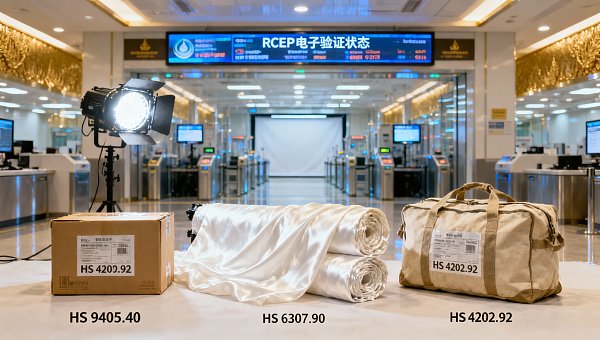
Effective April 22, 2026, THAICUSTOMS began accepting electronic verification of Form RCEP for imports from China classified under HS codes 9405.40 (photographic lighting fixtures), 4202.92 (non-essential textile bags, e.g., prop storage), and 6307.90 (other made-up textile articles, e.g., backdrops and drapes). The system validates electronic declarations issued by the China Council for the Promotion of International Trade (CCPIT) and its authorized issuing bodies. Verified shipments qualify for zero tariff treatment under RCEP, with customs release targeted within 48 hours.
Industries Affected
Direct Exporters of Wedding Photography Props
Companies exporting HS 9405.40, 4202.92, or 6307.90 goods from China to Thailand now face a new documentation requirement: Form RCEP must be issued electronically by CCPIT or an authorized body, not just submitted as paper. This shifts administrative responsibility toward certified digital issuance and real-time data alignment between exporter, chamber, and Thai customs.
Manufacturers Sourcing Components for Prop Assembly
Firms assembling lighting kits, portable backdrops, or storage solutions using imported components (e.g., LED modules, fabric substrates, metal frames) may need to reassess origin qualification. Under RCEP rules of origin, cumulative regional value content applies — but only if all inputs are sourced from RCEP members and properly documented. This verification rollout signals stricter scrutiny of upstream origin claims.
Distribution & Import Agents in Thailand
Thai importers and logistics intermediaries handling wedding photography props must now integrate electronic Form RCEP validation into their pre-clearance checks. Unlike traditional paper-based preferential treatment, real-time verification requires coordination with Chinese exporters on declaration timing, format compliance, and fallback protocols if verification fails.
Trade Facilitation & Certification Service Providers
Chambers of commerce, third-party certifiers, and digital trade platform operators supporting Chinese exporters will see increased demand for CCPIT-authorized e-issuance capability. Their role expands beyond certification to include system interoperability assurance and error-resolution support for cross-border electronic verification.
What Businesses Should Monitor and Do Now
Track official guidance on scope expansion
THAICUSTOMS has confirmed implementation only for the three listed HS codes. Current more relevant is monitoring whether additional codes — such as 9006.59 (accessory parts for cameras) or 6702.90 (artificial flowers used as decor) — will be added in subsequent phases. No announcement has been made beyond April 22, 2026.
Verify eligibility and issuance capacity with CCPIT-authorized bodies
Not all CCPIT branches or delegated agencies currently issue electronic Form RCEP. Exporters must confirm whether their local chamber supports live e-signing and API integration with THAICUSTOMS systems — and test submission before shipment. Paper submissions remain invalid for preferential treatment under this new process.
Distinguish policy launch from full operational readiness
While the system went live on April 22, 2026, analysis来看, initial adoption may involve manual reconciliation steps or intermittent connectivity issues. Early filers should retain audit-ready records (including timestamps, declaration IDs, and verification receipts) for at least six months, pending THAICUSTOMS’ public performance reporting.
Align internal documentation and procurement practices
For manufacturers relying on imported materials, current more advisable is reviewing supplier-origin declarations against RCEP accumulation rules. If non-RCEP inputs exceed allowable thresholds, zero-tariff access may not apply — even with a valid Form RCEP. Procurement teams should flag sourcing dependencies ahead of customs submission.
Editorial Observation / Industry Perspective
This development is better understood as an operational signal than an immediate market shift. From industry angle, it reflects Thailand’s prioritization of high-frequency, low-risk consumer goods categories to stress-test RCEP digital infrastructure — rather than a broad-based tariff liberalization milestone. Observation来看, the narrow HS code selection suggests pilot-phase discipline; it does not indicate imminent coverage of broader photography equipment or creative services inputs. Continued attention is warranted because ASEAN-wide replication of such verification systems — especially for time-sensitive, low-value-per-unit goods — could reshape documentation expectations across regional supply chains.
Conclusion
This initiative confirms RCEP’s transition from agreement to executable framework — but only for tightly scoped product lines and verified digital pathways. It does not imply automatic tariff benefits across all Chinese exports to ASEAN, nor does it replace national customs risk assessments. Currently, it is more appropriately interpreted as a procedural benchmark: a step toward interoperable origin administration, not a wholesale reduction in trade friction.
Information Sources
Main source: Thailand Customs Department (THAICUSTOMS) official notice dated April 22, 2026. No further expansion of HS codes or participating institutions has been publicly announced as of publication. Ongoing observation is recommended for updates on system stability metrics and potential extension to adjacent categories.
Recommended News
 Export UpdatesThailand Launches RCEP Origin Verification for Chinese Wedding Photo PropsRCEP origin verification for Chinese wedding photo props is live in Thailand—unlock zero tariffs & faster clearance for HS 9405.40, 4202.92, 6307.90 exports now.Apr 23, 2026
 Fabrics & YarnsTurkey TSE Mandates AATCC 100-2024 for Antibacterial Wedding BackdropsAATCC 100-2024 is now mandatory for antibacterial wedding backdrops entering Turkey — ensure compliance, avoid customs delays, and secure market access before 1 June 2026.Textile Industry AnalystApr 23, 2026
 Export UpdatesCanton Fair Phase II 2026 Launches Green Compliance Zone for Wedding Photo PropsGreen Compliance Zone launched at Canton Fair 2026 for wedding photo props — EU REACH, US CPSC & more. Get certification-ready now!Apr 23, 2026
 Garment MfgIndia BIS Mandate for Wedding Apparel: IS 15620:2026 Effective July 2026India BIS mandates IS 15620:2026 for wedding apparel — bridal gowns, veils & formal wear must meet safety testing by July 2026. Act now to avoid port delays!Textile Industry AnalystApr 23, 2026