Industry News
Curation by industry experts
Hot Articles
Popular Tags
Child Resistant Packaging: Common Testing Failures and How to Prevent Them
Child resistant packaging can fail critical compliance tests for reasons that are often preventable, from weak locking mechanisms to inconsistent production tolerances. For quality control and safety managers, understanding these common testing failures is essential to reducing risk, avoiding recalls, and ensuring regulatory readiness. This article outlines where child resistant packaging typically falls short and how to strengthen performance before products reach the market.
Understanding Child Resistant Packaging in a Compliance Context
Child resistant packaging is designed to reduce the likelihood that young children can access potentially harmful products while still allowing normal use by adults. In practice, this means the package must perform reliably under real testing conditions, not just look secure on paper. For quality control personnel and safety managers, the issue is broader than package design alone. It includes material consistency, closure precision, user interaction, manufacturing repeatability, labeling clarity, and alignment with applicable regulations such as 16 CFR 1700 and related poison prevention standards.
Across packaging, pharmaceuticals, household chemicals, cannabis products, nicotine items, and selected industrial goods, regulators and buyers expect child resistant packaging to function as a risk control system. A closure that opens too easily, a blister that tears inconsistently, or a locking tab that weakens after transport can all undermine product safety. In global trade, these failures also affect supplier credibility, import approvals, insurance exposure, and brand trust. That is why testing should be viewed as an operational discipline, not a final checkbox.
Why the Industry Pays Close Attention to Testing Failures
The importance of child resistant packaging has increased because products are moving through longer, more complex supply chains. A package may be designed in one country, molded in another, filled in a third location, and sold across several jurisdictions. Every handoff introduces risk. Tighter sustainability goals also add complexity, since material downgauging, recycled content, and alternative substrates can alter stiffness, friction, torque response, and lock integrity.
For B2B decision-makers, the cost of a failed child resistant packaging program is significant. It can trigger product recalls, delayed launches, CAPA activity, relabeling, customer claims, and emergency requalification of suppliers. For companies serving regulated categories, a single test failure can stop distribution. This is why organizations such as Global Supply Review emphasize verified technical insight: procurement and sourcing decisions must be supported by evidence, not assumptions, especially where packaging safety intersects with compliance and consumer protection.
Where Child Resistant Packaging Is Most Commonly Used
While the exact performance standard depends on the product and market, child resistant packaging is most relevant where accidental ingestion, skin exposure, or misuse creates serious harm. Quality teams should map package risk to both product hazard and end-use behavior.
Common Testing Failures in Child Resistant Packaging
Most child resistant packaging failures fall into a few recurring categories. Understanding them early helps teams create stronger specifications, audit the right process controls, and reduce trial-and-error during qualification.
1. Weak or Inconsistent Locking Mechanisms
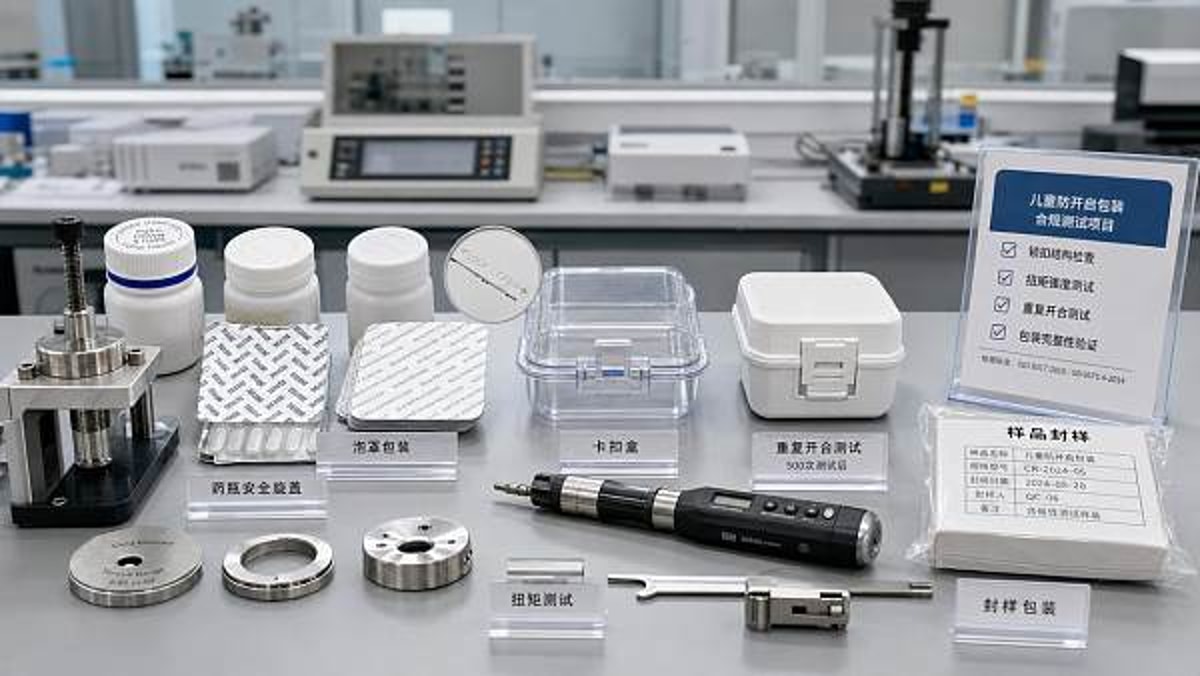
A package may pass initial bench checks but fail formal testing because the locking feature does not engage consistently. This is common in snap-fit lids, squeeze-and-turn closures, slide boxes, and push-tab cartons. Small variations in tooling wear, resin shrinkage, hinge memory, or assembly force can create a lock that feels secure in one batch and loose in another. Children often discover weaknesses adults overlook, especially where a closure can be opened by twisting, peeling, or bending from an unintended angle.
2. Excessive Tolerance Variation
Dimensional inconsistency is one of the most underestimated causes of child resistant packaging failure. A closure system that depends on precise alignment may fail if neck finish dimensions, thread profiles, tab lengths, or wall thicknesses vary too much between cavities or production lots. In high-volume programs, even minor drift can lower removal torque or reduce latch retention enough to affect test outcomes. This is particularly risky when components come from multiple suppliers.
3. Poor Reclosure Performance
Some packages perform acceptably the first time but lose child resistance after opening and reclosing. This happens when users cannot easily tell whether the cap has been fully re-engaged, when liner compression changes after first use, or when locking tabs fatigue too quickly. In sectors such as medicine and household chemicals, repeated use is expected. If the protective function weakens after one or two cycles, compliance risk rises sharply.
4. Material Selection Problems
Material substitutions can alter package behavior in ways that are not immediately visible. Recycled resin content, lower-density polymers, thinner paperboard, and alternative barrier films may support sustainability goals but can reduce rigidity or change flex patterns. In child resistant packaging, these changes affect burst resistance, lock engagement, tear propagation, and tactile feedback. A design validated in one material family should never be assumed equivalent after a material change without re-evaluation.
5. User Interface Confusion
A package can fail not because it is too easy for children, but because adults cannot operate it correctly. Child resistant packaging must balance child deterrence with senior-friendly access. If instructions are unclear, symbols are too small, or the opening sequence is counterintuitive, adult-use testing may suffer. This can lead to redesigns even when the lock itself is strong. Human factors should therefore be considered as part of technical validation.
6. Distribution and Environmental Stress
Transport vibration, compression, humidity, temperature swings, and product contact can all weaken child resistant packaging before it reaches end users. Caps may back off, adhesive bonds may soften, paperboard may delaminate, and molded parts may warp. Testing only pristine lab samples creates a false sense of security. For global supply chains, simulated transit and environmental conditioning should be integrated into the qualification plan.
How to Prevent These Failures Before Market Release
Prevention starts with treating child resistant packaging as a controlled system that spans design, sourcing, validation, and production. The most effective programs combine engineering review with manufacturing discipline.
Build Design Controls Around Critical-to-Function Features
Identify the exact features that create child resistance: tab geometry, thread lead, squeeze panel deflection, blister push-through force, hinge recovery, and closure torque window. These should be defined as critical-to-quality or critical-to-function characteristics with measurable limits. Tool qualification, first-article inspection, and cavity comparison should focus on these points rather than only cosmetic acceptance.
Control Supplier and Component Variation
For many failures, the root cause is not the concept but inconsistent execution. Quality managers should require material certifications, dimensional capability data, and change notification protocols from component suppliers. If the child resistant packaging system includes bottle, cap, liner, label, induction seal, carton, and insert, then all interacting parts need compatibility review. Multi-supplier programs should include interoperability testing, not just separate component approvals.
Validate Under Realistic Use and Abuse Conditions
Formal testing is essential, but development testing should go further. Evaluate the package after drop events, temperature cycling, storage aging, shipping simulation, and multiple open-close cycles. Include filled product whenever possible, since product weight, headspace, and chemical compatibility may change performance. This approach helps reveal whether child resistant packaging remains effective after the kinds of stress it will face in commerce.
Improve Work Instructions and Line Controls
Even a validated design can fail in production if assembly settings drift. Torque application, sealing temperature, insertion depth, snap-fit force, and orientation checks should be standardized on the line. Operators need clear acceptance examples for properly engaged closures. In-line testing and layered process audits can detect weak assembly before nonconforming units leave the plant.
A Practical Evaluation Framework for Quality and Safety Teams
To manage child resistant packaging more effectively, teams can evaluate risk in a structured way across development and commercialization stages.
What Deserves Extra Attention in Cross-Border Supply Chains
For companies sourcing internationally, child resistant packaging should be reviewed not only for technical performance but also for documentation quality. Test reports, specification control, mold maintenance records, resin traceability, and revision history all matter when products move between markets. Safety managers should confirm that packaging claims align with the destination country’s requirements and that any design transfer to a new plant or converter triggers requalification.
This is where intelligence-driven sourcing adds value. A supplier may offer an attractive format, but unless it can demonstrate repeatable child resistant packaging performance under controlled production conditions, the commercial benefit is weak. Strong suppliers support validation with data, communicate process changes early, and understand the compliance implications of even minor design updates.
Frequently Asked Questions
Does passing one test mean the package is fully safe?
No. Child resistant packaging can pass a formal test and still fail in market conditions if production variation, shipping stress, or reclosure problems are not controlled. Ongoing verification is necessary.
Can sustainable materials be used in child resistant packaging?
Yes, but sustainability changes must be validated carefully. Recycled or downgauged materials may alter stiffness, lock behavior, and durability, so they should be tested as part of a full performance review.
What is the most common internal mistake companies make?
A common mistake is treating child resistant packaging as a design purchase rather than a controlled quality system. Without robust line controls, supplier management, and real-use testing, even a good design can fail.
Conclusion and Next Steps
Child resistant packaging is only effective when design intent, material selection, manufacturing consistency, and compliance testing all work together. The most common failures are rarely random. They usually trace back to preventable issues such as weak locking features, excessive tolerance variation, poor reclosure behavior, or insufficient stress testing. For quality control and safety managers, the priority is to shift detection earlier by combining technical specifications, supplier oversight, and realistic validation methods.
Organizations that want fewer recalls, smoother regulatory review, and stronger buyer confidence should evaluate child resistant packaging as part of a broader supply chain quality strategy. With verified technical insight and disciplined execution, companies can reduce risk before products enter distribution and build a more reliable path to compliant global growth.
Recommended News
 Eco PackagingBiodegradable Straws Wholesale: What to Verify Before Switching SuppliersBiodegradable straws wholesale: verify certifications, drink performance, packaging, and export reliability before switching suppliers to cut risk, protect compliance, and improve sourcing results.Packaging Supply ExpertMay 04, 2026
 Policy & RegulationsChild Resistant Packaging: Common Testing Failures and How to Prevent ThemChild resistant packaging failures often stem from weak locks, tolerance drift, or poor reclosure. Learn how to prevent test issues, reduce recall risk, and improve compliance readiness.May 04, 2026
 Policy & RegulationsThermal Paper Receipts: BPA Rules and Compliance Questions in 2026Thermal paper receipts face tougher BPA scrutiny in 2026. Learn the key compliance questions, supplier checks, and risk-reduction steps buyers and safety teams should act on now.May 04, 2026
 Office FurnitureWholesale A4 Copy Paper: GSM, Brightness, and Jam Rate ExplainedWholesale A4 copy paper buying made simple: learn how GSM, brightness, and jam rate affect print quality, machine uptime, and sourcing costs across offices, schools, and print shops.Interior Sourcing LeadMay 04, 2026