Industry News
Curation by industry experts
Hot Articles
Popular Tags
Thermal Paper Receipts: BPA Rules and Compliance Questions in 2026
As 2026 approaches, thermal paper receipts are under renewed scrutiny as BPA rules tighten and buyer requirements become more rigorous. For quality control and safety managers, compliance is no longer just a labeling issue—it affects supplier audits, material selection, regulatory risk, and customer trust. This article outlines the key compliance questions businesses should ask now to stay ahead of changing standards.
Why 2026 Feels Different for Thermal Paper Receipts
The conversation around thermal paper receipts has shifted from a narrow chemical concern to a broader market access and risk-management issue. In previous years, many businesses treated BPA in receipt paper as a technical compliance point to be handled by converters or paper suppliers. That approach is becoming less reliable. In 2026, procurement teams, retailers, packaging buyers, and safety leaders are all facing stronger expectations around restricted substances, worker exposure, traceability, and documented proof of conformity.
For quality control and safety managers, the key change is not only that BPA rules are evolving, but that the standard of evidence is rising. Buyers increasingly want more than a declaration saying thermal paper receipts are “BPA-free.” They want to know what developer chemistry is being used instead, whether BPS or other phenolic substitutes are present, what test methods support the claim, and whether the supply chain can maintain consistency across production lots.
This matters across the broader light manufacturing ecosystem as well. Thermal paper receipts sit at the intersection of packaging, printing, retail operations, and chemical compliance. That means a change in one area—regulatory interpretation, retailer policy, NGO pressure, or customer sustainability goals—can quickly affect sourcing decisions and audit criteria in another.
The Main Trend Signals Buyers and Compliance Teams Are Seeing
Several market signals explain why thermal paper receipts are drawing renewed attention. First, buyers are no longer satisfied with substance-specific claims that focus only on BPA. Second, occupational safety considerations are being linked more directly to routine handling of receipt paper in retail, logistics, hospitality, and service environments. Third, enterprise customers are trying to simplify global compliance by adopting more restrictive internal specifications than local law may strictly require.
Another trend is the growth of “future-proof” purchasing. Instead of changing paper grades every time a new substance is questioned, many organizations now prefer thermal paper receipts designed around broader restricted-substance screening and more transparent formulation management. This reduces the risk of requalification costs, customer complaints, and sudden supplier replacement.
What Is Driving the Shift Beyond BPA Alone
The pressure on thermal paper receipts is coming from multiple directions at once. Regulatory developments remain a core driver, but they are not the only one. Corporate ESG commitments, retailer brand protection, cross-border product stewardship, and downstream customer requirements are all accelerating reformulation and documentation demands.
There is also a practical reason behind this shift. When one restricted substance is phased out, the replacement is often examined next. That is why many compliance teams are asking a more strategic question: not just whether a receipt paper grade is legal today, but whether it is likely to remain commercially acceptable across the next contract cycle. In 2026, thermal paper receipts are increasingly evaluated through this forward-looking lens.
At the same time, digitization has changed expectations. Because e-receipts are expanding in some sectors, paper receipts that remain in use are under greater scrutiny. Businesses keeping printed receipts need a stronger justification for material choices, especially when safer or lower-risk options may be available.
Key drivers behind the compliance shift
- Broader restricted-substance policies from multinational buyers
- Growing focus on substitution risk, including BPS and similar chemistries
- Higher audit expectations for document control and supplier traceability
- Increased alignment between product safety, worker safety, and sustainability teams
- Pressure to reduce reformulation disruptions and avoid repeated qualification cycles
How the Impact Spreads Across Operations
The effects of these changes do not stop at raw material approval. Thermal paper receipts now influence supplier onboarding, incoming inspection criteria, documentation retention, customer communication, and complaint handling. For organizations with multiple sales regions, the challenge becomes even more complex because legal requirements, buyer standards, and enforcement intensity may differ by market.
Quality control teams are often the first to feel the pressure when claims and production reality do not match. A paper mill may certify one chemistry, but slitting, coating, converting, or distribution changes can create documentation gaps. Safety managers face a different but related issue: they must assess whether front-line employees who handle large volumes of receipts need revised controls, training, or substitution recommendations.
The Compliance Questions That Matter Most in 2026
For thermal paper receipts, the most important questions are becoming more detailed and more operational. Quality and safety managers should not wait for a customer escalation to ask them. They should become part of supplier qualification, annual review, and change-control routines.
1. Is the paper only BPA-free, or does it also avoid other high-risk developers?
A BPA-free claim can be technically accurate but commercially incomplete. Buyers increasingly ask whether thermal paper receipts contain BPS or related substances that may trigger future concern. The stronger question is whether the chemistry profile aligns with both current law and foreseeable buyer scrutiny.
2. What evidence supports the claim?
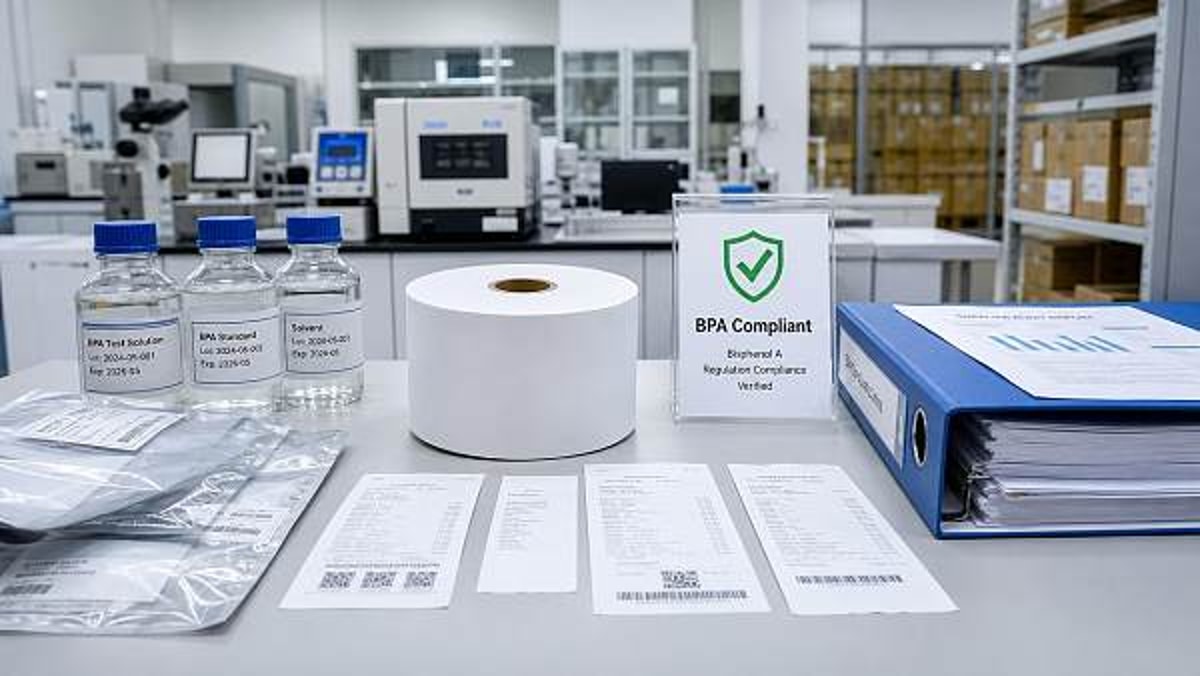
Declarations should be backed by recent analytical reports, specification sheets, and a clear statement of test scope. If documentation only covers the base paper but not the final converted roll, a gap may remain. Traceable evidence is becoming essential for thermal paper receipts in regulated or audited supply chains.
3. How is change control managed?
A compliant grade today can become a problem if the supplier changes mill source, coating chemistry, or subcontracted conversion without formal notification. Change management is often the hidden weakness in thermal paper receipts compliance programs.
4. Are regional requirements mapped against customer requirements?
Legal compliance does not always equal market acceptance. A grade that can be sold in one region may still fail a global retailer’s internal chemical policy. Companies should compare destination-market rules, customer restricted-substance lists, and their own internal standards.
5. What is the operational fallback plan?
If a nonconformity is discovered, can the business switch quickly to an approved alternative? The best programs for thermal paper receipts include dual-source planning, preapproved substitutions, and customer communication templates.
What Better Prepared Companies Are Doing Now
The most resilient companies are not waiting for a universal global rule to force action. They are using 2025 and early 2026 to tighten specifications, update supplier questionnaires, and review whether their receipt paper portfolio is built for continuity. This is especially important for businesses serving retail chains, food service groups, transport networks, banks, hospitals, and large service operators.
Many are also treating thermal paper receipts as part of a wider chemical governance program rather than a one-off exception. That means integrating receipt paper into restricted-substance review calendars, supplier scorecards, and corrective action systems. When a material category is embedded into routine governance, compliance becomes more stable and less reactive.
Signals Worth Monitoring Through 2026
Not every development will require immediate reformulation, but several signals deserve close tracking. Watch for changes in major retailer chemical policies, updates to occupational health guidance related to handling-sensitive materials, and shifts in preferred developer systems from leading mills. Also monitor how large buyers phrase their tender requirements. Their wording often reveals future market direction before formal regulation catches up.
Another useful signal is the type of questions customers ask. If inquiries move from “Are your thermal paper receipts BPA-free?” to “What is the full developer chemistry and how is it verified?” that indicates a more mature compliance expectation. When that happens across multiple customers, it is usually a sign that the market standard is changing.
A Practical Decision Framework for Quality and Safety Managers
For decision-makers, the goal is not to predict every future restriction. It is to create a system that can absorb change without operational disruption. In practice, that means ranking thermal paper receipts by customer sensitivity, application volume, regional exposure, and supplier transparency. High-risk categories should be reviewed first, especially where worker handling is frequent or customer specifications are strict.
An effective framework usually includes four steps: identify where receipt paper is used, verify current chemistry claims, compare them against customer and market expectations, and establish fallback options. This approach turns compliance from a reactive paperwork exercise into a structured risk-management process.
Conclusion: The Right Questions Now Reduce Risk Later
The most important trend in thermal paper receipts for 2026 is not simply tighter BPA scrutiny. It is the broader shift toward deeper chemical transparency, stronger proof requirements, and more cautious buyer behavior. For quality control and safety managers, the real challenge is to determine whether current materials can withstand not just legal review, but customer review, audit review, and future substitution review.
If your business wants to judge how these changes may affect operations, start by confirming five points: what chemistry is actually in your thermal paper receipts, what evidence supports the claim, how supplier changes are controlled, whether buyer standards are stricter than law, and what approved alternatives exist. Companies that can answer those questions clearly will be in a far stronger position as 2026 compliance expectations continue to evolve.
Recommended News
 Eco PackagingBiodegradable Straws Wholesale: What to Verify Before Switching SuppliersBiodegradable straws wholesale: verify certifications, drink performance, packaging, and export reliability before switching suppliers to cut risk, protect compliance, and improve sourcing results.Packaging Supply ExpertMay 04, 2026
 Policy & RegulationsChild Resistant Packaging: Common Testing Failures and How to Prevent ThemChild resistant packaging failures often stem from weak locks, tolerance drift, or poor reclosure. Learn how to prevent test issues, reduce recall risk, and improve compliance readiness.May 04, 2026
 Policy & RegulationsThermal Paper Receipts: BPA Rules and Compliance Questions in 2026Thermal paper receipts face tougher BPA scrutiny in 2026. Learn the key compliance questions, supplier checks, and risk-reduction steps buyers and safety teams should act on now.May 04, 2026
 Office FurnitureWholesale A4 Copy Paper: GSM, Brightness, and Jam Rate ExplainedWholesale A4 copy paper buying made simple: learn how GSM, brightness, and jam rate affect print quality, machine uptime, and sourcing costs across offices, schools, and print shops.Interior Sourcing LeadMay 04, 2026