Industry News
Curation by industry experts
Hot Articles
Popular Tags
Canton Fair Phase II: Eco-Backdrop Orders Rise to 68%
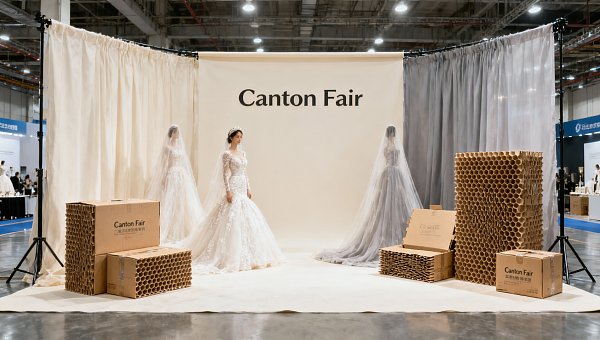
On April 27, 2026, the China Import and Export Fair (Canton Fair) released its Phase II (April 23–27) transaction summary for wedding photography products. Environmental backdrop boards—specifically those using honeycomb paper core with recycled PET lamination—accounted for 68% of all backdrop orders, up 217% year-on-year. This shift signals growing procurement influence from sustainability requirements in key export markets, particularly Germany, Canada, and Australia. Suppliers and manufacturers in visual production, exhibition materials, and sustainable packaging sectors should monitor this trend closely.
Event Overview
On April 27, 2026, the Canton Fair Organizing Committee published a transaction brief for Phase II (April 23–27), covering the wedding photography category. It reported that orders for eco-friendly backdrop boards—defined as products combining honeycomb paper core and recycled PET film—grew by 217% year-on-year and represented 68% of total backdrop-related orders. Purchasers were predominantly from Germany (32%), Canada (21%), and Australia (18%). A majority requested FSC certification and formal declarations of recycled material content. No further technical specifications, regional breakdowns beyond the three countries, or supplier-level data were disclosed in the official release.
Which Subsectors Are Affected
Direct Export Trading Enterprises
These firms face revised buyer expectations: sustainability documentation is no longer optional but a prerequisite for market access in target regions. The requirement for FSC certification and verified recycled content statements directly affects quotation preparation, compliance verification timelines, and pre-shipment documentation workflows.
Raw Material Sourcing Enterprises
Suppliers of paperboard, honeycomb cores, and PET films are experiencing increased demand for traceable, certified inputs. The 217% order growth reflects not just volume but specificity—buyers now prioritize verifiable recycled PET grades and FSC-certified paper sources over generic alternatives.
Manufacturing & Lamination Facilities
Producers of finished backdrops must adapt production lines to accommodate dual-material lamination (honeycomb paper + recycled PET) while maintaining dimensional stability and surface finish. Process validation, material compatibility testing, and batch-level traceability become operationally critical—not merely quality control steps.
Distribution & Logistics Service Providers
Third-party logistics and fulfillment partners handling these goods may need updated documentation handling protocols. Certificates (e.g., FSC Chain of Custody), material declarations, and origin labeling now form part of standard shipping packages—not supplementary add-ons.
What Relevant Enterprises or Practitioners Should Focus On Now
Monitor official sustainability procurement guidance from EU, Canadian, and Australian trade agencies
Analysis shows that current buyer requests align with emerging regulatory frameworks—including the EU’s Ecodesign for Sustainable Products Regulation (ESPR) and Australia’s proposed Green Procurement Principles. While not yet mandatory for all backdrop imports, early adoption signals de facto market entry conditions.
Verify traceability capacity for recycled PET and FSC-certified paper inputs
Observably, buyers are shifting from self-declared sustainability claims to auditable supply chain evidence. Firms should assess whether their current suppliers can provide batch-specific certificates and third-party test reports—not just general certifications.
Prepare dual documentation sets for each order: product specs + sustainability disclosures
From an industry perspective, separating technical datasheets from environmental compliance files increases administrative overhead—but omitting either risks order rejection. Standardizing bilingual (English + buyer’s local language) declaration templates is now operationally advisable.
Test production feasibility of honeycomb paper + recycled PET lamination at pilot scale
Current more suitable understanding is that the 68% share reflects demand pull—not full supply readiness. Early adopters report adhesion consistency and humidity sensitivity challenges during lamination. Small-batch trials ahead of peak season (Q3–Q4) help identify process adjustments before scaling.
Editorial Perspective / Industry Observation
This data point is best understood as a structural signal—not yet a fully consolidated market outcome. Analysis shows it confirms an ongoing recalibration of procurement criteria in visual display and event staging sectors across high-income economies. It does not indicate universal adoption, nor does it reflect domestic Chinese market shifts. Rather, it marks a threshold where sustainability compliance transitions from competitive differentiation to baseline eligibility for specific export channels. Continued monitoring is warranted because buyer mandates are tightening incrementally—not abruptly—and regional divergence remains significant (e.g., U.S. and Southeast Asian buyers were not cited in the release).
Conclusion
This Canton Fair update reflects a measurable tightening of sustainability-linked procurement standards in select export markets—not a broad industry transformation. It underscores that for exporters targeting Germany, Canada, and Australia, material traceability and certification readiness are now operational prerequisites, not strategic options. The data is most usefully interpreted as an indicator of evolving market gateways—not as evidence of wholesale sectoral change.
Information Source
Main source: Canton Fair Organizing Committee, Phase II Wedding Photography Category Transaction Brief, issued April 27, 2026. Note: Market share figures, growth rates, and buyer country distribution are publicly confirmed. Certification requirements and material composition definitions are based solely on stated buyer requests in the official brief. Ongoing developments in national procurement policies remain under observation.
Recommended News
 Eco PackagingCanton Fair Wedding Photo Props Zone Sees 37% YoY GrowthWedding photo props at Canton Fair surge 37% YoY—biodegradable packaging & magnetic modular backdrops lead global demand. Discover key trends now!Packaging Supply ExpertApr 24, 2026
 Export UpdatesChina Customs Launches Beta 'Wedding Photo Props Export Compliance Self-Check Platform'Wedding photo props exporters: Use China Customs’ new beta Self-Check Platform for real-time export compliance guidance on HS codes like 9405.40, 4202.92 & 6307.90 — avoid delays in US, EU, ASEAN & Middle East markets.Apr 24, 2026
 Commercial LEDEN 14982:2026 Effective: LED Softlight Devices for Wedding Photography Must Pass Enhanced EMC Immunity TestsLED softlight devices for wedding photography must now pass enhanced EMC immunity tests per EN 14982:2026 — ensure CE compliance before EU market entry!Commercial Tech EditorApr 24, 2026
 Carton & PlasticsUS CPSC Recalls 7 Chinese Wedding Backdrop Makers for FormaldehydeUS CPSC recalls 7 Chinese wedding backdrop makers for formaldehyde—critical alert for婚纱摄影 exporters, MDF suppliers & US importers. Act now to avoid detention & liability.Packaging Supply ExpertApr 24, 2026