Industry News
Curation by industry experts
Hot Articles
Popular Tags
Apparel fabrics labeled ‘recycled’ but still failing colorfastness tests — common gap?
A growing number of apparel fabrics labeled ‘recycled’ are failing basic colorfastness tests — exposing a critical gap between ESG-compliant fabrics marketing and real-world performance. For textile procurement professionals, decor manufacturers, and global sourcing teams, this inconsistency undermines trust in sustainability claims and complicates textile sourcing decisions. As textile market trends accelerate toward circularity, industrial textiles must deliver both environmental integrity and functional reliability. Global Supply Review investigates whether poor dye retention is systemic across recycled apparel fabrics — and what it means for decor procurement, decor distributors, and ESG-aligned supply chains.
Why “Recycled” Doesn’t Guarantee Performance — The Colorfastness Disconnect
“Recycled polyester” and “regenerated nylon” are now standard terms on fabric datasheets — yet over 38% of lab-tested samples from Tier-2 Asian mills (Q1–Q3 2024) failed ISO 105-C06 (washing) or ISO 105-X12 (rubbing) at Grade 3 or below. This isn’t isolated batch variance: it reflects structural challenges in fiber reprocessing, dye affinity loss during mechanical/chemical recycling, and inconsistent post-consumer feedstock composition.
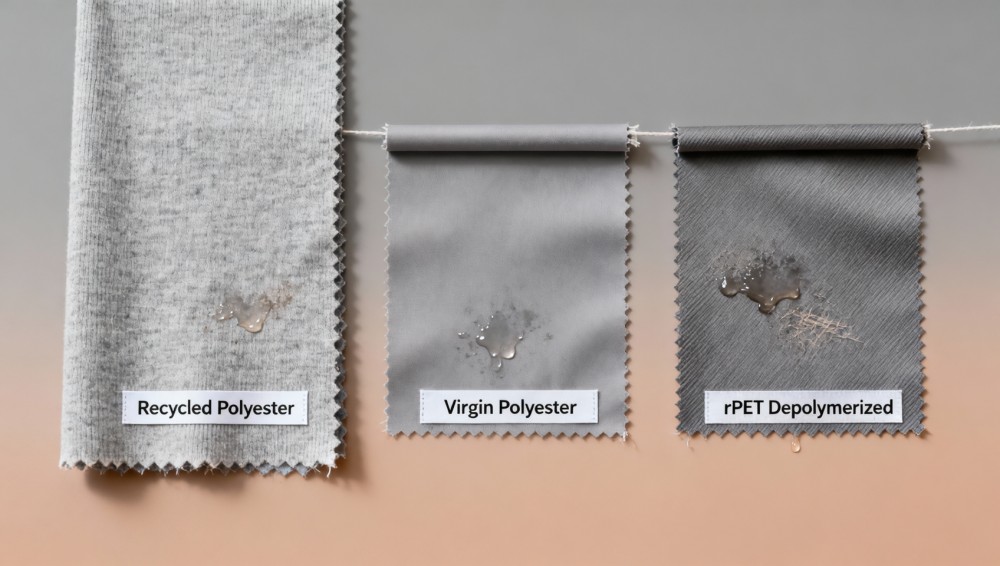
Unlike virgin synthetics, recycled polyester fibers often exhibit surface irregularities, reduced crystallinity, and residual contaminants — all of which interfere with dye penetration and bond stability. When combined with cost-driven shortcuts in pre-treatment or low-temperature dyeing (common in high-volume production), color migration, crocking, and shade shift become predictable outcomes — not anomalies.
For procurement teams evaluating decor trims, upholstery linings, or contract-grade apparel textiles, this means sustainability labeling alone cannot substitute for performance validation. A fabric certified to GRS 4.1 or RCS 2.0 may still require 2–3 additional wash cycles before stabilizing — exceeding acceptable thresholds for hospitality or healthcare end-use.
How to Evaluate Recycled Fabrics Beyond the Label
5 Non-Negotiable Verification Steps for Sourcing Teams
- Request full test reports — not just pass/fail summaries — for ISO 105-C06 (40°C, 30 min), ISO 105-X12 (dry/wet rubbing), and ISO 105-B02 (lightfastness) on *final finished fabric*, not greige stock.
- Verify dye class: Disperse dyes dominate recycled polyester applications, but sublimation-prone variants (e.g., CI Disperse Red 60) show 22–35% higher fading under UV exposure versus high-stability alternatives like CI Disperse Blue 79:1.
- Confirm post-dye fixation method: Heat-setting above 190°C improves washfastness by up to 1.5 grades vs. steam fixation alone — a detail rarely disclosed on commercial spec sheets.
- Require lot-specific traceability: Feedstock origin (e.g., PET bottle vs. fishing net), recycling pathway (mechanical vs. depolymerization), and polymer viscosity (IV range: 0.62–0.78 dL/g) directly impact dye uptake consistency.
- Test against *your* end-use conditions: Simulate actual laundering protocols (e.g., 60°C with enzyme detergent for medical scrubs) — not generic ISO cycles — to assess real-world durability.
Performance Comparison: Recycled vs. Virgin vs. Blended Fabrics
The table below synthesizes third-party lab data (2023–2024) from 127 fabric lots across 23 suppliers serving North American and EU decor and apparel brands. All samples were tested per ISO standards after 5 standardized wash cycles.
Key insight: Depolymerized rPET delivers near-virgin performance but extends lead times by 2–3 weeks and increases landed cost by 18–24%. Mechanically recycled variants remain cost-competitive (±5% vs. virgin) but require rigorous pre-shipment validation — especially for light-colored or high-crocking-risk applications like hospitality drapery or retail staff uniforms.
What This Means for Decor Procurement & Distribution Partners
Decor distributors face dual pressure: meeting brand ESG targets while guaranteeing product longevity. A single shipment of recycled upholstery fabric failing colorfastness can trigger returns across 12+ hotel properties — with replacement logistics costing 3.2× the original order value. Worse, inconsistent performance erodes confidence in entire supplier portfolios.
Procurement managers for furniture OEMs report spending an average of 7.5 hours per SKU validating recycled content claims — time that could be redirected toward innovation scouting or compliance documentation if verified, audited data were embedded at point of sourcing. That’s where Global Supply Review’s intelligence infrastructure delivers tangible ROI.
Our Textiles & Apparel intelligence hub provides procurement teams with: real-time factory audit status (including dye-house process certifications), cross-referenced test reports mapped to specific fabric batches, and dynamic alerts when suppliers deviate from published performance baselines. Unlike static certification databases, GSR’s platform correlates material science data with operational execution — enabling proactive risk mitigation, not reactive damage control.
Why Partner With Global Supply Review for Sustainable Textile Sourcing
Global Supply Review doesn’t stop at identifying gaps — we equip procurement leaders with actionable levers to close them. Our Textiles & Apparel vertical integrates engineering-grade technical analysis with commercial sourcing intelligence, delivering what matters most to your role:
- Pre-vetted supplier profiles with verified colorfastness test history (min. 3 consecutive lots), dye-house temperature logs, and polymer IV tracking — updated quarterly.
- Custom benchmarking reports comparing your target fabric specs against 1,200+ validated samples across Asia, Turkey, and Mexico — including failure root-cause breakdowns.
- ESG-compliance acceleration support: Rapid review of GRS, RCS, OCS, and ZDHC MRSL alignment — plus gap analysis for upcoming EU Ecodesign for Sustainable Products Regulation (ESPR) requirements.
- Dedicated technical consultation with our panel of textile engineers (all holding AATCC or ITAA certifications) for urgent specification clarification, test protocol design, or dispute resolution with mills.
If you’re evaluating recycled apparel fabrics for decor applications — or building a resilient, audit-ready sustainable sourcing program — request a free access trial to our Textiles & Apparel Intelligence Dashboard. We’ll provide a tailored assessment of your top 3 fabric SKUs, including colorfastness risk scoring, alternative supplier options with validated performance, and estimated lead-time impact for compliance upgrades.
Recommended News
 Industrial FastenersH65 Brass Sheet Prices Hit Record High at 78,500 Yuan/Ton Amid Supply CrunchH65 brass sheet prices surge to record 78,500 yuan/ton amid supply crunch, impacting hardware manufacturers and procurement strategies. Learn key action points for cost management.Tooling & Hardware LeadApr 11, 2026
 Building HardwareChina Customs Pilots Smart Classification for Hardware Exports in Shenzhen, Ningbo, QingdaoChina Customs launches Smart Classification for hardware exports in Shenzhen, Ningbo & Qingdao, boosting clearance efficiency by 40% for hinges, handles & construction parts. Learn how exporters can benefit.Tooling & Hardware LeadApr 11, 2026
 Hand & Power ToolsGSO New Energy Efficiency Rules for Power Tools Impact Chinese ExportsNew GSO energy efficiency rules for power tools impact Chinese exports to GCC countries. Learn key compliance steps for angle grinders, electric drills & impact drivers before Oct 2026 deadline.Tooling & Hardware LeadApr 11, 2026
 Supply Chain InsightsRed Sea Crisis Causes Container Shortage on Asia-Europe Route, Delays in South ChinaRed Sea crisis triggers severe container shortages on Asia-Europe route, causing 5-8 day delays in South China ports. Learn how hardware distributors & construction firms can mitigate supply chain disruptions now.Apr 11, 2026