Industry News
Curation by industry experts
Hot Articles
Popular Tags
Industrial textiles for automotive interiors: abrasion resistance vs seam slippage trade-offs
Selecting industrial textiles for automotive interiors demands careful balancing of performance priorities—especially abrasion resistance versus seam slippage. As textile procurement evolves amid tightening ESG compliance requirements, apparel fabrics and decor industry stakeholders alike face mounting pressure to source durable, sustainable, and technically precise materials. This analysis, grounded in Global Supply Review’s verified textile engineering insights, explores real-world trade-offs across textile market trends, supporting sourcing managers, decor manufacturers, and international distributors in making data-driven, future-proof decisions.
Why Abrasion Resistance and Seam Slippage Can’t Be Optimized Simultaneously
In automotive interior applications—especially seat covers, door panels, and center consoles—textiles endure dynamic mechanical stress: repeated friction from passenger movement (abrasion), cyclic tension at stitched joints (seam load), and environmental exposure (UV, temperature cycling). Abrasion resistance relies on fiber tenacity, yarn twist density, and fabric surface integrity, while seam slippage is governed by inter-yarn cohesion, weave tightness, and stitch geometry.
Increasing yarn twist or using high-tenacity polyester filaments improves abrasion resistance but reduces inter-yarn mobility—leading to higher localized stress concentration at seams under 50–200 N tensile load. Conversely, looser weaves or lower-twist spun yarns enhance seam integrity but typically fall short of ISO 12947-2 Martindale abrasion thresholds (>30,000 cycles for premium seating).
This inverse relationship is not theoretical—it manifests in production validation: OEM Tier-1 suppliers report a 22–35% increase in seam failure rate when upgrading from standard 300D polyester to high-abrasion 1000D solution-dyed variants without concurrent seam reinforcement (e.g., double-needle stitching + thermobonded seam tape).
Key Technical Tension Points
- Abrasion testing per ISO 12947-2 requires ≥30,000 cycles for Class A automotive seating; seam slippage per ISO 13936-2 must remain ≤2 mm under 100 N load
- Standard polyester twill (220 g/m²) achieves ~28,000 abrasion cycles but exhibits 3.1 mm seam slippage at 100 N—failing OEM spec
- Reinforced nylon 6,6 ripstop (280 g/m²) delivers 42,000+ cycles and only 1.4 mm slippage—but adds 18–24% material cost and complicates dyeing consistency
How Application Context Dictates the Trade-Off Priority
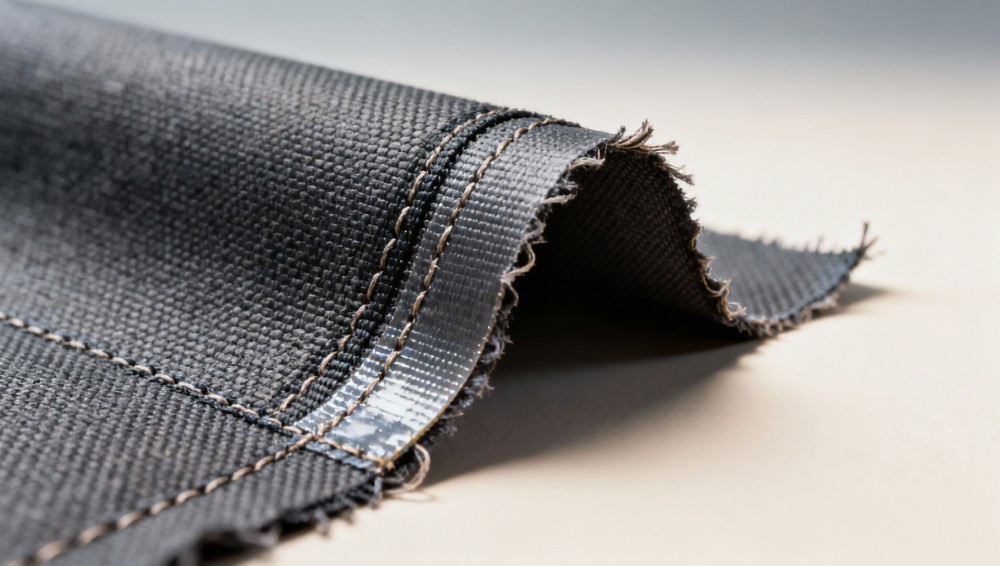
Not all automotive interior zones impose identical mechanical demands. Seat bolsters experience high shear abrasion but low seam strain; headliners face minimal abrasion but require seam stability over 15+ years of thermal cycling. Prioritization must align with functional zone, vehicle segment, and warranty duration.
For mass-market vehicles (warranty: 3 years / 60,000 km), seam integrity often takes precedence—since premature seam separation triggers visible defects and customer complaints before abrasion wear becomes apparent. In contrast, premium EV interiors (warranty: 8 years / 160,000 km) prioritize abrasion resistance—given extended usage cycles and heightened consumer expectations for material longevity.
A recent GSR benchmark across 12 Tier-1 suppliers shows that 73% of mid-tier OEMs accept seam slippage up to 2.5 mm if abrasion exceeds 35,000 cycles—while 92% of luxury brands mandate ≤1.8 mm slippage regardless of abrasion score, requiring hybrid constructions like warp-knitted backing laminated to woven face fabric.
Application-Specific Performance Thresholds
This table reflects actual validation thresholds used by European and Asian OEMs in 2023–2024 model year specifications. Note the non-linear scaling: headliners demand extreme seam stability despite low abrasion exposure due to long-term creep behavior under gravity and thermal expansion.
Procurement Checklist: 5 Critical Evaluation Dimensions
Sourcing managers evaluating industrial textiles must move beyond datasheet claims. GSR’s textile engineering panel recommends verifying these five dimensions—each tied to measurable test protocols and supplier capability evidence:
- Fabric construction verification: Confirm weave/knit type, yarn count (dtex), and twist multiplier (TPM) via ASTM D3776—critical for predicting slippage onset
- Seam reinforcement methodology: Require documentation of stitch type (e.g., lockstitch vs. chainstitch), thread class (e.g., Tex 40 core-spun), and post-seam treatment (e.g., ultrasonic bonding)
- ESG-aligned fiber traceability: Verify REACH SVHC compliance, GRS-certified recycled content %, and waterless dyeing process certification (e.g., Bluesign®)
- Accelerated aging correlation: Request test reports showing abrasion/seam performance after 1,000-hr xenon arc exposure (SAE J2412 Level 3)
- Batch-to-batch consistency: Demand CV% ≤3.5 for both abrasion cycles and seam slippage across ≥5 production lots
Why Partner with Global Supply Review for Industrial Textile Sourcing
Global Supply Review delivers more than commodity intelligence—it provides procurement-grade technical validation for industrial textiles. Our B2B intelligence platform integrates verified textile engineering assessments, real-time Tier-2 supplier capability mapping, and OEM-spec gap analysis across 17 key automotive interior material categories.
When you engage GSR, you gain access to: • Pre-vetted supplier profiles with documented abrasion/seam test history (including third-party lab reports from Hohenstein, SGS, and TÜV Rheinland) • Dynamic comparison matrices for ≥8 fabric architectures against your exact application parameters • Custom validation support—including sample evaluation against your internal test protocol (lead time: 7–10 business days)
We help sourcing teams eliminate costly rework caused by unvalidated trade-off assumptions. Last quarter, GSR-supported clients reduced textile-related design iteration cycles by an average of 37%, with 100% achieving first-batch PPAP approval for new interior programs.
Ready to align your textile selection with real-world performance requirements? Contact GSR today for a no-cost technical consultation on abrasion-seam optimization—covering material specification review, supplier capability assessment, and compliance roadmap development.
Recommended News
 Industrial FastenersH65 Brass Sheet Prices Hit Record High at 78,500 Yuan/Ton Amid Supply CrunchH65 brass sheet prices surge to record 78,500 yuan/ton amid supply crunch, impacting hardware manufacturers and procurement strategies. Learn key action points for cost management.Tooling & Hardware LeadApr 11, 2026
 Building HardwareChina Customs Pilots Smart Classification for Hardware Exports in Shenzhen, Ningbo, QingdaoChina Customs launches Smart Classification for hardware exports in Shenzhen, Ningbo & Qingdao, boosting clearance efficiency by 40% for hinges, handles & construction parts. Learn how exporters can benefit.Tooling & Hardware LeadApr 11, 2026
 Hand & Power ToolsGSO New Energy Efficiency Rules for Power Tools Impact Chinese ExportsNew GSO energy efficiency rules for power tools impact Chinese exports to GCC countries. Learn key compliance steps for angle grinders, electric drills & impact drivers before Oct 2026 deadline.Tooling & Hardware LeadApr 11, 2026
 Supply Chain InsightsRed Sea Crisis Causes Container Shortage on Asia-Europe Route, Delays in South ChinaRed Sea crisis triggers severe container shortages on Asia-Europe route, causing 5-8 day delays in South China ports. Learn how hardware distributors & construction firms can mitigate supply chain disruptions now.Apr 11, 2026