Industry News
Curation by industry experts
Hot Articles
Popular Tags
Wholesale Raincoats: What to Review Before Expanding a Seasonal Product Line
Expanding into wholesale raincoats can unlock strong seasonal demand, but smart distributors, agents, and resellers need to review more than price alone. From material performance and sizing consistency to supplier reliability, compliance, and market positioning, the right decisions can reduce risk and improve margins. This guide outlines the key factors to assess before adding wholesale raincoats to a broader seasonal product strategy.
Why a checklist approach matters before adding wholesale raincoats
For seasonal products, mistakes are usually expensive because the selling window is short, replenishment timing is tight, and unsold stock can linger until the next weather cycle. That is why distributors evaluating wholesale raincoats should use a checklist instead of relying on one supplier quote or one attractive sample. A structured review helps compare factories more objectively, identify quality risks earlier, and decide whether a rainwear line fits existing customers, channels, and margin targets.
In practical terms, the best decisions come from reviewing five areas together: product performance, supplier capability, compliance, commercial terms, and market fit. If one area is weak, even a low purchase price may turn into returns, delayed shipments, or discounting pressure. For agents and resellers, this is especially important because reputation depends not only on product availability but also on consistency across repeat orders.
First-pass review: the key questions to confirm early
Before requesting final quotations, use the following first-pass screening questions to narrow the supplier list for wholesale raincoats. These checks save time and reduce the risk of comparing offers that are not truly equivalent.
- What end market are the raincoats intended for: retail resale, promotional use, schoolwear, workwear, or emergency distribution?
- Which material category is being quoted: PVC, EVA, PU, polyester with coating, or reusable laminated fabric?
- Is the product positioned as disposable, budget reusable, or premium long-life rainwear?
- Can the supplier provide consistent sizing, color matching, and logo application across multiple batches?
- What are the minimum order quantity, lead time, peak-season capacity, and replenishment flexibility?
- Does the factory have documentation for chemical safety, restricted substances, packaging compliance, and social responsibility expectations?
- How are defects handled, and what is the agreed standard for inspection and claims?
If a supplier cannot answer these questions clearly, they may not be ready for stable wholesale partnerships. In B2B sourcing, clarity is often a better predictor of success than the lowest unit cost.
Core product checklist for wholesale raincoats
1. Material performance and weather suitability
The first technical review should focus on how the raincoat performs in actual use. Not all wholesale raincoats serve the same climate or customer expectation. Lightweight EVA may work well for promotional events and tourism, while coated polyester or PU may be better for commuters and professional users who expect stronger durability.
- Check waterproof performance, not just water resistance language in marketing sheets.
- Ask about seam construction: stitched only, heat sealed, or taped seams.
- Review thickness, fabric weight, and tear resistance for likely usage intensity.
- Confirm whether the material becomes stiff, sticky, or brittle under storage or temperature variation.
- Consider breathability if targeting commuters, riders, or outdoor workers.
2. Sizing consistency and fit standards
Sizing issues create avoidable returns and channel complaints. In wholesale raincoats, fit also affects layering, especially when users wear jackets or uniforms underneath. Request a full measurement chart, tolerance standards, and fit references by region. A “free size” claim may work in some low-cost channels, but it usually limits repeat business in structured distribution.
Important checkpoints include sleeve length, chest allowance, hood depth, and closure overlap. If the target market includes schools, municipalities, or industrial buyers, sizing range is often a deal-breaker.
3. Construction details that affect customer satisfaction
Small design details strongly influence perceived value. When reviewing wholesale raincoats, inspect the zipper or snap quality, hood drawstring strength, cuff finish, ventilation openings, pocket usability, and reinforcement at stress points. A raincoat can look acceptable in a catalog but fail quickly in active use if closures break or seams split.
For higher-volume distribution, create a standard inspection checklist for these details. This is particularly useful when sourcing from more than one factory.
4. Packaging and presentation requirements
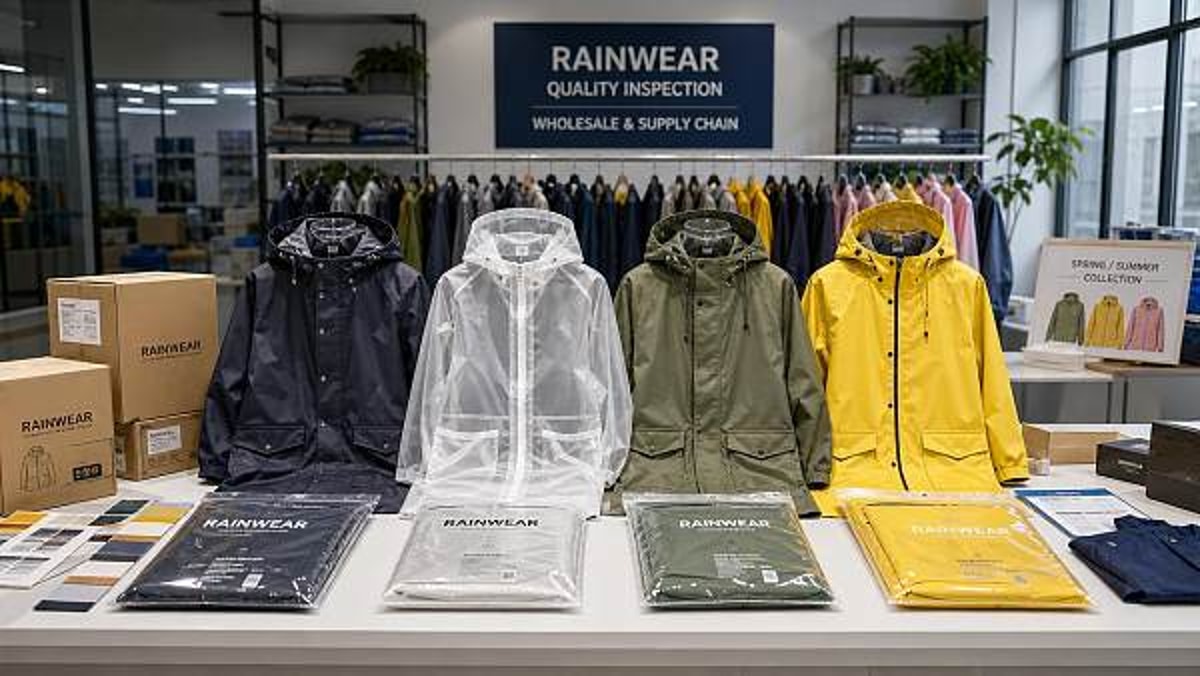
Packaging affects freight cost, retail readiness, and brand impression. Folded dimensions, polybag quality, barcode placement, carton strength, and master carton count all matter. For some distributors, compact packing density is essential; for others, shelf-ready individual presentation supports faster retail turnover. If the raincoat is part of a promotional or emergency kit, packaging compatibility should be checked early.
Supplier evaluation checklist beyond the product itself
A good raincoat sample does not automatically mean a dependable source. The supplier review for wholesale raincoats should include operational and commercial evidence.
For decision-makers managing cross-border sourcing, communication discipline is often underestimated. Suppliers that confirm specifications in writing, provide sample revision history, and clarify production milestones are usually easier to scale with.
Market-fit checks for distributors, agents, and resellers
Not every rainwear line suits every channel. Before committing to wholesale raincoats, match the product to the customer profile and sales rhythm.
For distributors serving retail chains
Focus on SKU clarity, reliable packaging, visual consistency, and broad size coverage. Retail buyers often prioritize sell-through rate, display efficiency, and return control. Color trends and branded presentation may matter as much as technical performance.
For agents serving institutional or project buyers
Uniformity, compliance records, and delivery scheduling are usually more important than fashion appeal. Schools, municipalities, transport operators, and relief programs may also need specific colors, reflective features, or packaging labels.
For resellers in e-commerce and mixed channels
Product images, clear feature claims, consumer-friendly size charts, and low return risk are critical. If wholesale raincoats are sold online, inaccurate descriptions around waterproofing or fit can quickly lead to rating problems and margin erosion.
Commonly overlooked risks when sourcing wholesale raincoats
- Seasonal timing is reviewed too late. A strong product loses value if production starts after weather demand begins.
- Samples are approved, but bulk tolerances are not defined. This creates disputes over acceptable variation.
- Packaging details are ignored until shipment booking, increasing carton waste or freight inefficiency.
- Chemical or labeling compliance is assumed rather than verified. This is risky for export markets.
- Only one factory is qualified. A single-source strategy may be vulnerable during peak season.
- Raincoats are added without checking overlap with existing umbrellas, ponchos, or outdoor accessories, causing internal channel conflict.
Practical execution plan before launch
A disciplined rollout can make wholesale raincoats a profitable add-on instead of a reactive seasonal gamble. The following sequence works well for most B2B buyers.
- Define the target segment and expected price band before requesting samples.
- Shortlist suppliers based on material type, compliance readiness, and lead-time fit.
- Approve samples only after confirming measurements, packaging, and branding details in writing.
- Run a landed-cost review, including freight, duty, repacking, and likely return costs.
- Place a pilot order first if entering a new channel or testing a new product tier.
- Set a reorder trigger tied to weather forecasts, account demand, and supplier capacity.
This process is especially relevant for companies expanding broader seasonal categories such as umbrellas, waterproof bags, outdoor accessories, school gear, or emergency supply kits. In those cases, wholesale raincoats should be evaluated not as isolated items but as part of a coordinated seasonal assortment strategy.
FAQ: quick answers buyers often need
How many styles of wholesale raincoats should a new distributor start with?
Usually two to four styles are enough: an entry-level option, a stronger reusable option, and possibly one channel-specific design such as children’s, workwear, or promotional rainwear. Too many SKUs can complicate inventory before demand patterns are proven.
Is low MOQ more important than low unit price?
For first-time category expansion, lower MOQ often creates better risk control. A slightly higher unit price may be acceptable if it reduces dead stock and allows faster market testing.
What documents should be requested from suppliers?
At minimum, request specification sheets, measurement charts, test reports where relevant, packaging details, inspection standards, and production lead-time commitments. For regulated destinations, confirm labeling and substance compliance early.
Final decision guide and next-step questions
Expanding into wholesale raincoats works best when the decision is based on a complete commercial and operational review, not just a favorable quote. The strongest opportunities usually come from products that align with a clear customer segment, offer dependable quality, and can be replenished on time during seasonal peaks.
Before moving forward, distributors, agents, and resellers should prioritize a final discussion around these points: target market positioning, material and seam standards, size range, packaging requirements, MOQ, lead time, compliance documents, inspection process, and claim handling. If those areas are clear, wholesale raincoats can become a practical extension of a seasonal product line with stronger margin control and lower sourcing risk.
Recommended News
 Home DecorBlackout Curtain Manufacturer Comparison: Lead Times, Coating Quality, and RiskBlackout curtain manufacturer comparison guide: evaluate lead times, coating quality, compliance, and sourcing risk to choose reliable suppliers and avoid costly delays.Interior Sourcing LeadMay 02, 2026
 Garment MfgWholesale Raincoats: What to Review Before Expanding a Seasonal Product LineWholesale raincoats buyers: review materials, sizing, compliance, supplier reliability, and margins before expanding your seasonal product line. Reduce risk and choose smarter.Textile Industry AnalystMay 02, 2026
 Eco PackagingCustom Garment Bags: Materials and Print Choices That Shape Brand PerceptionCustom garment bags shape brand perception through material and print choices. Discover how to balance quality, sustainability, cost, and sourcing for stronger B2B packaging decisions.Packaging Supply ExpertMay 02, 2026
 Garment MfgIndustrial Sewing Needles: Small Specification Changes That Cause Big DowntimeIndustrial sewing needles can cause major downtime when point, size, coating, or length is mismatched. Learn how to spot hidden issues faster and reduce costly line stops.Textile Industry AnalystMay 02, 2026