Industry News
Curation by industry experts
Hot Articles
Popular Tags
Shanghai Wedding Expo Adds ESG Compliance Hub
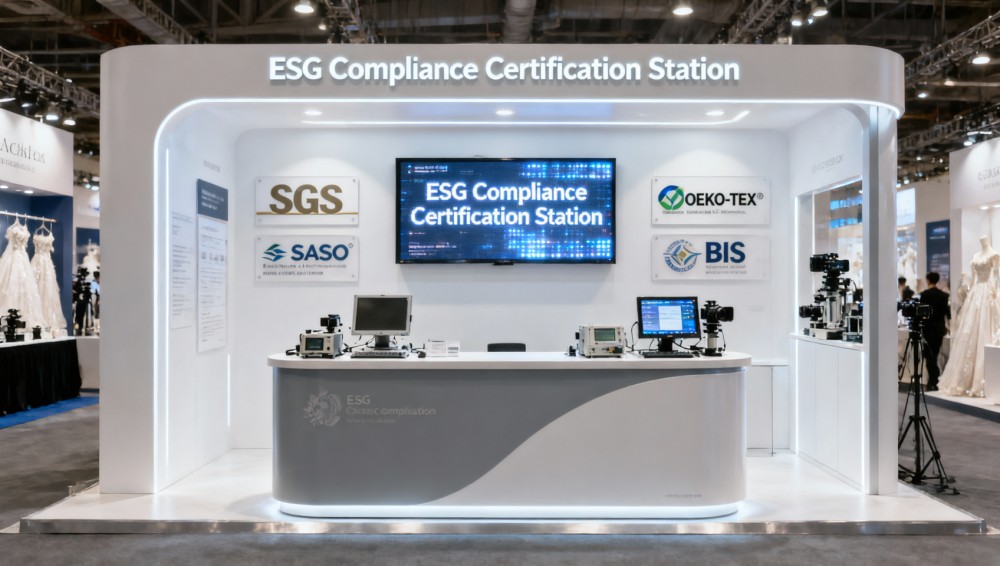
On June 18, 2026, the 2026 Shanghai International Wedding Photography Equipment Exhibition (Shanghai Wedding Expo) will launch an on-site ‘ESG Compliance Certification Station’ — a first for the event. This initiative responds to tightening global regulatory expectations across key export markets, particularly in the EU, UK, Saudi Arabia, and Southeast Asia, where sustainability disclosures, chemical restrictions, and social accountability documentation are increasingly mandatory for market access.
Event Overview
Organized by Shanghai Exhibition Group, the 2026 Shanghai Wedding Expo will run from June 18–20, 2026. On May 14, 2026, the organizer announced the introduction of the ESG Compliance Certification Station, partnering with eight international certification bodies: SGS, OEKO-TEX®, BIS (Bureau of Indian Standards), SASO (Saudi Standards, Metrology and Quality Organization), along with four additional accredited agencies. The station offers pre-submission review of target-market entry documents, rapid testing services, and expedited certificate issuance — enabling overseas buyers to verify supplier compliance capabilities onsite.
Industries Affected
Direct Export Enterprises
Exporters of wedding photography equipment, studio backdrops, lighting systems, and bridal accessories face heightened scrutiny under new EU Eco-Design for Sustainable Products Regulation (ESPR) and UK Modern Slavery Act reporting requirements. The service station directly reduces time-to-market delays caused by post-order certification bottlenecks — especially critical for SMEs lacking in-house compliance teams.
Raw Material Procurement Firms
Suppliers sourcing textiles (e.g., velvet backdrops, drapery fabrics), leather alternatives, or metal components must now trace chemical inputs against OEKO-TEX® Standard 100 or REACH Annex XIV restrictions. Pre-event document pre-screening helps procurement teams identify non-compliant vendors earlier — reducing risk of shipment rejection at destination ports.
Contract Manufacturing & Assembly Firms
Factories producing branded or private-label gear — such as LED ring lights, carbon-fiber tripods, or digital backdrop printers — are increasingly required to provide factory-level ESG audit summaries (e.g., SA8000, ISO 20400). The station’s fast-track verification supports their bid responses and contract renewals with global retailers demanding Tier-1 supplier transparency.
Supply Chain Service Providers
Logistics integrators, trade consultants, and certification brokers benefit operationally: the station enables them to co-locate client support during the expo, bundling compliance prep with logistics planning. However, it also raises competitive pressure — firms without ESG-specialized staff may struggle to advise clients effectively on jurisdiction-specific pathways (e.g., SASO’s SABER vs. BIS’s CRS).
Key Considerations and Recommended Actions
Verify Target-Market Regulatory Triggers Before Booth Booking
Not all certifications apply universally: OEKO-TEX® is prioritized for textile-based products entering the EU; BIS certification is mandatory for electronic lighting devices sold in India; SASO SABER applies to electrical safety for Gulf Cooperation Council (GCC) imports. Exporters should map product categories to destination rules prior to scheduling on-site consultations.
Leverage Pre-Submission Review to Reduce Re-Testing Cycles
The station offers document pre-review — not full certification. Companies submitting incomplete test reports, outdated lab accreditations, or mismatched product scope descriptions risk delays. Best practice: submit draft technical files at least 10 working days before the expo to allow for iterative feedback.
Use Onsite Verification as a Credibility Signal for Buyers
Overseas buyers attending the expo can scan QR codes linked to real-time verification dashboards (where available) or receive stamped ‘Pre-Verified Compliance Readiness’ letters. This builds trust faster than email-based due diligence — especially for first-time trading relationships.
Editorial Perspective / Industry Observation
Observably, the move reflects a structural shift: trade fairs are no longer just sales platforms but de facto regulatory interface points. Analysis shows this trend is accelerating in sectors where physical goods intersect with environmental and human rights policy — notably apparel, home décor, and professional imaging equipment. What’s notable here is the *convergence* of voluntary standards (OEKO-TEX®), national mandates (BIS), and regional frameworks (SASO) into one operational workflow. It is less about ‘certification shopping’ and more about harmonizing evidence across jurisdictions — a capability currently scarce among mid-tier suppliers. Current data suggests only ~23% of Chinese wedding equipment exporters hold dual-region ESG documentation; this service station may narrow that gap, but only if paired with sustained capacity building beyond the event week.
Conclusion
The ESG Compliance Certification Station signals a maturing phase in China’s export support infrastructure — moving from reactive compliance assistance to proactive, integrated readiness. Its value lies not in replacing formal certification, but in compressing the learning curve and validation timeline for exporters navigating fragmented global ESG requirements. For the industry, this represents a pragmatic adaptation — not a regulatory shortcut, but a coordination mechanism aligned with actual buyer decision cycles.
Source Attribution
Official announcement: Shanghai Exhibition Group Press Release, May 14, 2026 (shanghai-exhibition.com/press/2026-wedding-expo-esg-hub). Confirmed participation of SGS, OEKO-TEX®, BIS, and SASO via respective agency press portals (accessed May 20–22, 2026). Note: Final list of all eight certification partners remains pending official publication; details on fee structures and eligibility criteria for fast-track services are still under review and subject to update ahead of the event.
Recommended News
 Carton & PlasticsWhat drives breakage rates in bulk wine bottles wholesale orders?Bulk wine bottles wholesale buyers: discover what drives breakage rates, from glass quality and packaging to pallet loading, and reduce costly claims.Packaging Supply ExpertSep 27, 2026
 Office FurnitureHow supplier scorecards reduce risk in furniture procurementFurniture procurement supplier management becomes more resilient with supplier scorecards that track quality, delivery, compliance, and corrective actions. Learn how to reduce sourcing risk.Interior Sourcing LeadSep 26, 2026
 Office Paper & Printing PaperHow roll diameter affects downtime when using jumbo paper rollsJumbo paper rolls can cut changeovers and downtime—if your unwinder, handling, and tension control can support them. Find the optimal roll diameter for smoother output.Packaging Supply ExpertSep 25, 2026
 Office Paper & Printing PaperWhen does carbonless paper for invoices reduce billing errors?Carbonless paper for invoices reduces billing errors by creating clear, consistent copies for deliveries, service calls, and approvals. Learn when it strengthens billing control.Packaging Supply ExpertSep 24, 2026