Industry News
Curation by industry experts
Hot Articles
Popular Tags
CPSC Recalls 3 Chinese-Made LED Ring Lights Over Fire and Burn Hazards
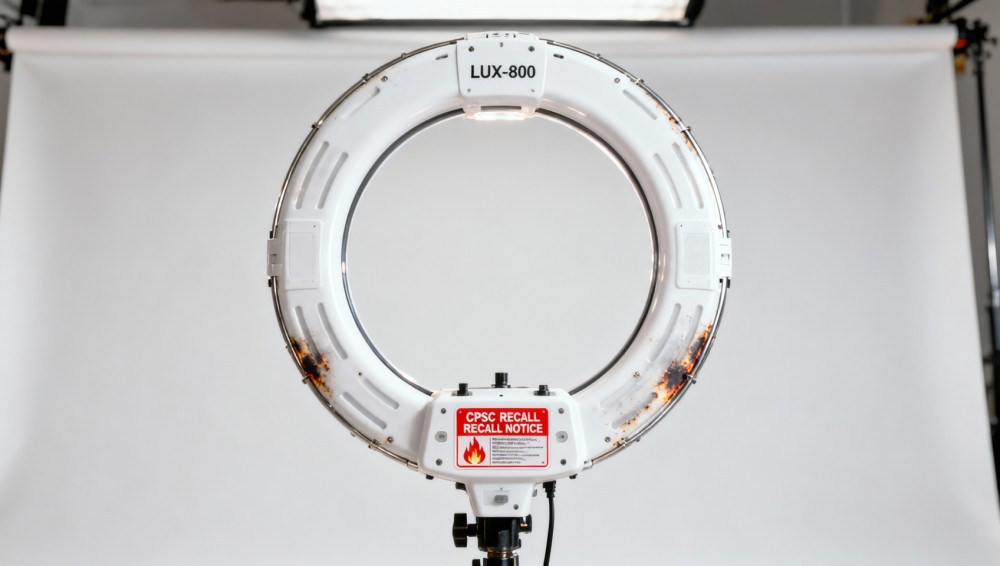
On May 24, 2026, the U.S. Consumer Product Safety Commission (CPSC) issued an urgent recall notice for three models of photography LED ring lights—LUX-800, GLOW-R12, and SUNNY-PRO—manufactured in China and marketed for bridal photo studio use. The recall stems from confirmed thermal control failures leading to housing melting and posing fire and burn risks, directly impacting the consumer electronics, lighting, and wedding services supply chain.
Confirmed Recall Details
The CPSC announced the recall on May 24, 2026, targeting three specific models labeled as ‘photography LED ring light’: LUX-800, GLOW-R12, and SUNNY-PRO. All units were imported into the United States and sold for use in bridal portrait studios. Investigations confirmed that defective temperature regulation systems caused excessive heat buildup, resulting in partial melting of the outer housing. Seven incidents of consumer burns have been officially reported. Importers are required to immediately cease sales, remove affected units from inventory, and initiate full refunds for all purchased units.
Supply Chain Impact Across Key Roles
Importers and Distributors
As the primary responsible parties under CPSC regulations, importers face immediate compliance obligations—including inventory withdrawal, customer notification, and refund processing. Failure to act promptly may trigger civil penalties or reputational damage in U.S. retail and e-commerce channels.
Manufacturers and OEMs
Contract manufacturers producing these models must review thermal design validation protocols, especially for LED driver and heatsink integration. Post-recall scrutiny will likely extend to third-party test reports covering IEC 62368-1 (audio/video, information and communication technology equipment safety) and UL 1598 (luminaires), with emphasis on abnormal operating conditions.
Component Suppliers
Suppliers of thermal management components—including aluminum extrusions, thermal interface materials, and temperature-sensing ICs—may experience revised qualification requirements. Buyers are expected to request updated failure mode and effects analysis (FMEA) documentation specifically addressing thermal runaway scenarios.
Logistics and Compliance Service Providers
Third-party conformity assessment bodies and customs brokers may see increased demand for pre-shipment safety verification, particularly for products falling under CPSC’s ‘high-risk’ category for portable lighting with enclosed heat sources.
Key Compliance Actions for Exporters
Immediate Product Safety Audit
Exporters supplying similar LED ring lights to U.S. markets should conduct internal thermal stress testing under sustained operation (e.g., 4+ hours at maximum brightness), verifying surface temperatures against CPSC’s 70 °C skin-contact threshold and housing deformation limits.
Thermal Management Documentation Review
Review all technical files for evidence of validated thermal modeling (e.g., CFD simulations), component-level derating, and redundant overtemperature protection—especially where single-point thermal sensors or uncalibrated thermistors are used.
Supplier Qualification Reinforcement
Strengthen due diligence on sub-tier suppliers handling critical thermal subsystems. Require documented traceability for heatsink alloys, thermal paste batch certifications, and firmware revision logs for embedded temperature control logic.
U.S. Market Entry Risk Mitigation
Consider adopting voluntary CPSC-aligned labeling—such as explicit ambient temperature use warnings and mandatory cooling interval instructions—to demonstrate proactive risk communication ahead of future regulatory expectations.
Industry Implications: Beyond This Recall
Analysis shows this incident reflects a broader tightening of enforcement focus on thermal safety in low-voltage, high-lumen-density portable lighting—not just for consumer use but increasingly for professional-grade equipment sold via B2B channels. Observably, CPSC is prioritizing real-world failure modes over pass/fail lab certification outcomes, placing greater weight on field incident data and post-market surveillance. What deserves closer attention is how this shift may accelerate adoption of integrated thermal monitoring (e.g., embedded NTC networks with firmware-based shutdown logic) as a de facto industry baseline—even for products not yet mandated under formal standards updates.
Strategic Takeaway for Global Suppliers
This recall underscores that compliance is no longer defined solely by initial certification, but by continuous performance validation across product lifecycles. For manufacturers exporting to the U.S., robust thermal design, transparent supply chain controls, and responsive post-market reporting infrastructure are now essential operational capabilities—not optional enhancements.
Source Attribution and Monitoring Guidance
This article was generated based solely on the user-provided title, event date (May 24, 2026), and summary description. Specific official source links were not provided in the input and should be verified continuously. Stakeholders are advised to monitor CPSC’s official recall database, updates to 16 CFR Part 1115 (Reporting Requirements), and emerging guidance from ASTM F15.22 (Consumer Product Safety) subcommittees regarding thermal hazard classification for portable LED lighting. Ongoing observation is recommended for potential revisions to importer liability thresholds and expanded scope of ‘reasonably foreseeable misuse’ interpretations in upcoming enforcement actions.
Recommended News
 Home DecorWhich decor exhibition in the USA best fits a home decor sourcing trip?Decor exhibition USA guide: compare High Point Market, Las Vegas Market, NY NOW, and HD Expo to choose the best event for your home decor sourcing trip.Interior Sourcing LeadOct 08, 2026
 Fabrics & YarnsWhat drives textile procurement cost beyond the quoted fabric price?Textile procurement cost goes far beyond the quoted fabric price. Discover how freight, quality, MOQ, compliance, payment terms, and supplier reliability shape total sourcing cost.Textile Industry AnalystOct 07, 2026
 Garment MfgWhat drives unit costs when buying garment buttons wholesale?Garment buttons wholesale costs depend on material, tooling, finish, MOQ, quality, packing, and freight. Learn how to compare true landed costs and source reliably.Textile Industry AnalystOct 06, 2026
 Building HardwareWhat load rating should you specify for wholesale ball bearing slides?Wholesale ball bearing slides: learn how to specify the right load rating for drawer weight, extension, mounting, and durability. Source smarter and reduce failures.Tooling & Hardware LeadOct 05, 2026