Industry News
Curation by industry experts
Hot Articles
Popular Tags
Saudi SASO Enforces IEC 62612:2025 for Studio LED Lights
Saudi Arabia’s Standards, Metrology and Quality Organization (SASO) has mandated new energy efficiency requirements for imported LED studio lighting used in wedding photography—effective 1 July 2026—following the official update of the SASO IEC 62612:2025 standard on 23 May 2026. This regulatory shift directly impacts global manufacturers, exporters, and certification service providers supplying to the Saudi professional imaging market.
Official Update and Compliance Timeline
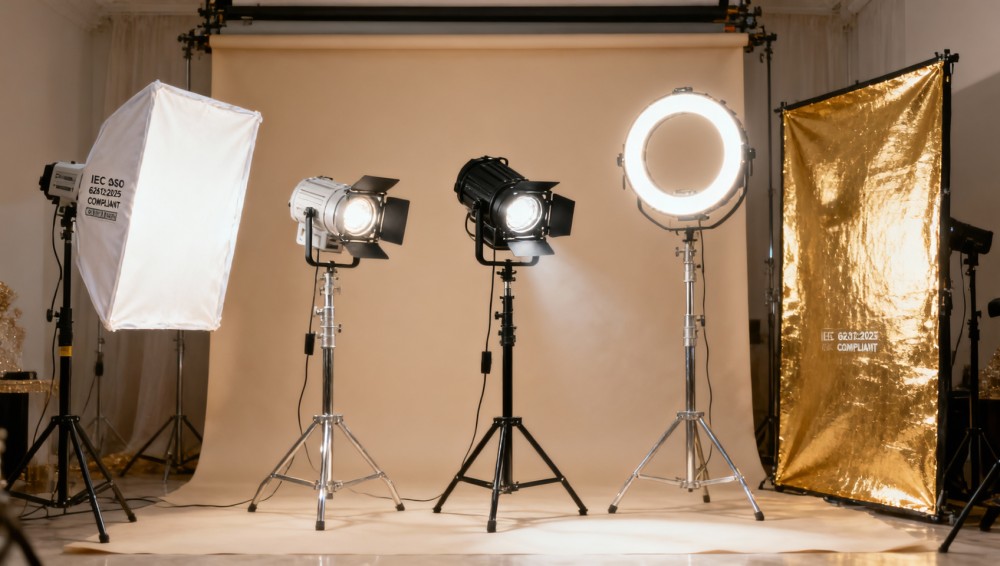
On 23 May 2026, SASO published the updated SASO IEC 62612:2025 standard, aligning national requirements with the latest international edition of IEC 62612. From 1 July 2026 onward, all imported LED studio lights intended for wedding photography—including softbox lights, track-mounted lights, and background lights—must comply with three core performance thresholds: luminous efficacy ≥140 lm/W, power factor ≥0.95, and total harmonic distortion (THD) ≤10%. In addition, each shipment requires a valid SASO Certificate of Conformity (CoC).
Impact Across Supply Chain Roles
Exporters and Trading Companies
Direct trade enterprises must now verify product compliance prior to shipment—not just at the model level but per batch, as SASO CoC issuance depends on test reports aligned to the revised standard. Non-compliant consignments risk customs rejection or mandatory retesting upon arrival in Saudi ports.
Raw Material and Component Suppliers
Suppliers of drivers, LED modules, thermal management systems, and control circuitry face heightened specification scrutiny. Components previously accepted under older versions (e.g., IEC 62612:2017) may no longer support the required power factor or THD limits—necessitating redesign or qualification against updated electrical stress profiles.
Lighting Manufacturers and OEMs
Manufacturers must revise internal design validation protocols to include full-system testing under SASO-specified operating conditions. Achieving ≥140 lm/W while maintaining color rendering consistency and thermal stability across dimming ranges demands updated optical and thermal engineering—not merely component substitution.
Compliance and Certification Service Providers
Third-party laboratories and certification bodies accredited by SASO must ensure their test capabilities cover the full scope of SASO IEC 62612:2025—including flicker measurement, surge immunity verification, and photometric reporting formats acceptable to SASO’s e-portal. Delays in accreditation renewal may bottleneck CoC issuance timelines.
Key Compliance Actions for Enterprises
Immediate Technical Documentation Review
Verify that existing test reports reference IEC 62612:2025 (not earlier editions), explicitly declare compliance with the three metrics (lm/W, PF, THD), and include traceable calibration data from SASO-recognized labs.
Supplier Qualification Alignment
Reassess upstream suppliers’ declarations—especially for constant-current drivers and integrated controllers—to confirm they meet the updated harmonic current emission and phase-shift tolerance requirements embedded in Clause 8.2 of SASO IEC 62612:2025.
CoC Application Workflow Adjustment
Integrate SASO’s updated CoC application checklist into pre-shipment planning: mandatory submission of Arabic-language user manuals, updated labeling per SASO SABER portal requirements, and factory audit readiness for lighting-specific process controls (e.g., binning, thermal aging, final QA sampling).
Industry Perspective: Beyond Minimum Thresholds
Analysis shows this revision marks a strategic tightening—not just of energy metrics, but of system-level reliability expectations. The jump from previous lm/W thresholds (typically ≥110–120 lm/W) to 140 lm/W reflects SASO’s growing emphasis on lifecycle energy cost, not just initial purchase price. Observably, achieving such efficacy without compromising CRI ≥90 or R9 ≥50 under high-CCT operation will require advanced phosphor blends and tighter binning discipline—raising both R&D and production quality control costs. It is more appropriate to understand this as a de facto technology gate for mid-to-high-tier studio lighting entering the Gulf market, rather than a generic energy label update.
Toward Sustainable Market Access
This enforcement underscores a broader regional trend: Gulf Cooperation Council (GCC) regulators are increasingly using harmonized IEC standards—not as benchmarks, but as enforceable minimum baselines for premium application segments. For lighting exporters, early alignment with SASO IEC 62612:2025 does not only secure market access; it also signals technical maturity to buyers across Jordan, UAE, and Qatar, where similar updates are under technical review. Rational preparation—not reactive adaptation—is now the operational prerequisite.
Source Attribution and Monitoring Guidance
This article was generated exclusively from the provided title, event date (2026-07-01), and summary text. Specific official source links were not provided in the input and should be verified continuously. Stakeholders are advised to monitor SASO’s official portal for implementation clarifications—including interpretation of ‘wedding photography use’ scope, transitional arrangements for pending shipments, and any supplementary guidance on THD measurement methodology (e.g., full-load vs. dimmed-state testing). Industry feedback on conformity assessment bottlenecks and laboratory capacity gaps remains critical for future regulatory refinement.
Recommended News
 Home DecorWhich decor exhibition in the USA best fits a home decor sourcing trip?Decor exhibition USA guide: compare High Point Market, Las Vegas Market, NY NOW, and HD Expo to choose the best event for your home decor sourcing trip.Interior Sourcing LeadOct 08, 2026
 Fabrics & YarnsWhat drives textile procurement cost beyond the quoted fabric price?Textile procurement cost goes far beyond the quoted fabric price. Discover how freight, quality, MOQ, compliance, payment terms, and supplier reliability shape total sourcing cost.Textile Industry AnalystOct 07, 2026
 Garment MfgWhat drives unit costs when buying garment buttons wholesale?Garment buttons wholesale costs depend on material, tooling, finish, MOQ, quality, packing, and freight. Learn how to compare true landed costs and source reliably.Textile Industry AnalystOct 06, 2026
 Building HardwareWhat load rating should you specify for wholesale ball bearing slides?Wholesale ball bearing slides: learn how to specify the right load rating for drawer weight, extension, mounting, and durability. Source smarter and reduce failures.Tooling & Hardware LeadOct 05, 2026