Industry News
Curation by industry experts
Hot Articles
Popular Tags
India BIS Adds Portable LED Lights for Wedding Photography to Mandatory Certification
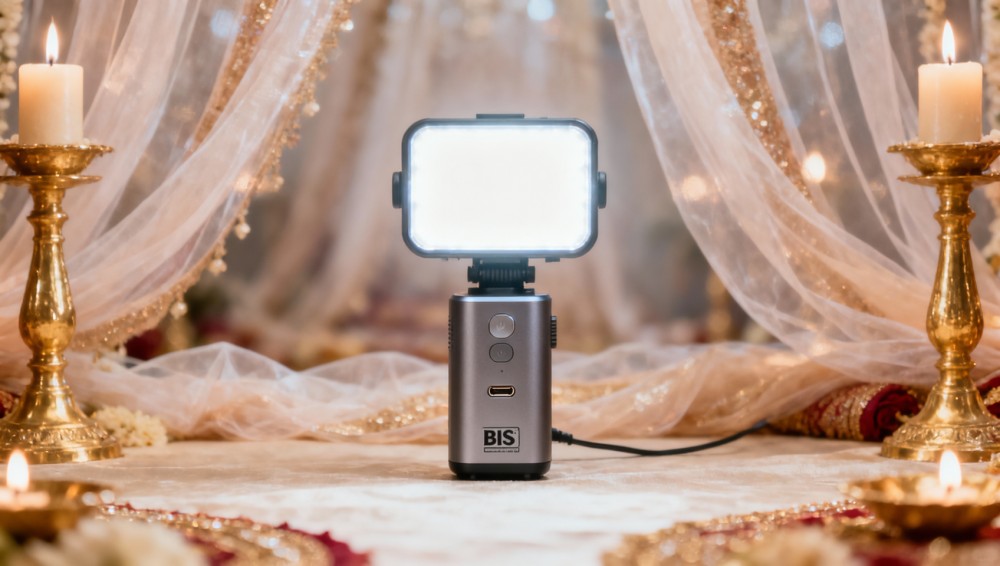
India’s Bureau of Indian Standards (BIS) has updated its mandatory certification list effective 22 May 2026, bringing portable lithium-ion battery–powered LED fill lights — including USB-C direct-charge models used in wedding photography — under the scope of IS 13252(Part 1):2023. Enforcement begins 1 October 2026: non-certified units will be barred from customs clearance. The move signals a tightening of safety oversight for consumer-grade portable lighting in India’s rapidly expanding digital content creation ecosystem.
Event Overview
On 22 May 2026, the Bureau of Indian Standards (BIS) issued an official update to its Compulsory Registration Scheme (CRS) product list, formally including portable, lithium-ion battery–powered LED fill lights designed for wedding and event photography. These devices — whether standalone or integrated into compact light panels with USB-C direct charging capability — now fall under the technical requirements of IS 13252(Part 1):2023 (“Information Technology Equipment — Safety Requirements — Part 1: General Requirements”). Certification becomes mandatory for import and domestic sale starting 1 October 2026. As of publication, only 17 Chinese battery module manufacturers have completed testing at BIS-recognized laboratories; no public data indicates certified final-product manufacturers or authorized Indian representatives for such lighting equipment.
Industries Affected
Direct trading enterprises: Exporters and importers handling wedding photography lighting equipment face immediate compliance risk. Since BIS certification must be held by the brand owner or authorized Indian representative — not the consignee — unaffiliated traders cannot clear shipments without verified certificate holders. This increases lead time, shifts liability to upstream partners, and may trigger contract renegotiations or order cancellations ahead of the 1 October deadline.
Raw material procurement enterprises: Firms sourcing lithium-ion cells, protection circuits, or USB-C power management ICs for OEM/ODM lighting products must now verify downstream certification readiness. Suppliers tied to uncertified battery modules risk stranded inventory or rework if their components fail to meet IS 13252(Part 1):2023’s thermal, overcharge, and short-circuit test criteria — particularly given that only 17 Chinese cell/module suppliers currently hold BIS-recognized lab validation.
Manufacturing enterprises: Contract manufacturers and branded OEMs producing portable LED lights for export to India must initiate full product-level certification — not just component-level approvals. This includes structural safety assessments, battery enclosure integrity tests, and labeling verification per IS 13252(Part 1):2023 Annexures. Delays are likely: average certification turnaround is reported at 12–16 weeks, and laboratory capacity constraints are already evident.
Supply chain service enterprises: Customs brokers, certification consultants, and logistics providers specializing in India-bound electronics now need updated competency in IS 13252(Part 1):2023 interpretation, especially around classification boundaries (e.g., distinguishing “IT equipment” from “household lighting” under BIS definitions). Misclassification could result in shipment rejection or retrospective penalties post-clearance.
Key Considerations and Recommended Actions
Verify certification status of battery modules before final assembly
Given the bottleneck among BIS-recognized labs and limited number of qualified Chinese cell/module suppliers (currently 17), manufacturers should audit existing battery supply chains against BIS-approved test reports — not just datasheets or CE declarations. A module tested to IEC 62133 alone does not satisfy IS 13252(Part 1):2023 unless validated in a BIS-recognized facility.
Appoint or engage an authorized Indian representative early
BIS certification requires a local legal entity or authorized representative in India to hold the registration and manage post-market surveillance. Overseas brands without Indian subsidiaries must secure this arrangement before submitting applications — a process requiring notarized authorization, MOA, and proof of address, typically adding 3–4 weeks to timelines.
Review product labeling and user documentation
IS 13252(Part 1):2023 mandates bilingual (English + Hindi or regional language) safety warnings, rated input/output parameters, battery chemistry disclosure, and explicit prohibition of third-party battery replacements. Labels affixed post-manufacture (e.g., via sticker) must withstand abrasion and solvent tests — a frequent point of failure during BIS factory inspections.
Editorial Perspective / Industry Observation
Observably, this regulatory expansion reflects BIS’s broader pivot toward treating high-power portable electronics — especially those marketed to non-industrial end users — as IT-class safety-critical devices. While wedding photography lights were previously treated as niche accessories, their increasing power density (up to 100 W output), widespread use of fast-charging lithium batteries, and direct consumer handling have elevated risk profiles. Analysis shows this is less about targeting a specific product category and more about closing enforcement gaps in India’s fragmented electronics import regime. From industry perspective, the timing — coinciding with rising demand for AI-enhanced on-location content creation gear — suggests proactive alignment with emerging usage patterns, not reactive crisis management.
Conclusion
This amendment marks a structural shift: portable professional lighting is no longer exempt from India’s core IT equipment safety framework. Rather than a temporary compliance hurdle, it signals institutional recognition of photography gear as digitally integrated, battery-intensive hardware. For global suppliers, timely engagement with BIS requirements is now a prerequisite for market access — not a post-sale administrative step.
Source Attribution
Official notice published by the Bureau of Indian Standards (BIS) under CRS Amendment No. 27/2026, dated 22 May 2026 (available at https://www.bis.gov.in). Current list of BIS-recognized labs and certified battery module manufacturers remains unpublished; status to be monitored via BIS’s quarterly CRS updates and accredited lab bulletins. Pending clarification: whether legacy stock imported pre-1 October 2026 but sold after that date requires retroactive certification.
Recommended News
 Garment MfgWhat drives unit costs when buying garment buttons wholesale?Garment buttons wholesale costs depend on material, tooling, finish, MOQ, quality, packing, and freight. Learn how to compare true landed costs and source reliably.Textile Industry AnalystOct 06, 2026
 Building HardwareWhat load rating should you specify for wholesale ball bearing slides?Wholesale ball bearing slides: learn how to specify the right load rating for drawer weight, extension, mounting, and durability. Source smarter and reduce failures.Tooling & Hardware LeadOct 05, 2026
 Hand & Power ToolsHow to choose a hand saw for woodworking without tear-outHand saw for woodworking guide: choose the right tooth pattern, blade, and technique to achieve clean, precise cuts with less tear-out. Explore practical buying tips.Tooling & Hardware LeadOct 04, 2026
 Eco PackagingWhat affects the price of kraft paper rolls bought wholesale?Kraft paper rolls wholesale pricing depends on grade, basis weight, roll size, order volume, freight, and certifications. Learn how to compare landed costs and choose reliable value.Packaging Supply ExpertOct 03, 2026