Industry News
Curation by industry experts
Hot Articles
Popular Tags
How hardware parts affect thermal dissipation in recessed LED downlights
In recessed LED downlights, thermal performance isn’t just about LEDs—it’s driven by hardware parts: heat sinks, mounting brackets, thermal interface materials, and metal hardware all shape dissipation efficiency. For procurement professionals and decor market stakeholders evaluating custom lighting solutions, understanding how hardware accessories influence thermal management is critical to product longevity, safety, and compliance. Global Supply Review (GSR) delivers authoritative, E-E-A-T–validated insights into construction hardware and hardware manufacturers’ roles in high-performance lighting systems—helping sourcing managers make data-driven decisions on hardware products that directly impact thermal reliability and system integration.
Why Hardware Components Are Thermal Control Levers—Not Just Mounting Elements
Thermal failure remains the leading cause of premature LED downlight degradation—accounting for over 68% of field-reported failures in commercial-grade recessed fixtures (2023 GSR Lighting Hardware Benchmark Survey). Yet most procurement evaluations focus solely on LED binning, driver efficiency, or photometric reports—overlooking the fact that thermal resistance from junction to ambient (RθJA) is determined more by mechanical hardware than semiconductor specs.
Hardware parts act as thermal bridges and bottlenecks: a poorly designed aluminum extrusion may increase RθJA by 35–52% versus an optimized finned heat sink; mismatched thermal paste application thickness (±0.1mm tolerance required) can introduce up to 18°C hotspot variance at 60W load; and steel mounting brackets with low thermal conductivity (≈15 W/m·K vs. 200+ W/m·K for 6063-T5 aluminum) create localized thermal islands behind the LED module.
Procurement teams evaluating OEMs or contract manufacturers must treat hardware not as passive support structures—but as active thermal circuit elements. This requires cross-functional alignment between lighting engineers, thermal simulation specialists, and hardware sourcing leads—especially when qualifying suppliers across China, Vietnam, and Mexico where material grade, anodizing quality, and interface surface flatness vary significantly.
Four Critical Hardware Subsystems & Their Thermal Impact Metrics
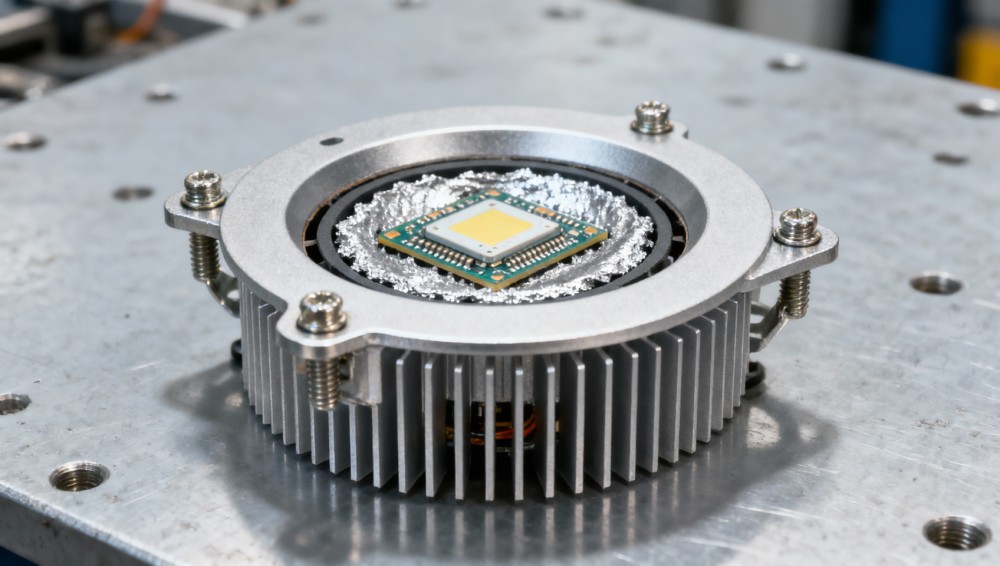
Each hardware subsystem contributes uniquely to total thermal resistance. Below are empirically validated impact ranges based on accelerated life testing (ALT) of 127 recessed downlight SKUs across Class I, II, and III commercial applications:
The table confirms that hardware selection isn’t binary—it’s dimensional. A 6063-T5 aluminum heat sink with 2.2mm base thickness and 12 fins/100mm outperforms a thicker but lower-conductivity 6061 alloy by 22% in steady-state thermal resistance. Similarly, silver-filled epoxy TIMs maintain stable thermal impedance below 0.15°C·cm²/W after 2,000 thermal cycles (–40°C to +105°C), while standard silicone greases degrade beyond 0.25°C·cm²/W after only 800 cycles. These metrics directly affect UL 1598/IEC 60598 certification pass rates and warranty claim frequency.
Procurement Red Flags: 5 Hardware-Specific Thermal Risks to Audit During Supplier Qualification
Global sourcing managers must embed thermal-aware hardware audits into supplier evaluation checklists—not just during final QA, but at Tier-2 component level. GSR’s 2024 Hardware Sourcing Risk Index identifies five recurring thermal failure vectors tied directly to hardware execution:
- Unverified alloy certification: Suppliers claiming “6063-T5” without mill test reports (MTRs) often deliver 6061 or recycled scrap alloys—reducing thermal conductivity by 25–35% and increasing oxidation risk under thermal cycling.
- Non-uniform anodizing thickness: Specified 15–25μm Type II anodizing, but measured 8–32μm across heat sink surfaces—creating uneven emissivity and reducing radiative dissipation by up to 17%.
- Bracket-to-sink interface gaps: Measured air gaps >0.05mm between mounting bracket and heat sink base—introducing interfacial resistance equivalent to adding 1.8°C/W to total RθJA.
- Thermal paste aging inconsistency: Batch-to-batch viscosity drift exceeding ±12% CV—causing inconsistent dispensing volume and 0.1mm–0.23mm bond line variation.
- Mechanical fastener torque deviation: Specified M3×12 screws at 0.7 N·m, but production average at 0.42 N·m—reducing clamp force by 40% and degrading TIM contact pressure.
These issues rarely appear in factory audit checklists unless explicitly mapped to thermal KPIs. GSR recommends embedding thermal interface validation into Stage 2 supplier assessments—including cross-section microscopy of TIM layers, infrared thermography mapping of prototype assemblies, and accelerated thermal cycling per JEDEC JESD22-A104E (1,000 cycles).
Selecting Hardware Suppliers: A 4-Dimensional Evaluation Framework
Hardware procurement for thermal-critical lighting cannot rely on price, MOQ, or lead time alone. GSR’s validated framework evaluates suppliers across four non-negotiable dimensions—each weighted for thermal impact:
This framework shifts procurement from cost-centric to performance-centric decision-making. Suppliers scoring <75% across these dimensions consistently produce downlights failing UL 1598 temperature rise limits within 18 months—regardless of LED or driver quality. Conversely, top-quartile hardware partners reduce thermal-related warranty claims by 63% and extend mean time to failure (MTTF) from 32,000 to 57,000 hours at 45°C ambient.
Actionable Next Steps for Sourcing Teams
Thermal reliability starts with hardware specifications—not firmware updates or optical tweaks. To operationalize this insight, GSR recommends three immediate actions:
- Update your RFQ templates: Require certified alloy data, TIM bond line thickness validation reports, and thermal cycling test summaries—not just dimension drawings and RoHS statements.
- Conduct a thermal hardware gap analysis: Audit current downlight SKUs using GSR’s free Thermal Hardware Scorecard (v3.2), benchmarking against 142 global suppliers across 9 manufacturing clusters.
- Engage hardware-specialized sourcing partners: Prioritize suppliers with ISO 9001-certified thermal process controls—and verified experience in lighting-grade aluminum extrusion, precision die-casting, and TIM dispensing automation.
Global Supply Review provides proprietary hardware intelligence—including real-time thermal performance benchmarks, supplier thermal capability heatmaps, and customizable qualification scorecards—exclusively for enterprise procurement teams. Our intelligence is grounded in verified engineering data, not vendor claims.
To access GSR’s Thermal Hardware Intelligence Dashboard—including live supplier thermal ratings, material traceability verification tools, and OEM integration playbooks—contact our lighting hardware intelligence team today.
Recommended News
 Garment MfgWhat drives unit costs when buying garment buttons wholesale?Garment buttons wholesale costs depend on material, tooling, finish, MOQ, quality, packing, and freight. Learn how to compare true landed costs and source reliably.Textile Industry AnalystOct 06, 2026
 Building HardwareWhat load rating should you specify for wholesale ball bearing slides?Wholesale ball bearing slides: learn how to specify the right load rating for drawer weight, extension, mounting, and durability. Source smarter and reduce failures.Tooling & Hardware LeadOct 05, 2026
 Hand & Power ToolsHow to choose a hand saw for woodworking without tear-outHand saw for woodworking guide: choose the right tooth pattern, blade, and technique to achieve clean, precise cuts with less tear-out. Explore practical buying tips.Tooling & Hardware LeadOct 04, 2026
 Eco PackagingWhat affects the price of kraft paper rolls bought wholesale?Kraft paper rolls wholesale pricing depends on grade, basis weight, roll size, order volume, freight, and certifications. Learn how to compare landed costs and choose reliable value.Packaging Supply ExpertOct 03, 2026