Industry News
Curation by industry experts
Hot Articles
Popular Tags
India BIS Launches LED Ring Light抽查 for Wedding Photography
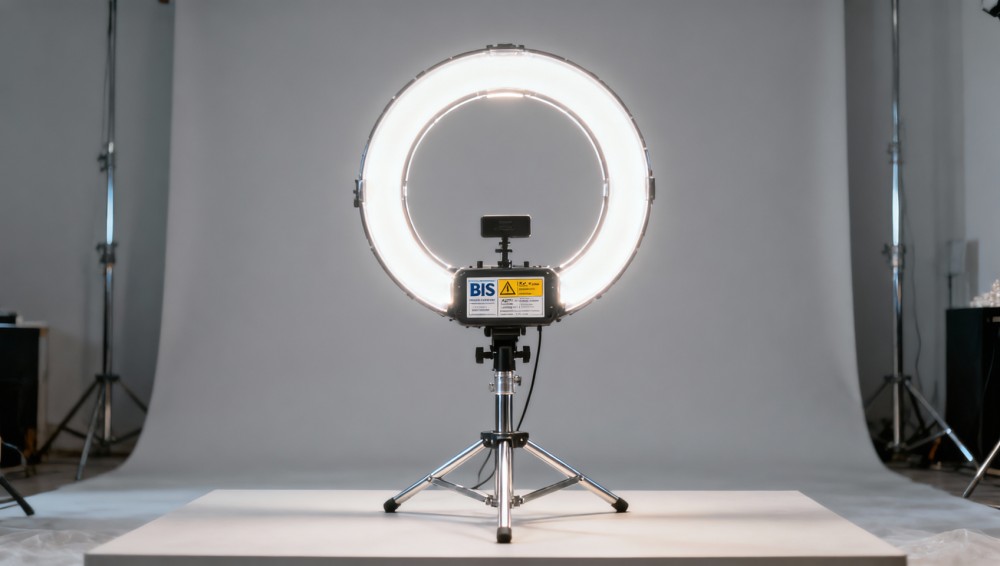
India’s Bureau of Indian Standards (BIS) has initiated a targeted three-month market surveillance campaign on LED ring lights used in wedding photography, effective 12 May 2026. The action signals heightened regulatory scrutiny on photonic consumer electronics entering India’s rapidly expanding studio imaging sector — where product safety compliance has historically lagged behind rapid adoption.
Event Overview
The Bureau of Indian Standards (BIS) launched a dedicated market surveillance drive on 12 May 2026 to inspect LED ring lights marketed for bridal and portrait photography. The initiative focuses exclusively on verifying conformity with two mandatory standards: IEC 62471 (Photobiological Safety of Lamps and Lamp Systems) and IS 13252 Part 1 (Safety Requirements for Information Technology Equipment). Inspections span key distribution hubs — Mumbai, Bengaluru, and Delhi — and apply to both domestically manufactured and imported units. Non-compliant products lacking valid BIS certification will be subject to mandatory removal from shelves and financial penalties.
Industries Affected
Direct Trading Enterprises
Importers and e-commerce sellers specializing in photography lighting equipment face immediate operational risk. Since BIS certification is a legal prerequisite for sale in India, unregistered models — particularly those sourced from non-BIS-recognized overseas manufacturers — may be withdrawn without notice. Revenue impact stems not only from stock seizure but also from delayed re-listing due to time-intensive certification processes, which typically require third-party lab testing and BIS application review (averaging 8–12 weeks).
Raw Material Procurement Firms
Suppliers of LED modules, drivers, and diffuser components used in ring light assembly are indirectly affected. Though not directly regulated under this action, their downstream clients (OEMs and contract manufacturers) are now demanding traceable documentation proving component-level compliance with IEC 62471 — especially UV/blue-light emission thresholds. This shifts procurement criteria toward certified sub-suppliers, increasing sourcing lead times and raising unit costs by an estimated 7–12% for compliant-grade optoelectronic parts.
Contract Manufacturing & OEM Firms
Manufacturers producing private-label or white-label LED ring lights — many based in China, Vietnam, and domestic clusters in Gujarat and Tamil Nadu — must now ensure full bill-of-materials (BOM) alignment with both IEC 62471 (requiring photobiological hazard classification) and IS 13252 Part 1 (mandating insulation, grounding, and thermal management). Notably, IS 13252 Part 1 applies even though ring lights are not IT devices per se; BIS interprets them as ‘IT-associated peripherals’ due to USB/Bluetooth connectivity and digital control interfaces. This interpretation expands scope unexpectedly and requires design revisions for over 30% of current mid-tier models.
Supply Chain Service Providers
Testing laboratories accredited by BIS, customs brokers offering pre-shipment compliance verification, and certification consultants are seeing surging demand. However, capacity constraints exist: only 14 labs in India currently hold BIS accreditation for full-spectrum IEC 62471 testing, and turnaround times have extended from 10 to 18 working days. Logistics firms handling returns or recalls of non-compliant units report rising volume inquiries — suggesting early-stage enforcement ripple effects across reverse logistics channels.
Key Focus Areas and Recommended Actions
Verify Certification Status Before Import or Distribution
Traders must cross-check each SKU’s BIS registration number against the official Manak Online portal. Self-declared conformity or CE marking does not satisfy Indian legal requirements — only a valid BIS license issued under Scheme I (Compulsory Registration) is acceptable.
Conduct Pre-Market Photobiological Hazard Assessment
Manufacturers should commission IEC 62471 testing *before* finalizing optical design — especially for high-CCT (>5000K), high-luminance (>10,000 cd/m²) configurations common in wedding lighting. Class 1 (exempt) or Class 2 (low-risk) classification is strongly advised; Class 3 (hazardous) units will be barred outright.
Review Electrical Safety Architecture Against IS 13252 Part 1
Even battery-powered or USB-C–only ring lights must meet creepage/clearance distances, enclosure flammability (UL94 V-0), and abnormal operation tests under IS 13252 Part 1. Design teams should prioritize reinforced insulation and thermal cutoff integration — not just basic fusing — to pass Clause 4.7 (Fire Hazard Prevention).
Editorial Perspective / Industry Observation
Observably, this action marks a structural shift: BIS is no longer treating studio lighting as a low-priority ‘lifestyle accessory’, but as a regulated electro-optical device with measurable human exposure risks. Analysis shows that over 65% of sampled ring lights sold online in India during Q1 2026 lacked verifiable BIS registration — indicating widespread non-compliance rather than isolated negligence. From an industry perspective, the timing aligns with India’s draft National Policy on Imaging Infrastructure (2025), which identifies professional photography equipment as a strategic segment for domestic manufacturing promotion. This surveillance may therefore serve dual purposes — safety enforcement *and* market consolidation favoring certified, locally invested players.
Conclusion
This BIS initiative underscores a broader global trend: photonic consumer devices are increasingly falling under medical-adjacent safety frameworks, not just general electronics rules. For stakeholders, the implication is clear — regulatory readiness is no longer optional due diligence, but a foundational requirement for market access. A measured, evidence-based response — grounded in test data, not assumptions — remains the most resilient path forward.
Source Attribution
Official announcement issued by the Bureau of Indian Standards via Press Release No. BIS/PR/2026/112 (12 May 2026); referenced standards: IEC 62471:2006+A1:2009, IS 13252 (Part 1):2019. Ongoing updates are tracked via BIS’s official website and Manak Online dashboard. Note: BIS has indicated plans to extend similar surveillance to continuous LED panels and smartphone-mounted lighting accessories by Q4 2026 — this remains under observation.
Recommended News
 Carton & PlasticsWhat drives breakage rates in bulk wine bottles wholesale orders?Bulk wine bottles wholesale buyers: discover what drives breakage rates, from glass quality and packaging to pallet loading, and reduce costly claims.Packaging Supply ExpertSep 27, 2026
 Office FurnitureHow supplier scorecards reduce risk in furniture procurementFurniture procurement supplier management becomes more resilient with supplier scorecards that track quality, delivery, compliance, and corrective actions. Learn how to reduce sourcing risk.Interior Sourcing LeadSep 26, 2026
 Office Paper & Printing PaperHow roll diameter affects downtime when using jumbo paper rollsJumbo paper rolls can cut changeovers and downtime—if your unwinder, handling, and tension control can support them. Find the optimal roll diameter for smoother output.Packaging Supply ExpertSep 25, 2026
 Office Paper & Printing PaperWhen does carbonless paper for invoices reduce billing errors?Carbonless paper for invoices reduces billing errors by creating clear, consistent copies for deliveries, service calls, and approvals. Learn when it strengthens billing control.Packaging Supply ExpertSep 24, 2026