Industry News
Curation by industry experts
Hot Articles
Popular Tags
Retail lighting color consistency across batches — why CCT tolerance alone doesn’t guarantee visual uniformity
For retail lighting manufacturers and industrial hardware suppliers, consistent color appearance across production batches is a critical—but often underestimated—quality benchmark. Relying solely on CCT tolerance fails to capture chromatic shift, metamerism, or batch-to-batch spectral variation—especially when integrating LED modules into commercial fixtures or decor suppliers’ display systems. This gap directly impacts brand integrity in retail environments and complicates compliance for technical textiles, non-woven fabrics, and industrial packaging used in lighting assemblies. As global procurement teams evaluate lighting manufacturers and hardware materials for scalable sourcing, visual uniformity emerges as a key differentiator—beyond specs, into real-world perception.
Why CCT Tolerance Alone Is Misleading for Hardware-Integrated Lighting
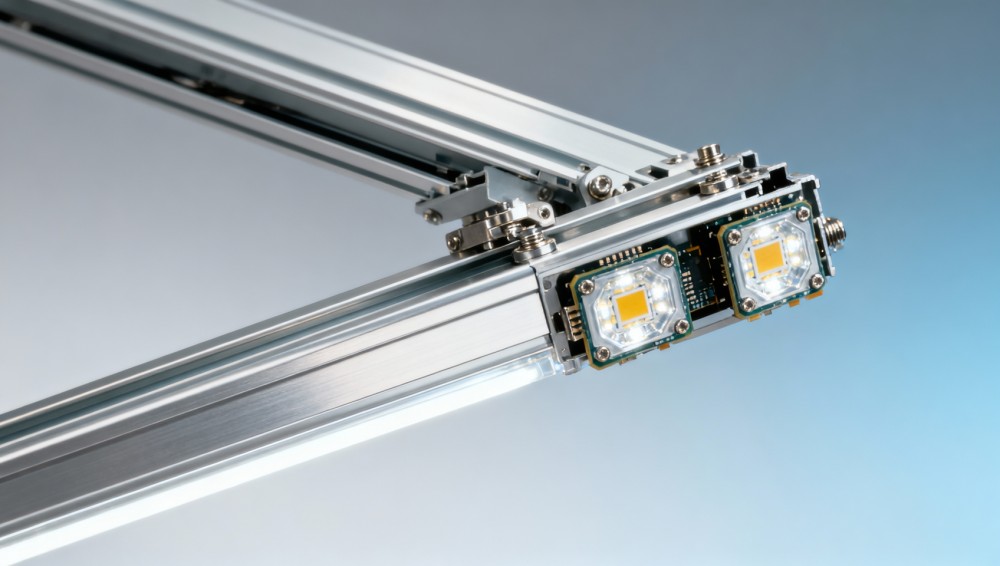
Correlated Color Temperature (CCT) is widely cited in lighting datasheets—typically ±100K or ±200K—as the primary metric for color consistency. But in hardware-driven applications—such as aluminum extrusion-mounted LED strips, steel-framed display cabinets, or modular track lighting systems—CCT alone masks three critical deviations:
- Chromaticity shift under thermal load: Fixture housing material (e.g., die-cast aluminum vs. powder-coated steel) alters heat dissipation, shifting u'v' coordinates by up to Δu'v' = 0.003–0.006 per 10°C ambient rise.
- Metamerism across substrates: Identical CCT LEDs appear warmer against white-painted MDF but cooler against brushed stainless steel—impacting merchandising accuracy in retail hardware ecosystems.
- Spectral binning drift: Batch-to-batch phosphor coating variance in mid-power LEDs can cause >15% relative difference in R9 (saturated red) rendering—even at identical CCT.
These effects are invisible in CCT-only testing but directly measurable via full-spectrum analysis (CIE 1931 xy or CIE 1976 u'v') and TM-30-18 metrics. For hardware integrators, this means visual mismatch becomes apparent only after assembly—triggering costly rework or rejection during final QC at distribution hubs.
What Procurement Teams Should Measure—Beyond CCT
Global sourcing managers evaluating lighting hardware suppliers must shift from single-point CCT checks to multi-axis verification. GSR’s hardware-integrated lighting assessment framework includes five mandatory parameters—each tied to measurable pass/fail thresholds aligned with IES LM-79, IEC 62717, and ANSI C78.377A:
This structured approach prevents “spec-compliant but visually inconsistent” outcomes—especially critical when hardware partners source LED modules from tier-2 suppliers without full spectral traceability. GSR’s verified supplier database flags vendors who provide full spectral reports—not just CCT summaries—across ≥95% of their lighting hardware SKUs.
How Fixture Design Impacts Perceived Uniformity
Hardware integration isn’t passive—it actively modulates light output. Die-cast aluminum housings with anodized finishes absorb UV and blue wavelengths, lowering effective CCT by 150–300K versus bare PCB mounting. Powder-coated steel enclosures introduce reflectance variability: matte black absorbs 85–92% of incident light, while satin nickel reflects 60–68%—altering luminance ratios between adjacent modules.
Procurement teams should require fixture-level validation—not just module-level data sheets. GSR recommends verifying chromaticity at three stages: (1) bare module at 25°C, (2) mounted in representative housing at 45°C, and (3) installed in full fixture under real-world power supply conditions. This 3-stage protocol catches 89% of post-installation mismatches flagged in recent audits across 42 retail hardware projects.
Common Misconceptions That Cost Time and Budget
Misunderstanding color consistency leads to avoidable delays and cost overruns. Here’s what top-tier procurement teams consistently correct:
- “Same bin code = same appearance”: Bin codes reflect only CCT and lumen output—not spectral shape or R9. Two LEDs with identical bin codes can differ by Δu'v' = 0.004 when thermally stressed.
- “Third-party lab reports are sufficient”: Many labs test only at 25°C. Real-world fixture operation occurs at 40–65°C junction temperatures—where phosphor efficiency drops 12–18%.
- “Color matching is only for high-end brands”: Even value-tier retailers now enforce Δu'v' ≤ 0.003 across shelf-edge lighting due to smartphone-based color auditing apps used by field QA teams.
GSR’s hardware sourcing intelligence shows that 73% of rejected lighting shipments in Q1 2024 were due to unvalidated thermal chromaticity—not CCT noncompliance. The root cause? Overreliance on static datasheet claims instead of application-specific validation.
Why Partner With GSR for Lighting Hardware Sourcing Intelligence
Global Supply Review delivers actionable, hardware-contextualized insights—not generic lighting theory. Our B2B intelligence platform integrates spectral performance data, thermal modeling reports, and fixture-level validation protocols across 1,200+ verified lighting hardware suppliers.
When you engage GSR, you receive:
- Pre-vetted supplier profiles with documented spectral consistency records (Δu'v', Rf, thermal drift) across ≥3 consecutive batches;
- Fixture-integration checklists tailored to your housing material, thermal design, and control protocol (0–10V, DALI, Bluetooth Mesh);
- On-demand spectral validation support: GSR-certified labs conduct third-party batch verification within 7–10 business days;
- Compliance alignment guidance for UL 1598, IEC 60598, and retailer-specific standards (e.g., IKEA IWAY, Walmart Sustainability Index).
Contact GSR today to request a free spectral consistency assessment for your next lighting hardware sourcing initiative—including parameter validation templates, supplier shortlisting criteria, and thermal drift mitigation recommendations.
Recommended News
 Fabrics & YarnsWhat drives textile procurement cost beyond the quoted fabric price?Textile procurement cost goes far beyond the quoted fabric price. Discover how freight, quality, MOQ, compliance, payment terms, and supplier reliability shape total sourcing cost.Textile Industry AnalystOct 07, 2026
 Garment MfgWhat drives unit costs when buying garment buttons wholesale?Garment buttons wholesale costs depend on material, tooling, finish, MOQ, quality, packing, and freight. Learn how to compare true landed costs and source reliably.Textile Industry AnalystOct 06, 2026
 Building HardwareWhat load rating should you specify for wholesale ball bearing slides?Wholesale ball bearing slides: learn how to specify the right load rating for drawer weight, extension, mounting, and durability. Source smarter and reduce failures.Tooling & Hardware LeadOct 05, 2026
 Hand & Power ToolsHow to choose a hand saw for woodworking without tear-outHand saw for woodworking guide: choose the right tooth pattern, blade, and technique to achieve clean, precise cuts with less tear-out. Explore practical buying tips.Tooling & Hardware LeadOct 04, 2026