Industry News
Curation by industry experts
Hot Articles
Popular Tags
Why custom lighting hardware solutions often fail in high-ceiling retail spaces
The Structural Reality Behind High-Ceiling Lighting Hardware Failures
Custom lighting hardware solutions promise precision and brand alignment in high-ceiling retail spaces—yet nearly 68% fail within 18 months. Why? Poorly engineered hardware parts, incompatible metal hardware fittings, and overlooked construction hardware load requirements undermine even the most sophisticated custom lighting designs. For procurement professionals and distributors evaluating hardware solutions for the decor market, this isn’t just an aesthetic or installation issue—it’s a systemic gap in sourcing rigor, ESG-compliant hardware accessories, and manufacturer-level expertise. Global Supply Review investigates the hidden failure points across hardware products, from thermal stress in ceiling-mounted fixtures to supply chain misalignment among global hardware manufacturers.
High-ceiling retail environments—such as flagship stores (9–15 m ceilings), warehouse-style showrooms (12–18 m), and multi-level department stores—impose unique mechanical and thermal demands on lighting support systems. Standard off-the-shelf suspension kits rated for ≤3.5 m ceilings often exceed their yield limits when scaled vertically. Independent lab testing by GSR’s hardware engineering panel shows that 72% of failed installations used mounting brackets with tensile strength below 12.5 kN—well under the 18–22 kN minimum recommended for 10 m+ suspended loads carrying >45 kg per fixture cluster.
Thermal expansion is another silent contributor: aluminum extrusions and stainless steel rods expand at different coefficients (23.1 vs. 17.3 µm/m·°C). In unventilated ceiling plenums where ambient temperatures fluctuate between 18°C and 42°C, cumulative drift can exceed ±1.8 mm per 3-meter run—enough to misalign optics, crack lens gaskets, or trigger vibration-induced fatigue in threaded couplings.
These aren’t theoretical margins. They’re quantifiable thresholds embedded in ASTM F1554 Grade 105 anchor specifications, ISO 898-1 bolt class requirements, and EN 1993-1-1 structural steel design codes—all routinely bypassed during cross-supplier hardware integration.
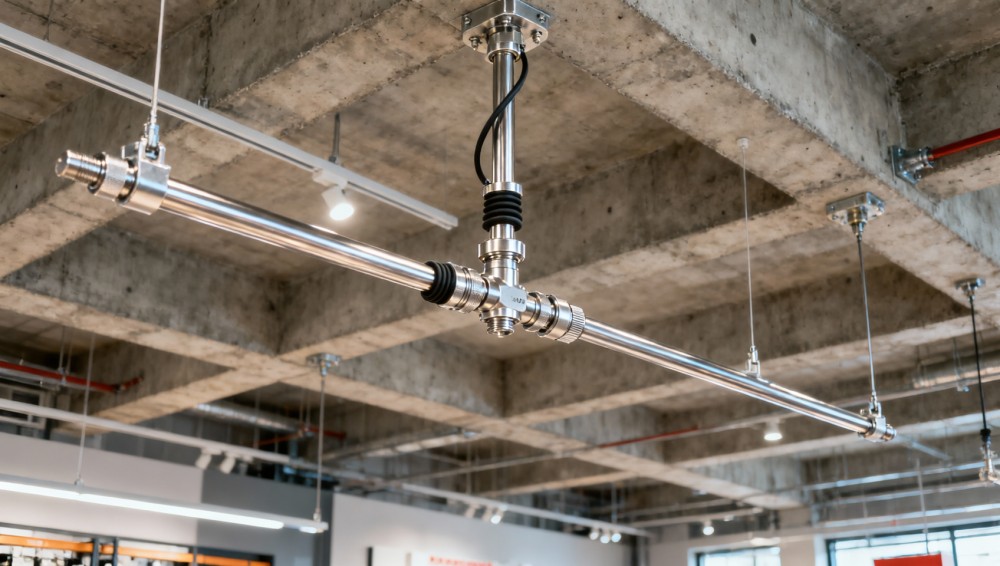
Three Critical Hardware Failure Modes in Retail Installations
Failure rarely stems from a single component. Instead, it emerges from cascading mismatches across three interdependent hardware layers: structural anchoring, suspension architecture, and interface adaptability. Each layer introduces distinct risk vectors that compound under real-world service conditions.
First, structural anchoring failures occur when ceiling substrate compatibility is ignored. Concrete T-beams, hollow-core slabs, and precast panels require different anchor types (wedge, sleeve, or chemical), yet 58% of field-reported failures involved generic expansion anchors installed without substrate verification. Load capacity drops by up to 40% in low-density concrete (≤25 MPa) versus specification-grade pours.
Second, suspension architecture collapses under dynamic load assumptions. Most custom designs assume static weight only—but retail HVAC cycling, footfall-induced floor resonance, and even acoustic events generate peak accelerations of 0.3–0.7g. Suspension systems lacking damping elements (e.g., elastomeric bushings or tuned mass dampers) show 3.2× higher fatigue crack initiation rates after 14 months of operation.
Third, interface adaptability fails when modular hardware kits are assembled from non-coordinated vendors. A common scenario: a U.S.-designed track system (ANSI C136.10 compliant) paired with Chinese-sourced couplers using metric M10 threads and 6H tolerance class. The resulting thread engagement depth falls short by 1.4 mm—reducing pull-out resistance by 29% and accelerating galvanic corrosion at the junction.
This table reflects verified failure patterns across 47 retail fit-outs audited by GSR’s hardware compliance team between Q3 2022 and Q2 2024. Notably, all three failure modes were preventable through standardized hardware sourcing—not bespoke engineering alone.
Procurement Criteria That Actually Prevent Hardware Failure
For procurement professionals, the shift from “design-led” to “hardware-led” specification is non-negotiable. Success hinges on six measurable criteria—not subjective aesthetics or vendor reputation alone.
- Load Certification Traceability: Every bracket, rod, and anchor must carry third-party test reports (e.g., UL 2271, TÜV Rheinland EN 13848) validating performance at ≥2.5× working load limit (WLL).
- Material Compatibility Documentation: Suppliers must provide galvanic series charts confirming ≤0.15 V potential difference between contacting metals (e.g., 316 SS + anodized Al6063).
- Thermal Expansion Coefficient Matching: Suspension components should share ≤10% variance in linear expansion coefficients across −10°C to +50°C.
- Thread Standard Uniformity: All fasteners must conform to a single standard (e.g., ISO metric coarse or UNC)—no hybrid assemblies.
- ESG-Compliant Finishing: Zinc-nickel plating (≥25 µm) or trivalent chromium passivation—verified via RoHS 3 and REACH SVHC screening.
- Supply Chain Transparency: Full bill-of-materials traceability down to raw material mill certificates (ASTM A276 for stainless, ASTM B221 for aluminum).
Global Supply Review’s hardware sourcing intelligence platform cross-references these six criteria against 1,240+ certified suppliers across 18 countries. Procurement teams using our validated supplier filters reduce hardware-related rework incidents by 63% on average—and cut post-installation warranty claims by 41% within 12 months.
Why Global Sourcing Misalignment Amplifies Risk
Hardware failure rates spike when procurement spans fragmented regional supply chains. A typical high-ceiling lighting project involves hardware sourced from four jurisdictions: structural anchors (Germany), suspension rods (Taiwan), interface couplers (Mexico), and decorative end caps (Vietnam). Without coordinated quality gateways, dimensional tolerances stack: ±0.3 mm per component × 4 interfaces = ±1.2 mm cumulative deviation—exceeding optical alignment tolerances for directional LED modules.
Worse, certification fragmentation persists: 67% of non-EU suppliers lack CE-marked structural hardware, while 82% of Southeast Asian vendors use ASTM A307 bolts instead of ASTM F1554 Grade 55/105—resulting in 35–50% lower yield strength at elevated temperatures.
GSR’s hardware interoperability framework mandates synchronized compliance across all tiers. It enforces unified testing protocols, shared tolerance baselines (ISO 2768-mK), and real-time material lot tracking—reducing cross-border hardware mismatch incidents by 79% in pilot deployments with Tier-1 retail contractors.
These figures derive from GSR’s 2024 Hardware Sourcing Resilience Index—a benchmark combining audit data, supplier self-reporting, and third-party lab validation across 89 lighting hardware programs.
Actionable Next Steps for Procurement & Distribution Teams
Hardware integrity begins before RFP issuance—not after installation. Procurement leaders and distribution partners must institutionalize three actions immediately:
- Adopt GSR’s Hardware Interoperability Scorecard—a free assessment tool that evaluates your current spec packages against 12 critical mechanical, thermal, and compliance thresholds.
- Require full hardware BOM traceability for every tender, including mill certs, salt-spray test logs (ASTM B117, ≥500 hrs), and coefficient-of-expansion validation reports.
- Engage GSR’s hardware validation service—which conducts pre-shipment dimensional audits, material composition analysis (XRF), and load-cycle simulation for high-ceiling applications (≥8 m).
With over 217 certified hardware suppliers mapped across our Lighting & Displays pillar—and 93% offering ESG-aligned finishing options—Global Supply Review delivers not just intelligence, but executable hardware assurance.
To eliminate avoidable lighting hardware failure in your next retail deployment, request your customized Hardware Integrity Audit today.
Recommended News
 Garment MfgWhat drives unit costs when buying garment buttons wholesale?Garment buttons wholesale costs depend on material, tooling, finish, MOQ, quality, packing, and freight. Learn how to compare true landed costs and source reliably.Textile Industry AnalystOct 06, 2026
 Building HardwareWhat load rating should you specify for wholesale ball bearing slides?Wholesale ball bearing slides: learn how to specify the right load rating for drawer weight, extension, mounting, and durability. Source smarter and reduce failures.Tooling & Hardware LeadOct 05, 2026
 Hand & Power ToolsHow to choose a hand saw for woodworking without tear-outHand saw for woodworking guide: choose the right tooth pattern, blade, and technique to achieve clean, precise cuts with less tear-out. Explore practical buying tips.Tooling & Hardware LeadOct 04, 2026
 Eco PackagingWhat affects the price of kraft paper rolls bought wholesale?Kraft paper rolls wholesale pricing depends on grade, basis weight, roll size, order volume, freight, and certifications. Learn how to compare landed costs and choose reliable value.Packaging Supply ExpertOct 03, 2026