Industry News
Curation by industry experts
Hot Articles
Popular Tags
Vietnam Enforces OEKO-TEX® Certification for Imported Wedding Backdrops
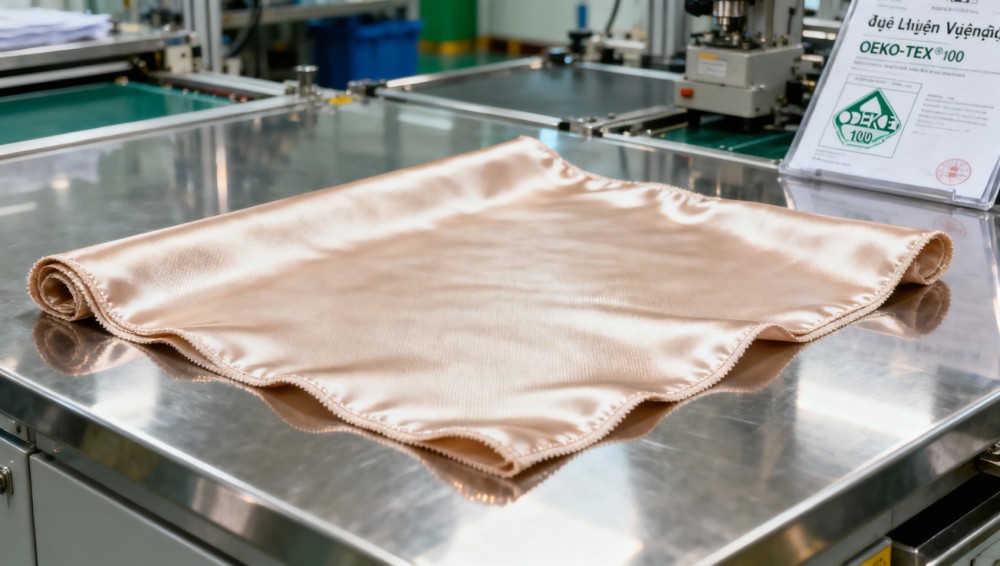
Effective 10 May 2026, Vietnam’s Ministry of Industry and Trade (MOIT) has introduced mandatory OEKO-TEX® Standard 100 certification — in Vietnamese language — for all imported fabric-based wedding photography backdrops. The regulation targets a niche but high-volume segment of the global wedding services supply chain, triggering immediate compliance adjustments among Chinese exporters and regional logistics providers.
Event Overview
Vietnam’s MOIT Circular No. 12/2026/TT-BCT entered into force on 10 May 2026. It requires that all imported fabric backdrops used in wedding photography — including polyester, cotton-linen blends, and flocking-based substrates — be accompanied by a Vietnamese-language OEKO-TEX® Standard 100 certificate at customs clearance. Shipments lacking compliant documentation will undergo 100% physical inspection at Ho Chi Minh City and Hai Phong ports and face mandatory return.
Industries Affected
Direct trading enterprises: Exporters based in China (the dominant source of such backdrops to Vietnam) now bear full responsibility for certificate localization. Non-compliant consignments risk port delays, storage fees, and re-export costs — directly impacting gross margin and delivery reliability. Unlike general textile exports, this rule applies regardless of shipment value or frequency, eliminating de minimis exemptions.
Raw material procurement enterprises: Buyers sourcing base fabrics (e.g., coated polyester film, flame-retardant cotton blends) from upstream mills must now verify whether those suppliers hold OEKO-TEX®-validatable production processes — and whether their existing certificates include Vietnamese translation rights. This adds a layer of due diligence previously absent in B2B textile procurement.
Manufacturing enterprises: Factories assembling finished backdrops (e.g., printed, sewn, or framed units) must ensure final product testing aligns with OEKO-TEX® Standard 100 Class I (for baby products) or Class II (for skin-contact items), depending on intended use. Since background fabrics often undergo post-printing treatments (e.g., anti-static coating, lamination), process validation — not just raw material certification — becomes critical.
Supply chain service enterprises: Customs brokers, third-party testing labs, and translation agencies serving cross-border textile trade are seeing surging demand for Vietnamese-language OEKO-TEX® documentation support. However, only laboratories accredited by OEKO-TEX®’s official partner network may issue valid certificates — limiting viable service providers to a narrow, pre-qualified pool.
Key Focus Areas and Recommended Actions
Verify certificate validity and language scope
OEKO-TEX® certificates issued in English or Chinese do not satisfy the requirement. Enterprises must confirm whether their current certifier is authorized to issue Vietnamese-language versions — and whether the certificate explicitly covers the exact fabric composition, finishing methods, and end-use category stated in Circular 12/2026/TT-BCT.
Initiate localized testing or re-certification before Q3 2026
Given typical OEKO-TEX® testing lead times (4–8 weeks) and Vietnamese translation turnaround (5–10 working days), suppliers should schedule new applications no later than early July 2026 to avoid clearance disruption during peak wedding season (September–November).
Update commercial invoices and packing lists
Customs declarations must now reference the Vietnamese certificate number and issuing lab ID. Misalignment between document sets (e.g., mismatched lot numbers or product descriptions) triggers automatic referral to MOIT’s Technical Compliance Unit — adding 3–5 working days to release timelines.
Editorial Perspective / Industry Observation
Analysis shows this is not an isolated safety measure but part of Vietnam’s broader regulatory convergence with EU-aligned textile sustainability frameworks. While OEKO-TEX® Standard 100 is voluntary globally, its adoption here signals a strategic pivot toward formalized chemical management — particularly for consumer-facing decorative textiles. Observably, similar requirements may soon extend to studio lighting gels, vinyl backdrops, and even non-woven props, given MOIT’s stated intent to harmonize with ASEAN Common Technical Regulation on Textile Products (ACTR-Textiles) by 2027.
From an industry perspective, the timing — just before Vietnam’s domestic wedding market enters its strongest annual cycle — suggests enforcement will be strict but calibrated: initial penalties likely emphasize education and corrective action over fines, especially for first-time filers. However, repeat non-compliance may trigger inclusion in MOIT’s ‘High-Risk Importer’ registry, triggering permanent 100% inspection status.
Conclusion
This regulation marks a tangible step toward institutionalizing chemical safety accountability across Vietnam’s creative services supply chain. It does not signal market closure — rather, it redefines entry conditions. For international suppliers, compliance is less about cost burden than operational discipline: aligning testing, documentation, and logistics around a single, localized standard. That shift, once embedded, may ultimately raise baseline quality expectations across ASEAN’s broader event production ecosystem.
Source Attribution
Official text: Vietnam Ministry of Industry and Trade (MOIT), Circular No. 12/2026/TT-BCT, effective 10 May 2026. Available at moit.gov.vn.
OEKO-TEX® accreditation framework: oeko-tex.com.
Note: MOIT has indicated plans to publish a list of approved Vietnamese-language OEKO-TEX® issuing labs by 30 June 2026 — a development requiring ongoing monitoring.
Recommended News
 Office FurnitureHow supplier scorecards reduce risk in furniture procurementFurniture procurement supplier management becomes more resilient with supplier scorecards that track quality, delivery, compliance, and corrective actions. Learn how to reduce sourcing risk.Interior Sourcing LeadSep 26, 2026
 Office Paper & Printing PaperHow roll diameter affects downtime when using jumbo paper rollsJumbo paper rolls can cut changeovers and downtime—if your unwinder, handling, and tension control can support them. Find the optimal roll diameter for smoother output.Packaging Supply ExpertSep 25, 2026
 Office Paper & Printing PaperWhen does carbonless paper for invoices reduce billing errors?Carbonless paper for invoices reduces billing errors by creating clear, consistent copies for deliveries, service calls, and approvals. Learn when it strengthens billing control.Packaging Supply ExpertSep 24, 2026
 Home DecorHow to compare floating wall shelves suppliers for consistent load capacityFloating wall shelves supplier comparison guide: evaluate load capacity, brackets, wall fixings, testing, and production consistency before you buy.Interior Sourcing LeadSep 23, 2026