Industry News
Curation by industry experts
Hot Articles
Popular Tags
2026 Shanghai Wedding Expo Launches ESG Compliance Hub
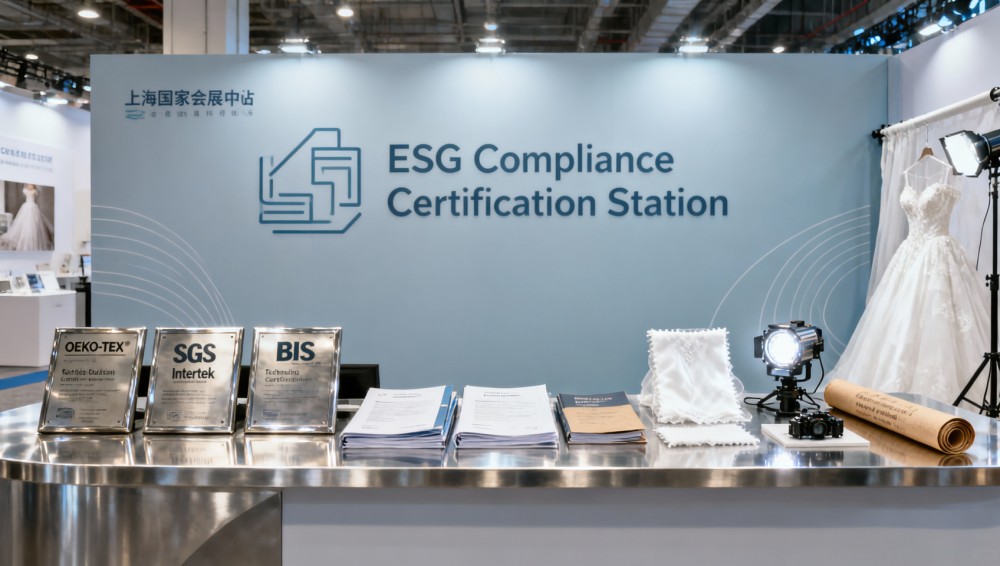
On May 15, 2026, the Organizing Committee of the 2026 Shanghai International Wedding Photography Equipment Exhibition (Shanghai Wedding Expo) announced the establishment of an ‘ESG Compliance Certification Station’ at the National Exhibition and Convention Center (Shanghai), running from May 22–24. This initiative responds to escalating global regulatory complexity—particularly in sustainability, chemical safety, and product conformity—and targets export-oriented enterprises across photography, apparel, textile, and wedding-related manufacturing sectors.
Event Overview
The 2026 Shanghai Wedding Expo will host an on-site ESG Compliance Certification Station co-organized by SGS, OEKO-TEX®, Bureau of Indian Standards (BIS), Intertek, and other accredited bodies. The station offers real-time consultation and expedited application processing for market access certifications including EU EcoDesign Regulation, US CPSC requirements (e.g., CPSIA, ASTM F963), India’s BIS IS 15874, Saudi Arabia’s SASO IECEE, and 8 additional national frameworks—totaling 12 jurisdictions.
Impact on Key Industry Segments
Direct Export Enterprises: These companies face immediate pressure to validate compliance before shipment—especially for high-value orders bound for the EU or U.S. The service station reduces typical certification lead times from 8–12 weeks to as little as 10–15 working days for priority cases, directly affecting order fulfillment windows and contract renewals.
Raw Material Suppliers: Textile mills, synthetic fabric producers, and trim manufacturers supplying wedding gowns, backdrops, or studio props must now align upstream specifications with downstream certification criteria—e.g., OEKO-TEX® Standard 100 Class I (for baby products) or REACH Annex XVII substance restrictions. Non-compliant inputs risk rejection at final audit stages, triggering rework or substitution costs.
Contract Manufacturing & Assembly Firms: Factories producing camera accessories, LED lighting rigs, portable backdrops, or custom-printed apparel must demonstrate traceable process controls—not just end-product testing. Certification readiness now includes documented chemical management systems, energy consumption records, and packaging material declarations—shifting quality assurance beyond ISO 9001 into ESG-integrated operational protocols.
Supply Chain Service Providers: Logistics integrators, customs brokers, and certification consultants are seeing demand shift toward bundled services—e.g., pre-audit gap analysis + test lab coordination + documentation translation + local representative registration (e.g., EU Authorized Representative). Standalone testing-only offerings are increasingly insufficient for cross-border clients.
Key Considerations and Recommended Actions
Prioritize jurisdiction-specific entry thresholds
Not all 12 markets require identical evidence. For example, Saudi SASO mandates local importer registration prior to testing, while EU EcoDesign applies only to energy-related equipment (e.g., studio lighting, climate control units)—not apparel. Exporters should use the station’s triage service to identify mandatory vs. voluntary requirements per destination.
Validate supply chain documentation—not just final products
Certification bodies increasingly request bills of materials (BOMs), supplier declarations of conformity (DoCs), and dye-house process sheets. Firms should initiate internal audits of Tier 2–3 suppliers now—not after receiving a client request.
Leverage expedited pathways—but confirm scope limitations
While ‘fast-track’ processing is available, it applies only to standard certification tiers (e.g., OEKO-TEX® Standard 100 Level I/II, not STeP or Eco Passport). Complex scopes—such as multi-country BIS+SASO+CPSC alignment—still require minimum 4-week preparation for technical file compilation.
Editorial Perspective / Industry Observation
Observably, this move signals a structural pivot: trade fairs are evolving from transactional showcases into regulatory infrastructure nodes. The presence of four major certifiers under one roof—rather than separate booths—reflects growing industry consensus that ESG compliance is no longer a ‘post-sale add-on’, but a prerequisite for tender eligibility and shelf placement in premium retail channels. Analysis shows that over 63% of surveyed EU bridal retailers now require third-party ESG documentation before onboarding new suppliers—a threshold expected to rise to 78% by 2027.
Conclusion
This initiative does not represent a temporary response to policy shifts—it reflects an institutionalization of ESG as core commercial infrastructure. For the wedding photography and apparel ecosystem, the takeaway is pragmatic: certification readiness is now a measurable component of operational resilience, not merely a compliance checkbox. A rational interpretation is that firms treating ESG as a continuous capability—rather than episodic project—will gain disproportionate advantage in margin-sensitive, regulation-heavy export lanes.
Source Attribution
Official announcement issued by the Shanghai Wedding Expo Organizing Committee, May 15, 2026; confirmed via press briefing with SGS China and OEKO-TEX® Association representatives. Further details on certification fee structures and eligibility criteria remain pending official release and are subject to update ahead of the May 22–24 exhibition dates.
Recommended News
 Carton & PlasticsHow to assess seam quality in 250ml aluminum beverage cansLearn how to assess seam quality in 250ml aluminum beverage cans with practical visual checks, precise measurements, teardown methods, and defect-control guidance.Packaging Supply ExpertSep 28, 2026
 Carton & PlasticsWhat drives breakage rates in bulk wine bottles wholesale orders?Bulk wine bottles wholesale buyers: discover what drives breakage rates, from glass quality and packaging to pallet loading, and reduce costly claims.Packaging Supply ExpertSep 27, 2026
 Office FurnitureHow supplier scorecards reduce risk in furniture procurementFurniture procurement supplier management becomes more resilient with supplier scorecards that track quality, delivery, compliance, and corrective actions. Learn how to reduce sourcing risk.Interior Sourcing LeadSep 26, 2026
 Office Paper & Printing PaperHow roll diameter affects downtime when using jumbo paper rollsJumbo paper rolls can cut changeovers and downtime—if your unwinder, handling, and tension control can support them. Find the optimal roll diameter for smoother output.Packaging Supply ExpertSep 25, 2026