Industry News
Curation by industry experts
Hot Articles
Popular Tags
India BIS Mandates IS 13252 Part 1:2026 Registration for Wedding LED Lights
On May 15, 2026, the Bureau of Indian Standards (BIS) issued an urgent notification (Ref: BIS/ET/NOT/2026/088), imposing a 60-day compliance deadline for LED lighting products used in wedding and portrait photography sold in India. The move signals a tightening of technical market access requirements — particularly around electromagnetic compatibility (EMC) resilience and after-sales infrastructure — with implications across export-oriented manufacturing, trading, and logistics ecosystems serving the Indian consumer electronics and professional imaging sectors.
Event Overview
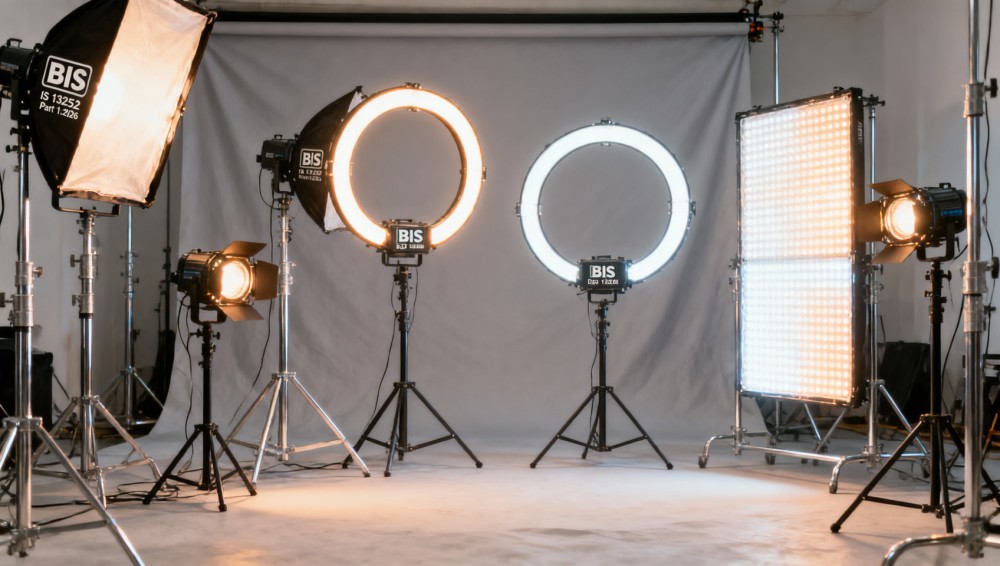
The Bureau of Indian Standards (BIS) published Notification BIS/ET/NOT/2026/088 on May 15, 2026, mandating that all LED lamps intended for bridal photography applications must obtain mandatory registration under the newly effective standard IS 13252 Part 1:2026 by July 14, 2026. Non-compliant products will be prohibited from sale or import into India after that date. Key technical additions in IS 13252 Part 1:2026 include EMC immunity level requirements (Level 3 per IEC 61000-4 series) and a new obligation for registrants to declare at least one authorized local service center in India.
Industries Affected
Direct Trading Enterprises: Exporters and distributors placing branded or private-label LED photography lights into the Indian market face immediate inventory and labeling risks. Products already cleared through customs but lacking valid BIS registration certificates may be detained or rejected at port-of-entry post-July 14. Impact manifests in delayed revenue recognition, increased documentation overhead, and potential contractual liability with Indian retail partners.
Raw Material Procurement Firms: Suppliers of key components — especially EMC-critical parts such as EMI filters, shielding gaskets, and certified power supply modules — are seeing rising demand for pre-validated, Level 3–compliant subassemblies. However, sourcing lead times are elongating due to limited regional certification capacity; this creates procurement bottlenecks unless firms proactively align with BIS-accredited test labs.
Manufacturing Enterprises: OEMs and ODMs producing LED studio lights — particularly those previously relying on legacy IS 13252 Part 1:2015 compliance — must now re-engineer PCB layouts, revise shielding designs, and conduct full-system EMC immunity testing. Retesting is not optional: BIS explicitly states that prior registrations under earlier editions do not grandfather into the 2026 version.
Supply Chain Service Providers: Certification consultants, local representative agencies, and BIS liaison service providers are experiencing surging inquiries. Yet the new local service center requirement adds operational complexity: third-party agents cannot substitute for physical, staffed, and BIS-declared service points — meaning logistics partners must now coordinate warehousing, technician training, and spare-part stocking aligned with BIS reporting timelines.
Key Focus Areas and Recommended Actions
Verify Product Scope Immediately
Not all LED lighting falls under this mandate. Only units marketed or functionally designed for ‘wedding, portrait, and studio photography’ — including ring lights, softboxes, and continuous LED panels with color temperature tuning — are covered. Firms should cross-check product literature, packaging claims, and BIS’s official scope guidance before initiating registration.
Prioritize EMC Level 3 Validation
Testing for immunity to radiated and conducted disturbances (IEC 61000-4-3, -4-4, -4-6) at Level 3 is non-negotiable and typically requires multiple design iterations. Companies should engage BIS-empanelled labs early — noting that lab capacity in India remains constrained, and overseas test reports require formal BIS acceptance via the Foreign Lab Recognition process.
Prepare Local Service Infrastructure Documentation
Applicants must submit proof of an operational service facility in India, including address verification, staffing details, and warranty handling protocols. This is not a nominal requirement: BIS reserves the right to conduct unannounced site audits. Firms without existing Indian entities may need to formalize partnerships with authorized service centers — but such arrangements must be contractually binding and disclosed during registration.
Editorial Perspective / Industry Observation
Observably, this notification reflects BIS’s broader strategic shift toward linking regulatory compliance with tangible domestic value creation — moving beyond safety and performance to include localized support infrastructure. Analysis shows that while EMC Level 3 is common in EU and U.S. professional lighting standards, its introduction into India’s mandatory regime marks the first time BIS has harmonized immunity rigor with service accountability in a single product standard. From an industry perspective, this is less about protectionism and more about accelerating maturity in India’s professional AV ecosystem — where reliability expectations are rising alongside content creator professionalism.
Conclusion
This regulation does not merely raise a technical bar — it redefines what constitutes ‘market-ready’ for photography lighting in India. For global suppliers, success hinges not only on engineering adaptation but also on institutional coordination across compliance, logistics, and after-sales planning. A rational interpretation is that BIS intends IS 13252 Part 1:2026 to serve as a pilot model for future revisions across other professional lighting categories — making timely response both urgent and strategically instructive.
Source Attribution
Official source: Bureau of Indian Standards (BIS), Notification No. BIS/ET/NOT/2026/088, dated May 15, 2026. Full text available via the BIS e-Portal (https://www.manakonline.in) under ‘Notifications > Electronics & IT’. Note: BIS has indicated that FAQs and updated application forms will be released by June 10, 2026 — these remain under active monitoring.
Recommended News
 Carton & PlasticsHow to assess seam quality in 250ml aluminum beverage cansLearn how to assess seam quality in 250ml aluminum beverage cans with practical visual checks, precise measurements, teardown methods, and defect-control guidance.Packaging Supply ExpertSep 28, 2026
 Carton & PlasticsWhat drives breakage rates in bulk wine bottles wholesale orders?Bulk wine bottles wholesale buyers: discover what drives breakage rates, from glass quality and packaging to pallet loading, and reduce costly claims.Packaging Supply ExpertSep 27, 2026
 Office FurnitureHow supplier scorecards reduce risk in furniture procurementFurniture procurement supplier management becomes more resilient with supplier scorecards that track quality, delivery, compliance, and corrective actions. Learn how to reduce sourcing risk.Interior Sourcing LeadSep 26, 2026
 Office Paper & Printing PaperHow roll diameter affects downtime when using jumbo paper rollsJumbo paper rolls can cut changeovers and downtime—if your unwinder, handling, and tension control can support them. Find the optimal roll diameter for smoother output.Packaging Supply ExpertSep 25, 2026