Industry News
Curation by industry experts
Hot Articles
Popular Tags
Indonesia BPOM to Regulate Wedding Prop Fabrics as Cosmetic Contact Materials
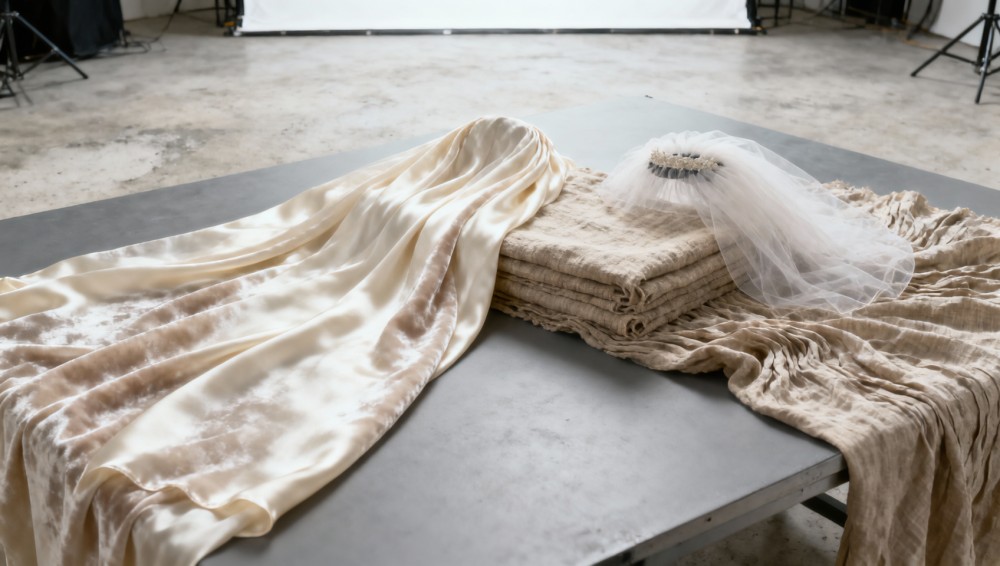
Indonesia’s National Agency of Drug and Food Control (BPOM) has proposed a regulatory shift that extends cosmetic contact material requirements to wedding photography fabric props—marking a notable expansion of its oversight into adjacent consumer-facing sectors. Announced on May 15, 2026, the move targets cotton-linen and silk-velvet items such as veils, shawls, and backdrop fabrics used in bridal photo sessions, citing potential dermal exposure during prolonged skin contact. While not classified as cosmetics per se, these items are now positioned within BPOM’s regulatory perimeter due to their functional proximity to cosmetic application contexts—particularly in studios where makeup, skincare, and hair styling occur concurrently with fabric-based posing.
Event Overview
On May 15, 2026, BPOM released Draft Regulation No. HK.02.02.BPOM.26.05.001 for public consultation. The draft proposes classifying bridal photography fabric props—including veils, shawls, and backdrop cloths made from cotton-linen or silk-velvet blends—as ‘cosmetic contact materials’. A pilot implementation begins June 1, 2026, in Jakarta and Bali. Under the proposal, formaldehyde migration from these materials must not exceed 15 ppm—a threshold stricter than ISO 105-E01:2020, which sets 75 ppm as the upper limit for general textile products.
Industries Affected
Direct trading enterprises: Exporters and importers of bridal photography props into Indonesia face new compliance obligations. As BPOM requires pre-market verification (e.g., test reports from BPOM-accredited labs), traders must now secure formaldehyde migration certifications prior to customs clearance. This adds lead time and third-party testing costs—especially for SMEs lacking in-house regulatory capacity.
Raw material procurement enterprises: Suppliers sourcing base textiles (e.g., bleached cotton gauze, dyed velvet) for downstream prop manufacturers will need to verify upstream chemical treatments. Since formaldehyde is often introduced via anti-wrinkle finishing or dye fixation, procurement teams must now request supplier declarations and batch-specific migration data—not just fiber composition or colorfastness reports.
Manufacturing enterprises: Factories producing veils, draping cloths, or studio backdrops must adapt production workflows to avoid formaldehyde-retaining finishes. This includes reformulating coating agents, adjusting curing temperatures, and implementing post-production rinsing protocols. Notably, the 15 ppm limit applies to finished goods—not raw fabrics—meaning final assembly (e.g., stitching lace onto tulle) may reintroduce contamination if non-compliant trims are used.
Supply chain service enterprises: Testing laboratories, certification bodies, and logistics providers offering BPOM-related support will see rising demand for formaldehyde migration testing under BPOM’s specified extraction method (HK.02.02.34.01). However, only labs accredited under BPOM’s Lembaga Uji Terakreditasi (LUT) framework can issue valid reports—limiting options for foreign labs unless they’ve completed local recognition procedures.
Key Considerations and Response Measures
Verify product scope before assuming exemption
Not all fabric-based props fall under the draft rule: only those marketed or functionally used in bridal photography settings where direct, repeated skin contact occurs (e.g., veils draped over shoulders, shawls worn during shoots). Studio décor items placed >1 m from subjects—or synthetic fabrics like polyester satin not listed in the annex—are currently outside scope. Enterprises should map product use cases, not just material composition.
Prioritize batch-level migration testing over generic claims
BPOM’s enforcement focuses on migration from the final assembled item. A ‘formaldehyde-free’ dye declaration does not suffice if heat-sealing tape or adhesive-backed lace introduces residual formaldehyde during finishing. Companies must test representative finished units—not just fabric swatches—using BPOM’s prescribed aqueous extraction at 40°C for 30 minutes.
Engage early with BPOM-accredited labs in Jakarta or Denpasar
Testing turnaround times are expected to rise during the pilot phase. Pre-booking slots with LUT-accredited labs—such as Balai Besar POM di Jakarta or BBPOM di Denpasar—is advisable. Note: Reports issued before June 1, 2026, remain valid only if re-validated against the final regulation text once published.
Editorial Perspective / Industry Observation
Analysis shows this proposal reflects BPOM’s broader strategic pivot toward ‘exposure-context-driven regulation’—where risk assessment hinges less on product category labels and more on real-world usage patterns. Observably, it also signals growing alignment with EU-style precautionary logic, albeit applied selectively to high-visibility consumer segments. From an industry perspective, this is less about tightening textile safety standards universally and more about establishing jurisdictional precedent: if bridal props qualify, future expansions to theatrical costumes, spa linens, or even infant photo props appear plausible. Current regulatory uncertainty lies not in technical feasibility—but in whether BPOM will extend the 15 ppm limit beyond the pilot regions, or retain flexibility for material-specific thresholds (e.g., higher allowances for dense velvet vs. sheer tulle).
Conclusion
This initiative underscores how regulatory boundaries are increasingly defined by human interaction—not manufacturing taxonomy. For global suppliers, it serves as a reminder that compliance must now account for downstream service environments, not just product specifications. A rational interpretation is that BPOM is using the bridal photography sector as a low-risk proving ground for a more dynamic, context-sensitive regulatory model—one that could reshape expectations across multiple adjacent industries in Southeast Asia.
Source Attribution
Draft Regulation No. HK.02.02.BPOM.26.05.001, published by Badan Pengawas Obat dan Makanan (BPOM) on May 15, 2026. Available via www.pom.go.id (public consultation portal). Final regulation text, effective date extension beyond pilot zones, and official list of accredited labs remain subject to revision and require ongoing monitoring.
Recommended News
 Carton & PlasticsHow to assess seam quality in 250ml aluminum beverage cansLearn how to assess seam quality in 250ml aluminum beverage cans with practical visual checks, precise measurements, teardown methods, and defect-control guidance.Packaging Supply ExpertSep 28, 2026
 Carton & PlasticsWhat drives breakage rates in bulk wine bottles wholesale orders?Bulk wine bottles wholesale buyers: discover what drives breakage rates, from glass quality and packaging to pallet loading, and reduce costly claims.Packaging Supply ExpertSep 27, 2026
 Office FurnitureHow supplier scorecards reduce risk in furniture procurementFurniture procurement supplier management becomes more resilient with supplier scorecards that track quality, delivery, compliance, and corrective actions. Learn how to reduce sourcing risk.Interior Sourcing LeadSep 26, 2026
 Office Paper & Printing PaperHow roll diameter affects downtime when using jumbo paper rollsJumbo paper rolls can cut changeovers and downtime—if your unwinder, handling, and tension control can support them. Find the optimal roll diameter for smoother output.Packaging Supply ExpertSep 25, 2026