Industry News
Curation by industry experts
Hot Articles
Popular Tags
EU Mandates ERP Energy Labels for LED Studio Lights Under EN 14904:2026
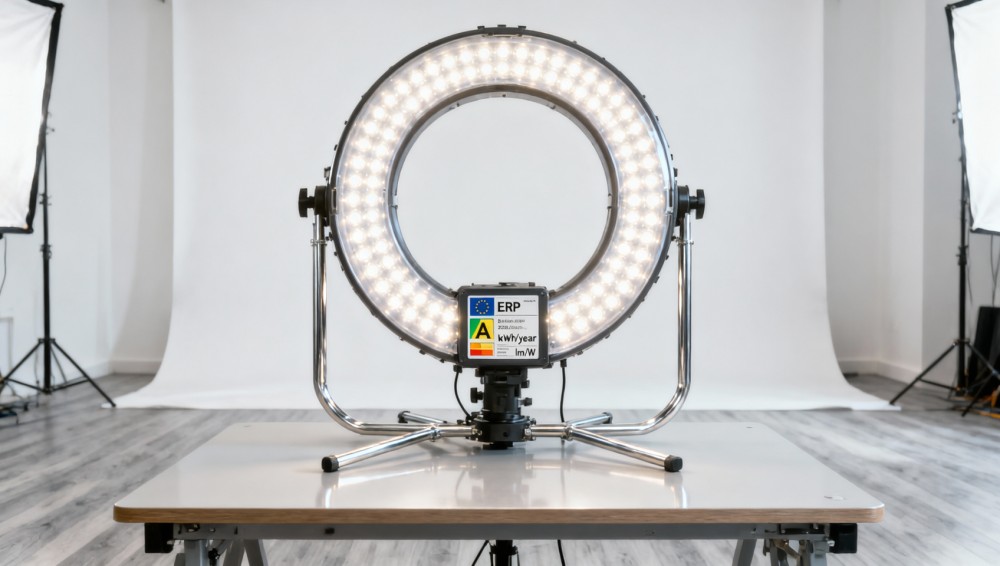
The European Union published an updated harmonised standard, EN 14904:2026, in the Official Journal of the European Union (OJEU) on 31 May 2026. This regulatory update introduces mandatory energy labelling requirements under the EU’s Ecodesign Directive (ERP) for LED studio lighting equipment — including ring lights, softbox light sources, and track-mounted follow-spot systems — destined for the EU market.
Regulatory Update: Key Facts Effective 1 December 2026
EN 14904:2026 was formally adopted and published in the OJEU on 31 May 2026. As of 1 December 2026, all LED studio lights placed on the EU market must comply with the ERP Ecodesign requirements. Compliance includes successful certification against the updated standard and affixing a multilingual ERP energy label directly on the product and its smallest retail packaging. The label must display the energy efficiency class (A–G), annual energy consumption (kWh/year), and luminous flux ratio (lm/W), using official EU languages appropriate to the destination member state. Exporters based in China are required to complete production-line label adaptation and testing registration within 90 days of the OJEU publication date.
Impact Across the Lighting Supply Chain
Export Trading Companies
These entities face immediate implications for customs clearance and market access. Non-compliant shipments risk rejection at EU borders or post-market surveillance penalties. Label language accuracy, correct classification, and traceability documentation now form critical components of export documentation packages — not just CE marking.
Raw Material and Component Suppliers
Suppliers of drivers, thermal management modules, and optical elements may experience revised technical specifications from downstream manufacturers. Increased demand for high-efficiency, low-power-loss components — especially those enabling higher lm/W ratios — is anticipated as OEMs recalibrate designs to meet the A–G grading thresholds.
Lighting Manufacturers and Assemblers
Production lines require revalidation to accommodate label placement (including durability, legibility, and multilingual layout), while internal test protocols must align with updated ERP verification methods. Product data sheets, user manuals, and online listings must reflect certified energy performance metrics — with no deviation between physical labels and digital representations.
Supply Chain Service Providers
Testing laboratories, certification bodies, and regulatory consultants will see heightened demand for EN 14904:2026-specific assessments, ERP dossier preparation, and multilingual label verification services. Lead times for certification may tighten, requiring earlier engagement in product development cycles.
Actionable Priorities for Exporters
Immediate ERP Certification and Labelling Alignment
Manufacturers must initiate ERP conformity assessment with an EU-recognised Notified Body before 1 December 2026. Internal labelling processes — including print resolution, adhesive durability, language set selection per country, and packaging integration — must be validated and documented within the 90-day window following the 31 May 2026 OJEU notice.
Energy Performance Validation and Technical Documentation
Test reports must cover full operating conditions per EN 14904:2026 Annexes, including photometric measurements under stable thermal equilibrium and power consumption across typical usage profiles. Technical files must include energy labelling declarations, calculation methods for luminous flux ratio, and traceable calibration records.
Supplier Qualification and Component Traceability
OEMs must verify that key subcomponents — particularly LED modules and drivers — are sourced from suppliers capable of providing ERP-relevant performance data. Supplier contracts should explicitly reference compliance obligations under EN 14904:2026 and ERP Regulation (EU) 2019/2020.
Industry Perspective: Beyond Compliance, Toward Differentiation
Analysis shows this update signals a strategic shift: energy labelling is evolving from a minimum-access requirement into a competitive differentiator. Observably, studios and broadcast facilities increasingly factor energy efficiency into procurement decisions — especially where multiple units operate continuously. It is more appropriate to understand this as both a compliance threshold and a market signal favouring integrated design excellence. What deserves closer attention is how rapidly ERP-driven efficiency gains may accelerate adoption of adaptive dimming, intelligent thermal control, and human-centric lighting features — all of which influence lm/W outcomes and long-term operational cost savings.
Strategic Implications for Global Lighting Markets
This regulation reinforces the EU’s role as a de facto global benchmark for professional lighting sustainability. While limited in scope to studio applications, EN 14904:2026 sets a precedent for broader ERP expansion into other specialty lighting categories. For exporters, it underscores that regulatory readiness must now be embedded in early-stage R&D — not treated as a final pre-shipment checkpoint.
Source Transparency and Verification Guidance
This article is generated exclusively from the provided input: title, event date (31 May 2026), and summary description. Specific official source links were not provided in the input and should be verified continuously. Stakeholders are advised to monitor updates from the European Commission’s Ecodesign and Energy Labelling Portal, national market surveillance authorities, and the latest OJEU supplements for implementation guidance, enforcement timelines, and interpretation clarifications. Continued observation is recommended regarding certification body acceptance criteria, label validation procedures, and potential transitional provisions for existing stock.
Recommended News
 Home DecorHow order size affects wholesale prices for round linen tableclothsBuying round linen tablecloths wholesale? Discover how order size, freight, and inventory costs affect pricing—and choose the right quantity to maximize real savings.Interior Sourcing LeadOct 14, 2026
 Outdoor FurnitureHow to verify outdoor furniture manufacturers' production capacityCan outdoor furniture manufacturers deliver on time? Learn how to verify production capacity, uncover bottlenecks, and validate supplier commitments before placing your next order.Interior Sourcing LeadOct 13, 2026
 Commercial DisplaysWhat makes an outdoor digital signage display manufacturer reliable?Discover how to choose a reliable outdoor digital signage display manufacturer with proven weather protection, quality control, smart visibility, and responsive after-sales support.Commercial Tech EditorOct 12, 2026
 Garment MfgWhen do bulk embroidered hoodies offer better value than printed ones?Bulk embroidered hoodies deliver lasting value for uniforms and premium branding. Compare durability, design, comfort, and cost to choose the right decoration.Textile Industry AnalystOct 11, 2026