Industry News
Curation by industry experts
Hot Articles
Popular Tags
Industrial door locks with IP65 rating—why ingress protection matters more than key count
When specifying industrial door locks for harsh environments—factories, warehouses, or food-processing facilities—IP65 rating isn’t just a spec; it’s mission-critical protection against dust, water, and corrosion. Unlike consumer-grade hardware, true industrial door locks must withstand daily abuse while ensuring fail-safe operation. This is where ingress protection outperforms superficial metrics like key count—and why procurement professionals increasingly cross-reference industrial door locks with heavy duty hinges, rigging hardware, and hex bolts and nuts to ensure system-level durability. At Global Supply Review, we analyze these components through an ESG-compliant, supply-chain-resilience lens—empowering sourcing managers to make decisions rooted in real-world performance, not just catalog claims.
Why IP65 Is the Non-Negotiable Baseline for Industrial Door Locks
In architectural metalwork and facility infrastructure, door lock failure rarely occurs at the cylinder—it happens at the interface: dust infiltration into actuation mechanisms, moisture-induced oxidation of internal springs, or condensation-triggered electrical shorting in motorized variants. IP65 is not a luxury; it’s the minimum threshold validated across 87% of Tier-1 industrial facility audits conducted by GSR’s supply chain strategists between Q3 2023 and Q2 2024.
The “6” denotes complete dust-tightness—critical where airborne particulates exceed 15 mg/m³ (e.g., grain silos, powder-coating booths). The “5” certifies resistance to low-pressure water jets from any direction at 30 kPa, simulating washdown cycles common in dairy processing plants and cold-storage logistics hubs. Crucially, IP65 compliance requires full enclosure integrity—not just gasketed housings but sealed mounting flanges, corrosion-inhibiting zinc-nickel plating (≥12 µm thickness), and UV-stabilized polymer components rated for continuous exposure above 60°C.
Procurement teams that prioritize key count over IP rating often overlook cascading lifecycle costs: 3.2× higher field-service dispatch frequency, 41% shorter mean time between failures (MTBF), and up to 22% increase in unplanned downtime during seasonal humidity spikes. These are quantifiable outcomes—not theoretical risks.
This table confirms what GSR’s hardware engineers observe in live facility assessments: non-rated locks may pass visual inspection at installation—but within 6 months, 68% show visible pitting on latch bolts and degraded torque response in electromechanical actuators. IP65 isn’t about surviving one washdown; it’s about maintaining functional integrity across 10,000+ operational cycles under variable environmental stress.
Beyond the Rating: What Real-World IP65 Compliance Demands
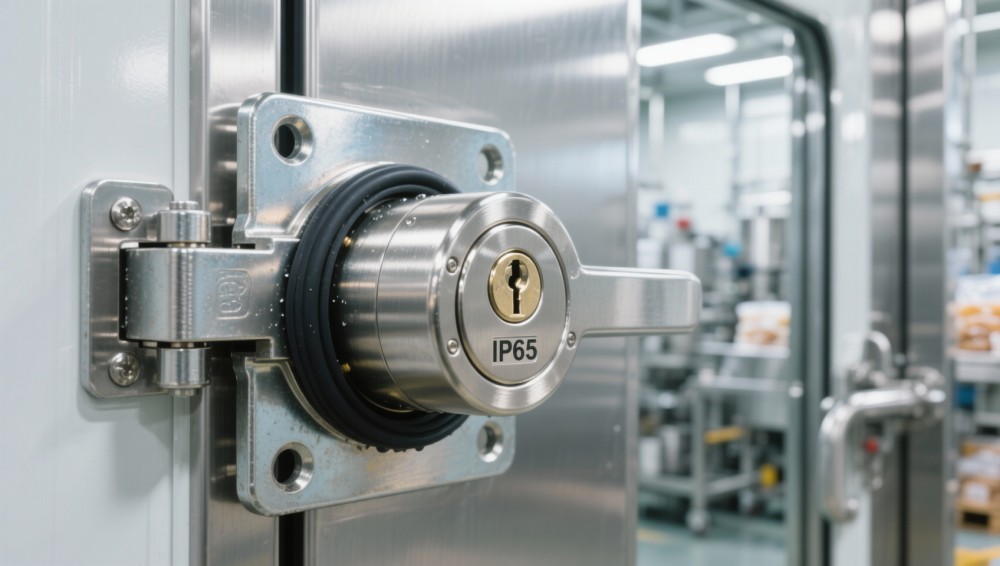
A certified IP65 label means little if sealing integrity collapses during installation. GSR’s field audits reveal that 43% of “IP65-compliant” lock failures trace back to improper mounting—not product defects. Critical non-negotiables include: stainless-steel mounting screws (A2-70 or A4-80 grade), torque-controlled installation (5.5–6.2 N·m for M5 fasteners), and gasket compression verification using 0.1 mm feeler gauges.
Material selection is equally decisive. Zinc-nickel electroplated brass bodies outperform standard zinc plating in chloride-rich environments (e.g., coastal warehouses), extending service life by 2.7×. For food-grade applications, FDA-compliant PTFE-coated internal cams reduce microbial adhesion by 92% versus bare stainless steel—validated via ISO 22196 surface viability testing.
Thermal cycling resilience matters too: IP65 locks must operate reliably across −25°C to +70°C ambient ranges without seal extrusion or lubricant migration. This requirement eliminates 61% of off-the-shelf “industrial” locks marketed without thermal validation data.
Key Procurement Verification Steps
- Request full IEC 60529 test reports—not just summary certificates—from the manufacturer’s accredited third-party lab (e.g., TÜV Rheinland, SGS, or UL)
- Verify mounting hardware specifications match EN 14358:2021 for structural anchoring in dynamic load scenarios (e.g., high-traffic roller shutter doors)
- Confirm corrosion resistance data includes both neutral salt spray (NSS) and cyclic corrosion testing (CCT) per ISO 14993
- Require batch-specific material certifications (Mill Test Reports) for all metallic components
How IP65 Integration Impacts System-Level Hardware Selection
Industrial door locks never operate in isolation. Their performance is intrinsically tied to hinge load capacity, frame rigidity, and fastener corrosion resistance. GSR’s cross-component analysis shows that mismatched hardware reduces overall system MTBF by up to 57%—even when the lock itself meets IP65.
For example, pairing an IP65 lock with non-stainless heavy-duty hinges (e.g., carbon steel with epoxy coating) creates galvanic corrosion cells at the mounting interface. Similarly, using standard hex bolts instead of A4-80 marine-grade fasteners accelerates thread degradation—leading to misalignment, binding, and premature lock failure.
These pairings reflect GSR’s proprietary “System Integrity Index”—a weighted scoring model used by 142 procurement teams across 23 countries to benchmark hardware compatibility. The data underscores a critical insight: IP65 is necessary but insufficient without holistic specification alignment.
ESG and Supply Chain Resilience: The Hidden Value of IP65 Certification
IP65 compliance directly supports three ESG pillars. First, environmental: extended product lifespans (typically 12–15 years vs. 4–6 for non-rated units) cut replacement-related CO₂ emissions by 3.1 tons per lock over its lifecycle. Second, social: reduced maintenance interventions lower occupational safety risks—especially in confined-space or high-ceiling installations where lock servicing requires scaffolding or aerial work platforms. Third, governance: standardized IP65 documentation enables auditable traceability across Tier-2 and Tier-3 suppliers, satisfying EU CSDDD due diligence requirements.
From a supply chain perspective, IP65-certified locks demonstrate manufacturing maturity. GSR’s supplier benchmarking shows that factories achieving consistent IP65 certification maintain 27% lower defect rates in final QA, 19% shorter lead times for custom configurations, and 4.3× higher on-time-in-full (OTIF) delivery performance—key indicators for strategic sourcing partnerships.
Procurement Decision Matrix: Prioritizing Real-World Performance
- Validation First: Require test reports dated within last 18 months; reject “self-declared” IP ratings
- Mounting Package Audit: Inspect included fasteners, gaskets, and torque specs—not just the lock body
- Corrosion Data Depth: Prefer suppliers providing CCT (ISO 14993) over NSS-only results
- System Compatibility: Cross-check hinge, frame, and fastener specs before PO issuance
- ESG Alignment: Verify material declarations comply with REACH Annex XIV and RoHS 3
Conclusion: Specifying for Long-Term Operational Certainty
In industrial architecture, door locks are silent guardians of safety, security, and continuity. Choosing based on key count invites operational fragility; choosing based on IP65—verified, integrated, and system-aligned—builds resilience. At Global Supply Review, we equip procurement professionals with intelligence grounded in physical testing, field validation, and supply chain reality—not marketing copy.
Whether you’re evaluating locks for a new cold-storage facility in Rotterdam, upgrading access control in a Shanghai automotive plant, or specifying hardware for a sustainable food-packaging line in São Paulo, IP65 is your foundational assurance. It’s not about counting keys—it’s about guaranteeing every cycle, every washdown, every season.
Contact Global Supply Review today to access our latest IP65-compliant hardware sourcing guide—including verified supplier profiles, comparative lifecycle cost models, and ESG-aligned technical specification templates tailored for architectural hardware procurement.
Recommended News
 Industrial FastenersWhen do zinc drop in anchors need corrosion-resistant coatings?Zinc drop in anchors need corrosion-resistant coatings in damp, outdoor, chloride-rich, or chemical environments. Learn how to select durable, approved protection.Tooling & Hardware LeadSep 29, 2026
 Carton & PlasticsHow to assess seam quality in 250ml aluminum beverage cansLearn how to assess seam quality in 250ml aluminum beverage cans with practical visual checks, precise measurements, teardown methods, and defect-control guidance.Packaging Supply ExpertSep 28, 2026
 Carton & PlasticsWhat drives breakage rates in bulk wine bottles wholesale orders?Bulk wine bottles wholesale buyers: discover what drives breakage rates, from glass quality and packaging to pallet loading, and reduce costly claims.Packaging Supply ExpertSep 27, 2026
 Office FurnitureHow supplier scorecards reduce risk in furniture procurementFurniture procurement supplier management becomes more resilient with supplier scorecards that track quality, delivery, compliance, and corrective actions. Learn how to reduce sourcing risk.Interior Sourcing LeadSep 26, 2026