Industry News
Curation by industry experts
Hot Articles
Popular Tags
Synthetic Leather Coating Line Selection Guide for Buyers in 2026
Synthetic Leather Coating Line Selection Guide for Buyers in 2026
Buying teams entering 2026 are facing a more complex equipment market than they did only a few years ago. Synthetic leather production remains relevant across footwear, automotive interiors, furniture, bags, sports goods, and industrial materials, but expectations around consistency, cost control, environmental management, and production flexibility have all increased. For procurement specialists, commercial evaluators, financial approvers, and project owners, choosing a coating line is no longer a narrow machinery decision. It is a capital investment that can affect product positioning, operating efficiency, defect rates, and the ability to respond to customer specifications over time.
That shift matters because many coating projects are now expected to serve multiple product categories rather than a single fixed output. A line that appears acceptable on paper may still create hidden constraints if it struggles with coating uniformity, changeover efficiency, drying performance, or long-term maintenance. In many cases, the cost of poor equipment selection does not appear during installation. It shows up later through unstable quality, excessive energy use, bottlenecks in scaling production, or difficulty meeting buyer requirements for surface feel and visual consistency.
As a result, the most effective buyers in 2026 are likely to approach line selection as a cross-functional review. Technical suitability, supplier capability, lifecycle cost, and project execution risk all deserve equal attention. This is especially true in synthetic leather processing, where coating quality is closely tied to both machine design and process stability.
Why the Decision Deserves More Attention in 2026
Several industry realities are shaping the way companies evaluate new coating assets. First, customer expectations for finish quality have become more demanding. Surface defects, inconsistent thickness, uneven drying, and poor adhesion can reduce the commercial value of finished material even when raw material costs remain high. Second, operating costs continue to matter more in investment reviews. Energy consumption, labor efficiency, maintenance frequency, and scrap rate can materially change the total return on an equipment purchase.
Third, many manufacturers are under pressure to improve process discipline. That includes better control over emissions, safer plant operations, cleaner production environments, and more repeatable output. Even where regulations vary by market, internal quality systems and customer audits often push factories toward tighter operating standards. Equipment selection therefore affects more than production speed. It can also influence how confidently a plant manages compliance, reporting, and customer qualification.
For finance and project approval stakeholders, this means the purchase decision should not be reduced to initial price alone. A lower upfront figure may be less attractive if it introduces greater downtime risk, more manual intervention, or a weaker fit with planned product expansion.
Key Evaluation Criteria for a Coating Line
A practical selection process usually starts with production goals. Buyers should clarify target materials, coating types, expected output range, required finish quality, and downstream process integration. Without that baseline, comparing machine options becomes difficult and often misleading.
The following areas usually deserve close review:
- Coating precision: Uniform application is central to product quality. The line should support stable coating thickness and surface consistency across the intended material width.
- Drying and curing performance: Drying efficiency affects both throughput and finish stability. Uneven temperature control can create quality problems that are expensive to correct later.
- Material handling: Tension control, web guidance, and transport stability are important when working with different substrates or product specifications.
- Changeover flexibility: Plants serving varied orders may need faster adjustment between formulations, thickness targets, or product widths.
- Maintenance accessibility: Buyers should assess how easy it is to clean, inspect, service, and replace wear parts without excessive production interruption.
- Automation and controls: The right control level depends on plant capability, but stable monitoring and repeatable settings usually support better operating consistency.
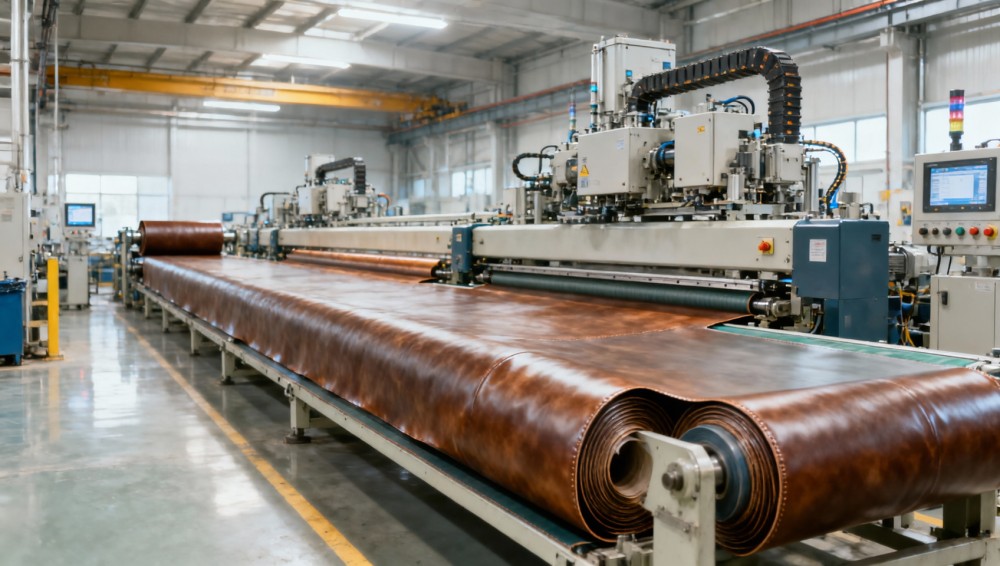
In many cases, a suitable synthetic leather coating line should be evaluated not only for nominal capacity, but also for its ability to maintain process stability across different product runs, resin systems, and production schedules. That broader view helps buyers avoid investing in equipment that performs well in ideal conditions but becomes inefficient under real factory demands.
Questions Procurement and Commercial Teams Should Ask
Commercial and sourcing teams often need a framework that translates technical complexity into decision-ready questions. A useful review may include the following:
- Does the line match current production needs only, or does it also support likely product expansion over the next several years?
- How dependent is stable performance on operator skill, and what training burden should the factory expect?
- Which components are most likely to affect downtime, and how available are replacements or technical support?
- What utility requirements should be factored into the project budget, including heat, ventilation, electrical load, and plant layout adjustments?
- How easily can the line integrate with existing upstream and downstream processes?
These questions matter because procurement decisions often fail when assumptions are left untested. A quotation may look competitive, but incomplete review of installation needs, spare parts planning, or line compatibility can delay commissioning and weaken the business case.
Common Selection Mistakes
One common mistake is focusing on peak output instead of usable output. A line rated for high speed may still deliver disappointing economics if quality becomes unstable at practical operating conditions. Another mistake is overlooking the relationship between coating formulation and machine design. Not every line handles every process requirement equally well, especially where drying behavior, viscosity control, or substrate sensitivity can vary.
Buyers also sometimes underestimate project execution risk. Delivery schedule, installation support, commissioning experience, and operator training can influence payback almost as much as machine configuration. For project managers, this means vendor evaluation should include not just equipment scope but also implementation readiness.
Another avoidable issue is treating maintenance as a secondary concern. In real manufacturing environments, access for cleaning and repair can have a direct effect on uptime. Equipment that is difficult to maintain may create recurring production losses that were not visible during early commercial comparison.
Comparing Options Through Total Cost of Ownership
For financial approvers, total cost of ownership is often the most reliable way to compare options. The purchase price is only one part of the equation. Energy demand, material waste, labor intensity, maintenance intervals, spare part consumption, and expected service life should all be considered.
This approach is particularly useful when internal stakeholders have different priorities. Procurement may focus on sourcing terms, engineering may focus on technical reliability, and finance may focus on capital efficiency. A total-cost framework helps align those views into a more defensible decision.
Selection Priorities by Business Scenario
Different factories may need different answers, even when they operate in the same broad market. A plant serving large-volume standardized output may prioritize stable throughput, energy efficiency, and predictable maintenance. A manufacturer handling smaller batches or varied finishes may care more about process flexibility, adjustment speed, and recipe repeatability.
For new project builds, layout fit and utility planning often deserve early attention. For expansion projects, compatibility with existing systems may matter more. In export-oriented production, process consistency and documentation discipline may carry added weight because customer audits can place pressure on both output quality and operating control.
This is why buyers should avoid copying another company’s machine choice without examining their own production mix, staffing model, and commercial objectives. A technically sound line in one factory may not be the right commercial fit in another.
What a Strong Buying Process Looks Like
A disciplined buying process typically combines technical review, supplier discussion, internal cost modeling, and implementation planning. Teams may benefit from documenting critical requirements in advance, including target substrates, coating method, required width, quality tolerance, utility constraints, and expected operating rhythm. That reduces ambiguity during quotation and technical clarification.
It is also sensible to review the supplier’s ability to support installation, commissioning, training, and after-sales service. In capital projects, weak execution support can delay ramp-up and reduce confidence among internal stakeholders. For project leaders, the objective is not simply to install a line, but to reach stable production with manageable risk.
By 2026, buyers who treat coating line selection as a strategic manufacturing decision are likely to be in a stronger position than those who focus narrowly on headline specifications. The right equipment choice can support quality consistency, cost discipline, and future flexibility. The wrong one can lock a business into years of preventable inefficiency. For companies investing in synthetic leather production capability, careful selection remains one of the clearest ways to protect both operational performance and capital value.
Recommended News
 Commercial DisplaysWhat makes an outdoor digital signage display manufacturer reliable?Discover how to choose a reliable outdoor digital signage display manufacturer with proven weather protection, quality control, smart visibility, and responsive after-sales support.Commercial Tech EditorOct 12, 2026
 Garment MfgWhen do bulk embroidered hoodies offer better value than printed ones?Bulk embroidered hoodies deliver lasting value for uniforms and premium branding. Compare durability, design, comfort, and cost to choose the right decoration.Textile Industry AnalystOct 11, 2026
 Carton & PlasticsHow to compare packaging automation suppliers for line integrationPackaging automation supplier comparison guide: evaluate line integration, controls, safety, testing, lifecycle costs, and support to select a proven partner.Packaging Supply ExpertOct 10, 2026
 Home DecorWhich decor exhibition in the USA best fits a home decor sourcing trip?Decor exhibition USA guide: compare High Point Market, Las Vegas Market, NY NOW, and HD Expo to choose the best event for your home decor sourcing trip.Interior Sourcing LeadOct 08, 2026