Industry News
Curation by industry experts
Hot Articles
Popular Tags
Canton Fair Phase II: $121M in Bridal Photo Props Deals, ESG-Compliant Kits Lead
On May 17, 2026, the China Import and Export Fair (Canton Fair) Phase II — focused on home goods and gifts — concluded with $121 million in意向成交 (intended trade deals) from its newly launched ‘Bridal Photography Props Export Zone’. Notably, ESG-compliant kits — comprising LED lighting, OEKO-TEX®-certified fabrics, and FSC-certified cardboard packaging — accounted for 68% of those deals. This development signals a measurable shift in buyer priorities among European and U.S. importers, particularly in sectors where product compliance, sustainability documentation, and multi-market regulatory alignment are increasingly decisive factors over price alone.
Event Overview
According to the Canton Fair Organizing Committee’s official closing notice issued on May 17, 2026, the ‘Bridal Photography Props Export Zone’ — introduced during Phase II of the 2026 Canton Fair — achieved $121 million in intended trade deals. Of this total, 68% consisted of integrated ESG-compliant kits defined as combinations of LED lighting units, OEKO-TEX®-certified textile components, and FSC-certified shipping cartons. The Organizing Committee reported that European and U.S. buyers explicitly cited ‘single-package compliance with multiple national regulatory requirements’ as their primary procurement rationale.
Industries Affected
Direct Exporting Enterprises
Exporters specializing in wedding-related photo props — including backdrops, stands, lighting accessories, and decorative fabric elements — face revised buyer expectations. The dominance of bundled ESG kits indicates demand is shifting from component-level sourcing toward pre-validated, documentation-ready systems. Impact manifests in tighter lead times for certification coordination, increased need for cross-supplier traceability, and pressure to consolidate third-party audit evidence into unified product dossiers.
Raw Material Suppliers
Suppliers of textiles, LEDs, and paper-based packaging are experiencing downstream demand realignment. OEKO-TEX® certification for fabrics and FSC certification for corrugated boxes are no longer optional differentiators but de facto prerequisites for inclusion in high-volume export kits. Impact includes heightened inquiry volume for certified stock lots, requests for batch-level compliance documentation, and potential margin compression where certification costs cannot be passed through efficiently.
Contract Manufacturers & Assemblers
Manufacturers assembling photo props — especially those integrating lighting, fabric, and structural elements — must now manage multi-tier compliance integration. The 68% share of ESG kits implies that final assembly lines are expected to verify, retain, and sometimes co-brand compliance data across subcomponents. Impact includes added internal QA steps, documentation handover protocols with Tier-2 suppliers, and exposure to delays if upstream certifications lapse or lack harmonization.
Distribution & Logistics Service Providers
Forwarders, customs brokers, and labeling service providers supporting bridal prop exports are encountering more complex documentation workflows. ESG kits require coordinated submission of OEKO-TEX® test reports, FSC chain-of-custody records, and LED safety certifications (e.g., CE, UL) per shipment. Impact includes longer pre-shipment verification cycles, higher frequency of document rejections due to mismatched certificate expiry dates or incomplete scope statements, and growing demand for compliance-aware logistics support staff.
What Relevant Companies or Practitioners Should Focus On Now
Monitor Official Updates on Certification Harmonization Efforts
The Canton Fair’s reporting highlights buyer emphasis on ‘multi-country regulatory alignment’. Analysis shows this reflects ongoing efforts by EU and U.S. agencies to converge textile chemical restrictions (e.g., EU REACH Annex XVII vs. U.S. CPSIA limits) and packaging sustainability rules. Companies should track updates from the European Commission’s Joint Research Centre and the U.S. Consumer Product Safety Commission — not just for compliance, but to anticipate which certification combinations may gain broader recognition.
Prioritize Verification of Supplier-Level Certification Validity and Scope
Because ESG kits aggregate certifications across tiers, invalid, expired, or narrowly scoped certificates from raw material suppliers directly jeopardize entire kit eligibility. Current practice requires verifying not only certificate issuance date and issuing body, but also whether test reports cover the exact dye lots, substrate weights, or electrical configurations used in final assembly. This goes beyond standard supplier audits and demands documented, version-controlled certificate repositories.
Distinguish Between Policy Signals and Operational Readiness
The 68% share of ESG kits at Canton Fair Phase II reflects strong buyer intent — but does not yet indicate universal market adoption. Observably, this figure represents deals struck at a single trade fair under controlled conditions; it does not reflect fulfillment rates, post-order compliance audits, or return patterns. Companies should treat this as an early signal of tightening standards — not proof of full-scale market conversion — and avoid premature capital expenditure on full-line ESG retrofitting without validating actual order-level requirements.
Prepare Documentation Handover Protocols with Tier-2 Suppliers
ESG kits require traceable, auditable links between final product and underlying certifications. From industry perspective, successful exporters are already implementing standardized digital templates for certificate submission — specifying required fields (e.g., report number, test standard version, sample ID), acceptable file formats, and retention timelines. Preparing these protocols now reduces friction when buyers request full compliance dossiers during order processing.
Editorial Perspective / Industry Observation
This Canton Fair outcome is best understood not as a completed market transition, but as a measurable inflection point in buyer decision-making criteria. Analysis shows the $121 million figure captures intended deals — not confirmed shipments — and the 68% ESG-kit share reflects concentrated demand from a specific buyer cohort (European and U.S. importers active in the bridal photography channel), not broad-based industry-wide adoption. Nevertheless, the explicit prioritization of regulatory alignment over cost suggests compliance infrastructure is evolving from a risk-mitigation function into a core commercial capability. It is currently more accurate to interpret this as a strong policy signal than an operational mandate — one that warrants structured monitoring, not immediate wholesale reengineering.

Conclusion: The Canton Fair Phase II results underscore a maturing expectation among key Western buyers: sustainability and safety compliance are no longer additive features, but foundational prerequisites embedded in product system design. For affected enterprises, the priority is not to replicate the ESG kit model universally, but to strengthen traceability, documentation discipline, and cross-tier certification governance — capabilities that will remain relevant regardless of how specific certification combinations evolve. This development is better viewed as a calibration point for compliance maturity, rather than a deadline for full ESG transformation.
Source: Canton Fair Organizing Committee, Closing Notice issued May 17, 2026.
Note: Ongoing observation is recommended regarding actual fulfillment rates of the $121M in intended deals, and whether the 68% ESG-kit share holds across subsequent trade fairs or direct B2B channels.
Recommended News
 Eco PackagingWhat affects the price of kraft paper rolls bought wholesale?Kraft paper rolls wholesale pricing depends on grade, basis weight, roll size, order volume, freight, and certifications. Learn how to compare landed costs and choose reliable value.Packaging Supply ExpertOct 03, 2026
 Commercial LEDHow to evaluate a canopy lights factory before placing a bulk orderCanopy lights factory evaluation guide: verify specifications, compliance, quality control, capacity, and after-sales support before placing a bulk order.Commercial Tech EditorOct 02, 2026
 Commercial LEDHow to choose lighting systems that meet workplace safety needsLighting systems for workplace safety: learn how to control glare, improve visibility, meet environmental demands, and protect workers with reliable, compliant lighting choices.Commercial Tech EditorOct 01, 2026
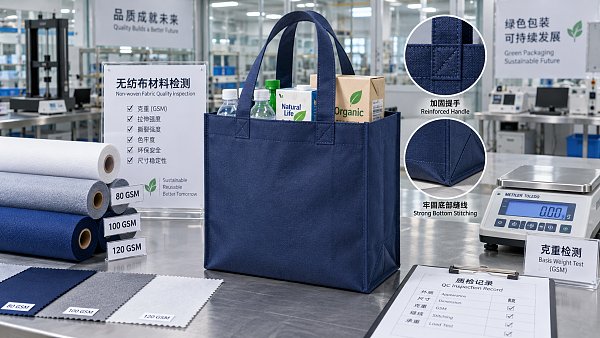
 Fabrics & YarnsWhat fabric weight works best for reusable non woven fabric bags?Non woven fabric for bags: discover the best GSM range for durability, load capacity, print quality, and cost-effective reusable bag sourcing.Textile Industry AnalystSep 30, 2026