Industry News
Curation by industry experts
Hot Articles
Popular Tags
EU EN 14904:2026 Mandates ERP Energy Labels for LED Studio Lights
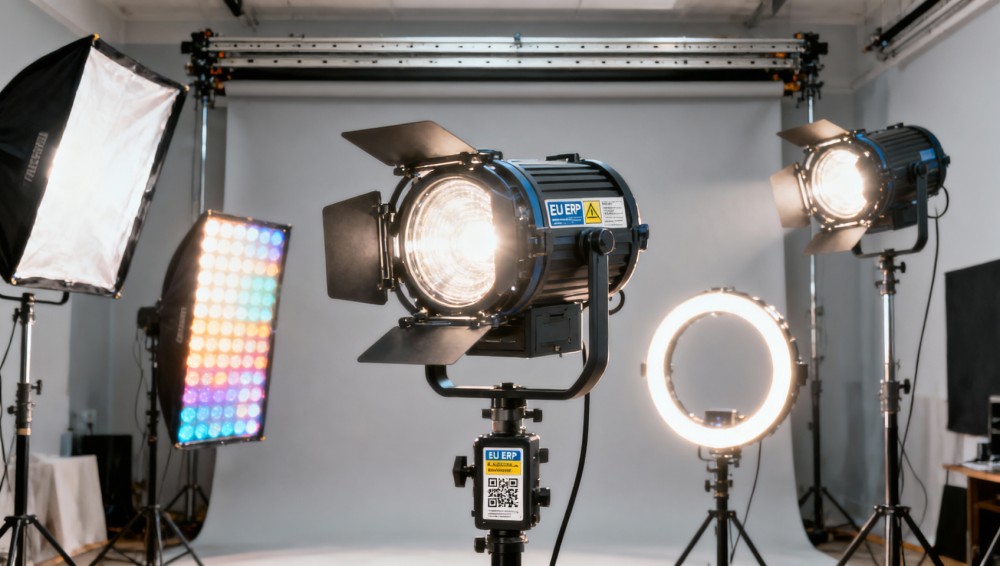
On 20 May 2026, the revised EU standard EN 14904:2026 enters into force, requiring all LED studio lighting products marketed in the EU for wedding and portrait photography to bear an ERP energy efficiency label and a reparability label—including a QR code linking to the official repair manual. This development directly affects manufacturers, importers, and distributors operating in professional photographic lighting markets—and signals a tightening of sustainability and compliance requirements across the EU’s lighting supply chain.
Event Overview
The European standard EN 14904:2026 becomes mandatory on 20 May 2026. It applies specifically to LED studio lamps intended for photographic studios, including those used in wedding photography. Under this standard, affected products must display both an ERP (Energy-related Products) energy efficiency rating and a reparability label with a functional QR code directing users to the manufacturer’s publicly accessible repair documentation. Non-compliant products will fail CE marking verification and risk market withdrawal or customs detention within EU member states.
Industries Affected by Segment
Manufacturers of Professional LED Studio Lighting
These companies are directly responsible for product design, labeling, documentation, and CE conformity assessment. The requirement introduces new technical obligations—not only for energy performance testing but also for structured repair documentation and QR-based digital accessibility—adding complexity to product certification workflows.
Importers and EU Authorized Representatives
As legal entities placing products on the EU market, importers and authorized representatives must verify compliance before affixing the CE mark. Failure to confirm label accuracy, QR functionality, or alignment between the repair manual and actual product architecture may trigger liability under Regulation (EU) 2019/1020 on market surveillance.
Distributors and E-commerce Platforms Selling Studio Lighting
Stock-holding and online sellers face increased due diligence responsibilities. They must ensure incoming inventory carries valid, correctly applied labels and that associated digital content remains live and up to date. Absence of compliant labeling may result in removal from listings or refusal of customs clearance at EU borders.
Aftermarket Service Providers and Repair Networks
While not directly regulated under EN 14904:2026, service providers may experience indirect impact: the standard’s emphasis on repairability could raise customer expectations regarding spare part availability, diagnostic support, and firmware update transparency—potentially influencing service-level agreements and warranty terms.
Key Focus Areas and Recommended Actions
Monitor Official Updates from CEN and the European Commission
Confirm whether transitional provisions apply, and whether guidance documents—such as interpretation notes on QR code hosting requirements or acceptable formats for repair manuals—will be published ahead of enforcement. No such clarifications have been issued as of the standard’s publication date.
Verify Labeling Requirements Against Product Portfolio
Identify which specific SKUs fall under the scope of EN 14904:2026 (i.e., LED-based, fixed or portable studio lights designed for portrait/wedding use). Note that general-purpose LED lighting or video production fixtures are not explicitly covered unless reclassified under future amendments.
Assess Supply Chain Readiness for Documentation and Label Integration
Ensure internal processes support timely generation and validation of QR-linked repair manuals—including version control, multilingual support (where required), and secure, persistent web hosting. Physical label placement must comply with visibility, durability, and legibility rules outlined in Annex ZA of EN 14904:2026.
Align CE Technical Files Ahead of Market Placement
Update existing CE technical documentation to include ERP test reports, reparability assessments, and evidence of QR code functionality. Notified bodies may request these during audits or random market surveillance checks post-20 May 2026.
Editorial Observation / Industry Insight
Observably, EN 14904:2026 reflects a broader regulatory shift toward integrating circular economy principles—particularly repairability—into energy-related product legislation. Analysis shows this is less a standalone technical update and more a signal of convergence between ERP Directive (2009/125/EU) and the upcoming Ecodesign for Sustainable Products Regulation (ESPR). From an industry perspective, it marks the first time reparability labeling has been formally mandated for a lighting subcategory under harmonized standards. Current enforcement appears focused on documentation integrity and label presence rather than deep technical re-evaluation of repair design—but sustained attention is warranted as market surveillance activity increases post-implementation.
Conclusion: EN 14904:2026 does not represent a broad-based lighting regulation, but a targeted compliance milestone for a high-value niche segment. Its significance lies not in immediate market disruption, but in its role as an early indicator of how sustainability criteria—especially digital-accessible repair information—are being operationalized in EU product law. For affected stakeholders, it is more appropriately understood as a procedural checkpoint than a strategic inflection point; readiness hinges on precise scoping, documentation rigor, and cross-functional coordination—not technological overhaul.
Source(s): European Committee for Standardization (CEN) – EN 14904:2026 publication record; Official Journal of the European Union reference: L 123/2026. Note: Implementation timelines, notified body interpretations, and potential amendments remain subject to ongoing observation.
Recommended News
 Home DecorHow order size affects wholesale prices for round linen tableclothsBuying round linen tablecloths wholesale? Discover how order size, freight, and inventory costs affect pricing—and choose the right quantity to maximize real savings.Interior Sourcing LeadOct 14, 2026
 Outdoor FurnitureHow to verify outdoor furniture manufacturers' production capacityCan outdoor furniture manufacturers deliver on time? Learn how to verify production capacity, uncover bottlenecks, and validate supplier commitments before placing your next order.Interior Sourcing LeadOct 13, 2026
 Commercial DisplaysWhat makes an outdoor digital signage display manufacturer reliable?Discover how to choose a reliable outdoor digital signage display manufacturer with proven weather protection, quality control, smart visibility, and responsive after-sales support.Commercial Tech EditorOct 12, 2026
 Garment MfgWhen do bulk embroidered hoodies offer better value than printed ones?Bulk embroidered hoodies deliver lasting value for uniforms and premium branding. Compare durability, design, comfort, and cost to choose the right decoration.Textile Industry AnalystOct 11, 2026