Industry News
Curation by industry experts
Hot Articles
Popular Tags
What to check before ordering wholesale nesting side tables in Europe
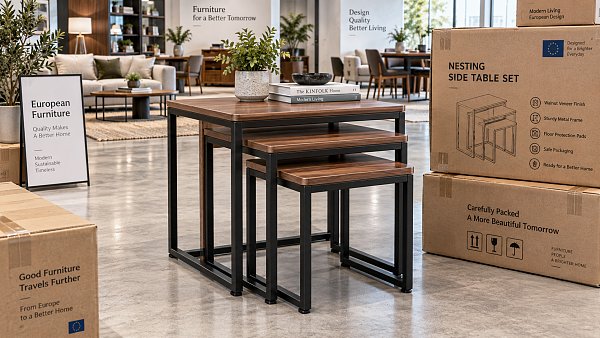
Before placing an order for wholesale nesting side tables in Europe, procurement teams should assess more than unit price and design appeal. A compact set of tables can look straightforward on a product sheet, yet the commercial risks often sit in the details: unstable frames, inconsistent veneer tones, inadequate cartons, unclear material declarations, or a lead time that does not match the retail calendar.
Nesting tables occupy an interesting position in the furniture market. They are space-efficient, visually flexible, and suitable for living rooms, hotel lounges, serviced apartments, reception areas, and compact urban homes. That versatility makes them appealing to buyers—but it also means the same product may be judged by very different standards depending on the channel. A retailer may focus on flat-pack damage rates and sell-through. A hospitality buyer may care more about surface durability, safety, and repeat-order consistency. Project purchasers may need exact dimensions, finish matching, and reliable delivery windows.
The following checks help purchasing teams compare suppliers on the basis of landed value and market readiness, rather than an attractive quotation alone.
Begin with the commercial brief, not the catalogue image
“Nesting side table” describes a format, not a single product specification. Before requesting quotations, define the product role in your range. Is it a low-priced volume item for online retail? A design-led accent piece for an interiors collection? A durable contract-furniture set for public spaces? The answer changes the acceptable material, construction method, packaging level, and target cost.
A usable buying brief should state the intended market, number of tables per set, dimensional range, preferred materials, colour direction, target retail or project price, required order quantity, and delivery deadline. It should also identify any non-negotiable features: adjustable feet, rounded corners, a particular wood appearance, scratch-resistant coating, or plastic-free packaging, for example.
This step prevents a common sourcing problem: comparing quotations that look comparable but are built around different assumptions. One supplier may quote powder-coated steel and melamine board; another may assume solid wood legs and veneered tops. The lower offer is not necessarily a better offer—it may simply be a different product.
Ask for a full product specification sheet
For each shortlisted model, request a document that goes beyond overall dimensions. It should show the dimensions of every table in the set, nesting clearance, tabletop thickness, frame or leg profile, material grade, finish system, hardware, net and gross weight, assembly method, carton dimensions, and care instructions. If the tables are supplied assembled, confirm whether protective pads or separators are used where pieces contact one another during transport.
Pay close attention to the nesting mechanism itself. Tables should slide together smoothly without scraping finished surfaces, catching on weld points, or creating awkward gaps when displayed separately. The design needs enough tolerance for normal production variation, but not so much that the set looks loose or poorly resolved.
Check materials where the customer will touch, see, and judge them
Material descriptions can sound more definitive than they are. “Wood,” “marble look,” “metal finish,” and “oak effect” should all be translated into precise construction details before an order is issued.
For wood-based tops, establish whether the core is particleboard, MDF, plywood, solid timber, or another engineered panel. Each has different implications for edge quality, screw holding, weight, moisture resistance, and price. Veneered panels may offer a more natural appearance than printed décor paper, but they also require tighter control of grain selection, staining, and repairability. If a table has a natural timber surface, buyers should agree in advance how much tonal and grain variation is acceptable.
For metal frames, ask about wall thickness, tube or rod diameter, welding points, surface preparation, and coating type. A slim steel frame can be perfectly suitable for a light occasional table, but it must be engineered for the intended load and repeated handling. Uneven welds, sharp edges under paint, or poor powder-coat adhesion tend to become visible after delivery—not at the quotation stage.
Stone, ceramic, glass, and sintered-stone-look surfaces demand their own review. Confirm edge finishing, backing support, corner protection, and weight distribution. A beautiful top that is inadequately supported may crack in a warehouse or during final-mile delivery. For glass components, clarify thickness, edge treatment, and any safety-related documentation required for the intended market and application.
Finish consistency is a procurement issue, not only a design issue
European furniture buyers frequently work across multiple sales channels and seasonal collections. A mismatch between batches can create costly returns or leave a retailer with a range that no longer photographs consistently. Obtain physical finish samples where possible, not only digital renderings. Approve a master sample that identifies sheen level, colour reference, grain direction, metal tone, and texture.
For black, white, walnut, oak, brass, and travertine-look finishes, seemingly small shifts can be conspicuous when products are displayed in groups. Ask the supplier how colour is controlled across production batches and whether the same material source will be used for repeat orders. This is particularly important if the assortment includes matching coffee tables, consoles, shelving, or dining furniture.
Test structural performance in the way the tables will actually be used
A nesting set is moved more often than a fixed side table. Customers pull the smaller table out, reposition it beside a sofa, use it as an occasional laptop surface, or place drinks and decorative objects on it. Hospitality guests may use it less gently. That reality should shape the quality review.
Request information on intended load capacity for each table and how stability has been assessed. Rather than accepting a broad assurance, examine the likely weak points: leg-to-top connections, cross braces, weld joints, corner blocks, fasteners, and the contact area between the nesting pieces. Tables should stand level on a flat surface and remain steady under ordinary directional pressure.
Floor protection also matters. Confirm whether felt pads, glides, or adjustable feet are included and whether they are fitted at the factory or packed separately. Loose accessories may reduce factory labour, but they can increase consumer frustration and create preventable post-sale complaints.
Do not treat compliance documentation as an afterthought
Requirements vary by country, product construction, material, and route to market, but buyers selling furniture in Europe generally need confidence that products meet applicable safety, chemical, labelling, packaging, and product-information obligations. The responsible economic operator and importer obligations should also be understood before goods move.
Ask suppliers what documentation they can provide for the specific construction being quoted, rather than accepting generic statements. Depending on the materials involved, this may include declarations or test reports relating to restricted substances, formaldehyde emissions for wood-based panels, coatings, adhesives, metal finishes, or glass safety. Packaging materials may also trigger separate environmental and labelling considerations in the destination country.
Sustainability claims deserve the same discipline. If a supplier presents a table as recycled, responsibly sourced, low-emission, or plastic-free, request evidence that supports the wording you intend to use. Vague environmental language can become a commercial and reputational risk once product information reaches retailers or consumers.
For buyers supplying several European markets, it is worth creating a documentation matrix early: destination countries, applicable product information, language needs, packaging responsibilities, and files held by the supplier versus files held by the importer. This is less glamorous than selecting finishes, but it avoids frantic corrections when containers are already booked.
Calculate landed cost from the carton outward
The purchase price of a nesting table set is only one part of the financial picture. Because these products often contain multiple individual pieces, their packaging design can heavily influence freight cost and damage exposure. A set that nests efficiently may save cubic volume; a fully assembled set with bulky protective material may be more expensive to transport even if its ex-works price is lower.
Request carton dimensions, carton weight, units per carton, cartons per pallet, pallet height, and container-loading assumptions. Compare these figures on a like-for-like basis. If suppliers quote different Incoterms, normalise the offers before deciding which one is cheaper. Include inland transport, freight, insurance where relevant, duty exposure, port handling, customs administration, warehousing, quality inspections, and an allowance for damage or returns.
Packaging should be inspected as a system. Corner protectors, foam alternatives, honeycomb paper, protective sleeves, internal dividers, and drop-test performance may all be relevant depending on the material. The goal is not to demand excessive packaging; it is to use enough protection to survive the actual journey while meeting your waste-reduction objectives.
Minimum order quantity can conceal a working-capital problem
A competitive unit price attached to a high MOQ can be expensive if it forces a buyer to hold slow-moving stock. Clarify whether the MOQ applies per SKU, finish, carton, or total order value. Ask whether mixed colours or mixed models are permitted and whether repeat orders can use a lower production threshold after the initial run.
For a new range, a staged approach may be safer: approve samples, place a commercially viable opening order, review sales and damage data, then plan replenishment. This is especially relevant for trend-sensitive finishes and compact furniture collections where assortment changes quickly.
Audit the supplier’s ability to repeat the product
A sample tells you what a supplier can make once. Procurement needs to know whether the supplier can make the same product reliably at scale. Discuss production capacity, subcontracted processes, material sourcing, quality-control points, and contingency planning for delayed components. If the table combines wood, metal, and specialist surface materials, identify which elements are made in-house and which are purchased externally.
Lead time should be broken into realistic stages: sample approval, raw-material procurement, production, finishing, internal inspection, packing, booking, and dispatch. A quoted lead time without a clear start point can create confusion. Is it counted from deposit, artwork approval, final sample sign-off, or confirmed purchase order?
Before bulk production, establish an agreed reference sample and inspection standard. Define what counts as a major defect, which visual variations are acceptable, how measurements will be checked, and what corrective action applies if goods fail inspection. Independent pre-shipment inspection can be useful for higher-value orders or first-time supplier relationships, but it works best when the criteria are specific and agreed beforehand.
Questions worth asking before issuing the purchase order
- Can you provide a final bill of materials for this exact nesting table set?
- What are the tolerances for dimensions, colour, tabletop thickness, and nesting clearance?
- Which tests or declarations can support the materials and finishes used for European sale?
- How is each component protected inside the carton, especially edges and contact points?
- What is the planned production lead time, and what events could extend it?
- Are replacement parts available for damaged tops, legs, hardware, or floor pads?
- What are the MOQ rules for mixed finishes, repeat orders, and custom packaging?
- Can packaging artwork, warnings, assembly instructions, and origin markings be reviewed before printing?
A better buying decision is usually made before price negotiation
When sourcing wholesale nesting side tables Europe, the strongest negotiating position comes from a clear specification and a realistic view of risk. Once materials, finish standards, packaging, documentation, and delivery expectations are defined, price discussions become more meaningful. Buyers can decide where savings are acceptable—perhaps in carton design, a simplified frame detail, or a shared component across several models—without quietly sacrificing product performance.
Nesting side tables may be small pieces of furniture, but they travel through a long chain of decisions: factory production, container loading, customs handling, warehouse storage, retail display, assembly, and daily use. A disciplined pre-order review protects margin at every point in that chain. It also gives procurement teams something more valuable than the lowest quoted cost: confidence that the product arriving in Europe will be the product they approved.
Recommended News
 Home DecorWhat to check before ordering wholesale nesting side tables in EuropeWholesale nesting side tables Europe: assess materials, stability, compliance, packaging, landed cost, and supplier reliability before ordering with confidence.Interior Sourcing LeadSep 19, 2026
 Commercial LEDHow to verify product compliance when sourcing lighting suppliers in GermanyLighting suppliers Germany: learn how to verify CE evidence, test reports, labels, environmental declarations, and production controls before approving orders.Commercial Tech EditorSep 18, 2026
 Textile MachineryWhat capacity should you specify when choosing a garment washing machine manufacturer?Garment washing machine manufacturer guide: choose the right capacity by matching batch loads, wash recipes, daily output, utilities, and downstream line flow.Textile Industry AnalystSep 17, 2026
 Supply Chain InsightsHow to vet supplier reliability in hardware materials wholesaleHardware materials wholesale buyers can vet suppliers with practical checks for quality, capacity, compliance, pricing, and delivery reliability. Explore the full framework.Sep 16, 2026