Industry News
Curation by industry experts
Hot Articles
Popular Tags
How to verify mill test reports when buying A325 structural bolts wholesale
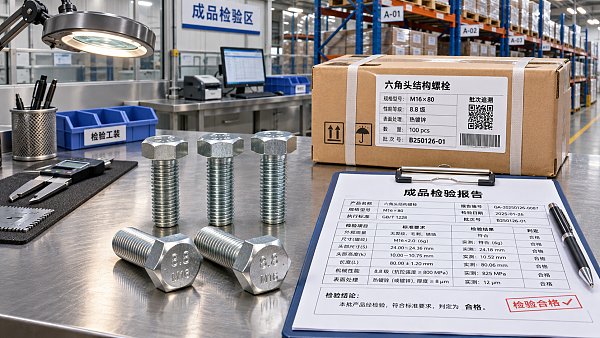
A low unit price for A325 structural bolts can quickly lose its appeal if the shipment arrives with certificates that cannot be linked to the supplied lots. Before accepting a wholesale order, compare the purchase specification, package identification, material records, and finished-bolt test results. A report with plausible numbers is useful only when its scope and traceability match the actual bolts.
The most reliable review starts before the order is placed. Define the required bolt grade, dimensions, coating, documentation, and applicable specification edition in the purchase order. Ask for records covering the finished fasteners and any required coating, rather than assuming a steel mill’s chemical analysis alone establishes compliance.
Start with the exact requirement on the order
A325 is commonly used as shorthand for a structural bolt grade now covered by ASTM F3125/F3125M. The purchase documents should state the applicable grade, specification edition, dimensions, and any supplementary requirements. An older drawing or contract may refer to ASTM A325; resolve that reference against the governing project documents before accepting a substitute designation. A supplier’s statement that two documents are equivalent does not, by itself, amend the order.
Identify whether the required fasteners are inch or metric, the specified diameter and length, the bolt type where applicable, and the finish. These details affect the requirements used to evaluate the report. For example, a test result that is acceptable for one diameter range cannot automatically be assessed against the limits for another. Likewise, a report for plain bolts does not establish that a subsequently coated shipment meets the ordered condition.
Include the required certificate package in the quotation request. If documentation must be available before shipment, state that explicitly. Establish who pays for independent testing, replacement, and freight if records are missing or the supplied goods fail agreed acceptance requirements. These terms make documentation costs visible when comparing offers.
Distinguish the steel report from the finished-bolt certificate
A mill test report generally records the identity and tested properties of a steel heat. It supports the material history, but bolts undergo manufacturing operations that can change their properties. Depending on the production route, those operations include forming, threading, heat treatment, and coating. A raw-material report alone therefore cannot demonstrate every requirement applicable to the finished fastener.
Request a manufacturer’s test report or certificate covering the finished bolt lot, together with supporting material records where required by the order. The documents should identify the applicable specification and grade, lot or production identification, test results, and the organization responsible for certification. When a separate laboratory performs testing, its report should identify the tested sample and the party requesting the work. A laboratory result and a manufacturer’s certificate serve different purposes; neither automatically fills gaps in the other.
Terminology varies between suppliers. A document titled “MTR,” “mill certificate,” or “certificate of compliance” may contain different levels of detail. Read its content rather than accepting the title as proof that all required tests were performed. A certificate that only says “conforms to A325” leaves no reported measurements to compare with the specification or the order.
Connect each box to the records
Traceability is the link between a physical shipment and its supporting evidence. Start with the package labels and packing list, then follow the lot identification through the finished-bolt certificate to the underlying material heat where records require it. Record the quantity, size, grade, finish, lot number, and relevant document references for each line item.
Do not assume that a heat number and a finished-fastener lot number mean the same thing. A heat identifies a batch of steel; a fastener lot identifies product grouped under the applicable production and testing rules. One steel heat can be used to make several fastener lots, and the treatment of mixed heats or production lots depends on the governing requirements. The certificate or a documented traceability statement should explain the relationship without relying on an undocumented verbal assurance.
Mixed shipments deserve particular attention. A pallet may contain several diameters, lengths, lots, or finishes, each with different supporting records. A single certificate attached to the invoice is insufficient unless it clearly covers every relevant lot. Repacked goods present a similar problem: if original labels are removed, the replacement labels and repacking records must preserve the link to the source lots.
Bolt head markings provide a useful identity check, including the grade and manufacturer identification required by the applicable specification. Compare the marks with the ordered grade and the certificate. Head markings do not normally identify the steel heat, and their presence alone does not prove the mechanical properties of a particular shipment.
Read the results in the context of the tested product
Compare each reported result with the requirements in the specified edition of the standard, including the applicable diameter range, bolt type, and test method. Preserve the units: a value expressed in ksi must be compared with limits in compatible units, and a metric report must not be judged against inch-product limits without confirming the correct designation and requirements.
Look for the actual measured values and the acceptance limits or a clear reference to them. The report should make it possible to identify which test applies to which lot and size. Depending on the applicable standard and the product dimensions, relevant evidence can include tensile strength, proof load, hardness, and chemical composition. The required tests and permitted alternatives must be determined from the governing specification; a blank field is not automatically a failure if that test was not required for the product, but the reason should be documented.
Be careful with results derived from different specimens. A tensile test on a machined specimen and a test of a full-size bolt do not describe identical test arrangements. Short bolts or particular geometries may be subject to different testing provisions. If a report lists only a material tensile value, establish whether it represents the finished bolt after processing and whether the test method satisfies the specified requirement.
Chemistry requires similar care. Heat analysis describes the steel heat; product analysis concerns a sample taken from the product and is evaluated under the applicable rules. A chemical result within a material range does not establish that the finished fastener received the correct heat treatment or achieved the required mechanical performance.
Examine the document for inconsistent dates, overwritten values, missing units, or identical test data repeated across unrelated lots. These signs justify a query, not an automatic finding of fraud. A shared heat or production batch can legitimately appear on multiple documents; the supplier should be able to explain the relationship and provide records that support it.
Follow the coating through the paperwork
Coating changes the condition of the delivered fastener and can add requirements that are absent from a plain-bolt report. The order should identify the specified finish and any coating standard or project requirement. Where coating is performed by a separate facility, request records connecting the coating batch or processed lot to the bolt lot and documenting the required inspections.
A zinc-coated bolt needs more than a certificate showing that the underlying steel met its chemical limits. Verify that the finished condition matches the order and that any required coating evidence is available. Coating processes and subsequent handling can also affect thread fit, so the accompanying nuts and their condition must match the specified assembly requirements. A certificate for the bolt alone does not establish that the entire fastener assembly is suitable.
Installation performance is a separate question from material certification. Where the governing project documents call for assembly or rotational-capacity testing, obtain the applicable records for the bolt, nut, and washer combination. Do not infer assembly test compliance from bolt tensile results, or assume that a test on a different combination covers the components delivered.
Resolve discrepancies before releasing the lot
Place a hold on the affected quantity when the paperwork and labels cannot be reconciled. Keep the material identified and separate while requesting a corrected certificate or traceability explanation. A corrected document should identify the issuing organization, the affected lot, the revision or correction, and the basis for the change. A new PDF with a changed number and no explanation does not resolve the underlying question.
The remedy depends on what is missing. A transcription error may be resolved through the original manufacturer’s documented records. Missing lot identity is harder: testing a few untraceable bolts may establish properties of those samples without restoring the required manufacturing history for the whole shipment. If heat treatment or coating records are absent, ask whether the contract and governing standard permit additional testing or require replacement.
Independent testing is most useful when the sampling plan, test methods, acceptance criteria, and lot identity are agreed before samples are selected. Specify which boxes and lots will be sampled, who controls custody, and how failed results affect the remaining quantity. A passing sample is evidence about the sampled population under that plan; it should not be presented as proof of every untested fastener or as a substitute for mandatory traceability.
Account for documentation in the landed cost
Compare quotations on the same documentation basis. An offer that excludes finished-fastener test reports, coating records, or lot-level identification may require additional laboratory work, administrative time, or replacement freight before the goods can be released. Ask whether the quoted price includes the requested certificates, whether they will be supplied before dispatch, and whether each size and lot will be separately identified.
For a large order delivered in stages, require records for each shipment and preserve them alongside receiving records. A certificate approved for an earlier delivery should not automatically be assigned to a later one: confirm that the later packages carry the same covered lot identification. This prevents an inexpensive first shipment from masking documentation gaps in the balance of the order.
Recommended News
 Garment MfgBangladesh's National Circular Textile Strategy Enters Final ConsultationBangladesh's National Circular Textile Strategy enters final consultation. Explore what the draft could mean for sustainable textiles and garment makers.Textile Industry AnalystNov 21, 2026
 Smart LightingHow much energy can smart street lighting save?Discover how much energy smart street lighting can save, compare LED and control upgrades, and learn how to build a reliable business case.Commercial Tech EditorNov 21, 2026
 Export UpdatesBrazilian Textile Exports Rise 13.6% to $3.88 Billion in January–September 2026Brazilian textile exports rose 13.6% to $3.88 billion in January–September 2026. Explore what the figures could mean for buyers and the textile supply chain.Nov 20, 2026
 Industrial FastenersHow to verify mill test reports when buying A325 structural bolts wholesaleBuying A325 structural bolts wholesale? Learn how to verify test reports, trace lots, and check coating records before accepting your order.Tooling & Hardware LeadNov 20, 2026