Industry News
Curation by industry experts
Hot Articles
Popular Tags
Middle East Shifts to Local LED Photo Light Assembly
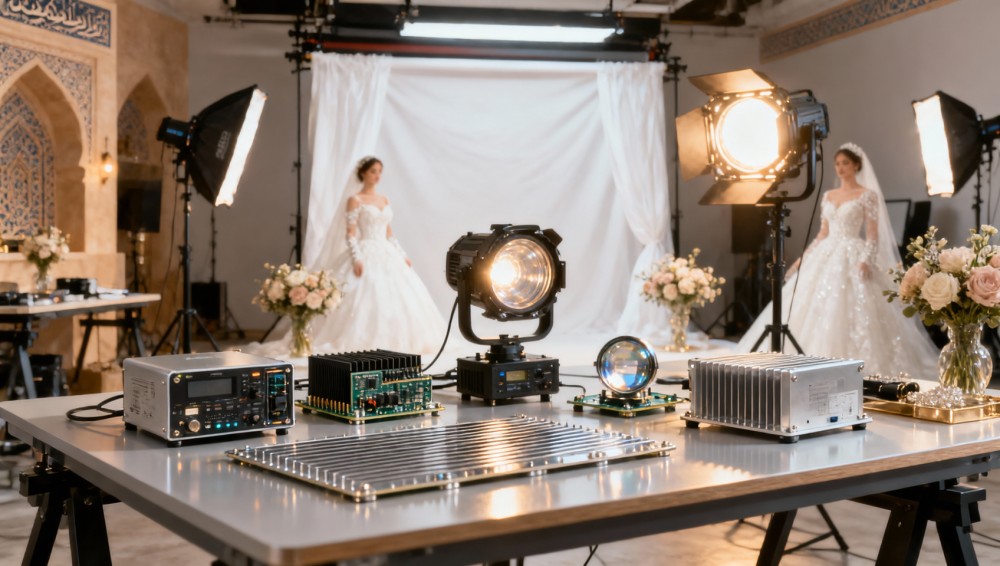
On June 29, 2026, new trade data from Jebel Ali Free Zone (JAFZA) showed a sharp increase in Middle East demand for Chinese core components used in Commercial LED photo lighting. In the second quarter of 2026, imports of LED driver modules, thermal management baseboards, and optical lenses rose 37% year on year, with the main flows going to assembly plants in the UAE and Saudi Arabia. For companies involved in LED photo light components, assembly, procurement, and supply chain coordination, this matters because it points to a move away from finished-product imports and toward localized assembly backed by technical cooperation.
What the latest trade data confirms
According to the JAFZA trade data cited in the event summary, imports from Chinese suppliers of core Commercial LED parts increased by 37% year on year in Q2 2026. The product categories specifically referenced are LED driver modules, heat dissipation baseboards, and optical lenses. The main destinations were LED photo light assembly plants in the United Arab Emirates and Saudi Arabia.
The same summary indicates that the market movement reflects a transition in the Middle East from importing complete units to a model centered on technical cooperation. It also states that this shift is raising requirements for supply chain consistency and EMC compatibility in Commercial LED products.
Why different parts of the chain may feel the change
Component exporters may face tighter technical alignment
From an industry perspective, Chinese suppliers of driver modules, thermal components, and optical parts are among the first to be affected. The reason is straightforward: when buyers move from complete fixtures to local assembly, the value of individual modules rises, but so does the need for consistent performance across batches and across multiple component categories. What deserves closer attention is whether product documentation, technical matching, and EMC-related coordination are sufficient for assembly-based customers.
Assembly plants in the UAE and Saudi Arabia may become more specification-driven
Observably, assembly facilities receiving these parts are likely to be affected at the points of incoming quality control, engineering coordination, and final product integration. A localized assembly model usually makes compatibility issues more visible at the factory level. Based on the provided information, consistency and EMC compatibility are the areas most likely to shape purchasing decisions and supplier selection.
Procurement and supply chain service providers may need closer coordination
For procurement teams and supply chain service providers, the shift may be felt less in headline demand and more in execution details. Analysis shows that when trade moves from finished goods to component-led cooperation, business risk can shift toward shipment composition, documentation accuracy, and communication between suppliers and assemblers. The practical issue is not just moving parts, but moving matched parts that support stable assembly outcomes.
What companies should watch now
Consistency is no longer a background issue
Companies serving this segment should pay close attention to how consistency is defined and checked in current business discussions. The event summary does not provide a new rule or standard, but it clearly signals that buyers are placing greater weight on uniformity across core LED parts. That makes product-to-product variation, lot stability, and technical coordination more commercially relevant than before.
EMC compatibility needs to be treated as a transaction issue, not only an engineering issue
Analysis shows that EMC compatibility should be monitored not only during design, but also during supplier communication and delivery preparation. In a localized assembly setting, compatibility problems can emerge when components from different sources are integrated. For exporters and procurement teams, this means customer communication, technical files, and pre-delivery confirmation may become more important in day-to-day execution.
Watch the difference between trade momentum and durable demand structure
What deserves closer attention is whether the Q2 increase represents a sustained procurement pattern or an early-stage acceleration tied to current assembly activity. The available information confirms stronger component imports and a change in operating model, but it does not yet confirm how broad or permanent that shift will be across the wider regional market. Companies should therefore distinguish between immediate order opportunities and longer-term supply positioning.
Follow any later clarification from official or market-side channels
The current input identifies a clear direction, but not a full rule framework. Businesses in this segment should keep tracking whether later official statements, company disclosures, industry association updates, or standard-related materials provide more detail on technical expectations, documentation needs, or execution practices linked to localized LED photo light assembly.
How this signal should be interpreted at this stage
Analysis shows that this development is more meaningful as a structural market signal than as a standalone trade fluctuation. The confirmed facts point to growing imports of core LED modules and a shift toward technical cooperation. That said, it is more appropriate to understand this as an evolving industry direction rather than a completed market transition. The evidence shows movement, but not yet the final shape of that movement.
Observably, the most important message is that product competitiveness in this segment may increasingly depend on how well suppliers support integration, consistency, and compatibility, not only on shipment volume. This is especially relevant for businesses that previously relied on complete-unit trade logic.
A measured reading of the Q2 increase
The 37% rise in Q2 imports of Chinese core LED components into key Middle East assembly markets is significant because it highlights a change in where value is being created along the supply chain. Rather than treating the development as a simple volume story, it is more appropriate to understand it as a practical signal that local assembly and technical coordination are becoming more important in LED photo lighting transactions in the region.
At this point, the news is best read as a credible industry indicator with immediate operational relevance and longer-term strategic implications that still require continued observation.
Basis of this article and what still needs verification
This article is based on the user-provided news title, event date, and event summary. The core factual basis cited in the input is the latest trade data from Jebel Ali Free Zone (JAFZA) referring to Q2 2026 imports of Chinese LED driver modules, thermal baseboards, and optical lenses, mainly into UAE and Saudi assembly plants.
For this type of industry update, commonly relevant source categories may include official trade disclosures, company announcements, industry association materials, authoritative media reporting, and standard-related documents. A specific official source link was not provided in the input, so the underlying details still require ongoing verification. Areas that deserve continued attention include whether further official wording, market disclosures, or standards-related updates clarify the scope and durability of this shift toward localized assembly and technical cooperation.
Recommended News
 Carton & PlasticsHow to assess seam quality in 250ml aluminum beverage cansLearn how to assess seam quality in 250ml aluminum beverage cans with practical visual checks, precise measurements, teardown methods, and defect-control guidance.Packaging Supply ExpertSep 28, 2026
 Carton & PlasticsWhat drives breakage rates in bulk wine bottles wholesale orders?Bulk wine bottles wholesale buyers: discover what drives breakage rates, from glass quality and packaging to pallet loading, and reduce costly claims.Packaging Supply ExpertSep 27, 2026
 Office FurnitureHow supplier scorecards reduce risk in furniture procurementFurniture procurement supplier management becomes more resilient with supplier scorecards that track quality, delivery, compliance, and corrective actions. Learn how to reduce sourcing risk.Interior Sourcing LeadSep 26, 2026
 Office Paper & Printing PaperHow roll diameter affects downtime when using jumbo paper rollsJumbo paper rolls can cut changeovers and downtime—if your unwinder, handling, and tension control can support them. Find the optimal roll diameter for smoother output.Packaging Supply ExpertSep 25, 2026