Industry News
Curation by industry experts
Hot Articles
Popular Tags
What cutting width does a print shop guillotine cutter need?
A paper guillotine cutter for print shop use needs a cutting width at least as large as the longest sheet edge that must lie along the cutting line, with practical clearance for loading and alignment. A shop cutting only A4 sheets may need substantially less width than one finishing oversized press sheets, even if both produce the same finished products.
Choose the width from the largest untrimmed sheet and the complete cutting sequence, not from the finished page size alone. Then check the machine’s depth, clamp, minimum cut, stack capacity, and accuracy: a wide blade does not guarantee that the sheet can be positioned or finished correctly.
How to size a paper guillotine cutter for print shop work
Cutting width is the usable distance along the cutting line, generally measured between the machine’s side limits. When a sheet is placed on the table, the dimension parallel to the blade must fit within that usable width; the dimension perpendicular to the blade must fit within the available positioning depth.
For each cut, use this starting rule:
Required cutting width = sheet dimension parallel to the blade + chosen operating clearance.
The clearance is not a universal percentage. It depends on sheet squareness, loading method, side guides, grippers or handling devices, and how close an operator can reliably position stock to the machine’s limits. Confirm with the manufacturer whether the stated width is unobstructed and usable under normal operating conditions.
Repeat the check after every planned rotation of the stack. A sheet that fits for the first cut can become too wide for the second if its longer dimension must then run parallel to the blade.
Start with the untrimmed sheet, not the finished product
Bleed, trim allowance, color bars, gripper margins, and imposition layout can make a press sheet larger than the finished pieces it contains. If those areas are present on the stock arriving at the cutter, they belong in the width and depth calculation.
For example, A3 measures 297 × 420 mm. If the cutting plan requires both orientations of a complete A3 sheet, the cutter must accommodate 420 mm along the blade, plus the chosen operating clearance. A machine advertised as a 420 mm cutter has no nominal lateral allowance for that orientation; its suitability depends on the actual usable opening and handling arrangement.
The same logic applies to SRA3 stock, which measures 320 × 450 mm. If the complete sheet must be turned so that its long edge lies along the cutting line, the width requirement becomes at least 450 mm before clearance. The fact that its finished work may be A3 or smaller does not reduce the size of the incoming sheet.
These are geometric checks, not equipment-size recommendations. A cutting plan that reduces a sheet before rotation may avoid needing the full long dimension as cutting width, but it must also preserve registration and provide enough material for subsequent positioning.
Test the entire cutting sequence
Width selection becomes more reliable when the largest job is drawn as a sequence rather than treated as a single sheet-size comparison. Mark the blade line, backgauge contact edge, trim waste, and remaining stack after each cut.
- Record the incoming dimensions. Use the actual untrimmed sheet supplied to finishing, including any print-control and handling margins.
- Define the first reference edge. Identify how the printed image is registered and which edge must be squared or trimmed first.
- Check width and depth for each cut. Include any rotations, intermediate stacks, and changes to the backgauge contact edge.
- Check the smallest final cut. Verify that the backgauge and clamp can position and hold the work at the required dimension.
- Validate the plan with representative stock. Include the heaviest or most difficult material expected, not just a convenient test sheet.
Consider a hypothetical 320 × 450 mm sheet. The first cut may be possible with 320 mm parallel to the blade. If the plan then calls for rotating the untouched 450 mm dimension parallel to the blade, a 430 mm usable width is insufficient. If an earlier, registration-safe cut reduces that dimension below the available width, the sequence may work—but the revised sequence must still meet the finished layout and accuracy requirements.
Width and depth must work together
A guillotine’s cutting width describes only one axis. The maximum backgauge depth determines how far the backgauge can position the sheet from the cutting line; front-table support affects how well the portion extending toward the operator is supported. Machine designs and published measurement conventions differ, so request a dimensioned diagram.
For every orientation, check whether the intended reference edge can reach the backgauge and whether the desired cut line can sit under the blade. A sheet may physically fit on the table yet be impossible to set to the required first-cut dimension if the backgauge travel is insufficient.
Overhanging stock introduces a separate concern. Unsupported material can sag or shift during jogging and clamping, particularly with large or flexible sheets. Side tables, front extensions, and material-handling equipment can improve support, but they do not automatically increase the cutter’s rated width or backgauge travel.
Minimum cut and clamp clearance
The maximum sheet size is only half the range. Small cards, labels, narrow strips, and final trims can be limited by the minimum distance between the blade and backgauge, clamp geometry, or accessories fitted to the machine.
Ask for the minimum programmable cut and minimum practical cut under the intended configuration. Clamp false plates or protective covers may affect usable dimensions; the relevant value is the one that applies when the equipment is set up for the stock and finish being produced.
Match stack capacity to the width decision
A wider cutter can accept a larger sheet, but its productivity also depends on how much material can be clamped and cut consistently. Maximum clamp opening is not the same as a guaranteed stack height for every substrate.
Paper thickness, coating, grain, stiffness, and stack uniformity affect how a pile behaves under pressure. Thick board and sensitive coated sheets can require different lift heights or clamp settings from ordinary uncoated paper. Confirm the machine’s permitted materials and operating limits rather than estimating capacity solely from the published opening.
Cut quality should be checked across the full working width. Inadequate clamping, blade condition, incorrect cutting-stick setup, or an unsuitable lift can cause shifting, uneven edges, or dimensional variation even when the sheet fits comfortably. A wider nominal format does not compensate for poor control of those variables.
When is a wider cutter worth the space?
Extra width is useful when it accommodates the largest recurring untrimmed sheet in a reliable cutting sequence, or when a documented future format would otherwise require outsourcing or an additional machine. It can also provide handling clearance around sheets close to a nominal size limit.
Beyond that requirement, width should be weighed against the rest of the installation. A larger machine can require more floor area, greater access around the table, suitable delivery routes, and more demanding lifting or electrical arrangements. The relevant comparison is not blade width alone, but whether the complete equipment and workflow fit the production space.
A smaller cutter remains a sound choice when all planned jobs can be reduced and registered within its width, depth, and minimum-cut limits. It is a weaker choice if the cutting sequence depends on awkward edge support, repeated reorientation, or cutting unusually low lifts just to make a large sheet manageable.
Specification checks before approval
Use a common set of job dimensions when comparing machines. Published capacities are easier to interpret when suppliers confirm the same operating conditions and measurement points.
- Usable cutting width: clear dimension at the blade, including any restrictions from guides or guards.
- Backgauge travel: maximum and minimum settings, and how each is measured from the cutting line.
- Table support: front and side dimensions, available extensions, and any restrictions on sheet overhang.
- Clamp and lift: opening, pressure adjustment, protective accessories, and suitability for the intended substrates.
- Accuracy: stated positioning and repeatability specifications, measurement method, and conditions under which they apply.
- Installation: machine footprint, service access, power requirements, floor loading, and delivery clearances.
- Safety: guarding, controls, maintenance provisions, and conformity documentation applicable to the installation location.
For the final comparison, request a demonstration or acceptance test using representative sheets, the intended cutting sequence, and agreed dimensional tolerances. Measure pieces from different positions in the lift and across the sheet; a single acceptable piece does not establish consistent performance.
The appropriate cutting width is the smallest usable width that supports every required cut with practical clearance—provided the depth, clamp, minimum cut, accuracy, and safe handling arrangements also satisfy the job. Where a future sheet format drives the decision, specify that format and its cutting sequence explicitly rather than relying on an undefined allowance for growth.
Recommended News
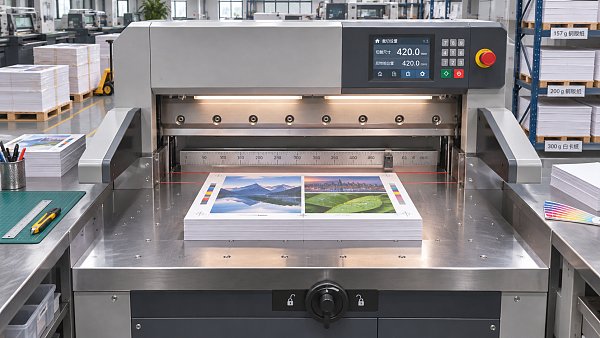
 Printing EquipmentWhat cutting width does a print shop guillotine cutter need?Choose the right paper guillotine cutter for print shop jobs. Learn how sheet size, cutting sequence, clearance, and depth affect your ideal cutting width.Packaging Supply ExpertNov 25, 2026
 Carton & PlasticsInternational Paper Expects EMEA Packaging Spinoff on December 7International Paper expects its EMEA packaging spinoff on December 7, 2026. Discover what DS Smith’s planned independence could mean for customers and suppliers.Packaging Supply ExpertNov 24, 2026
 Garment MfgUKFT Calls for Targeted Government Support for Textile and Fashion ExportsUKFT calls for targeted government support for fashion and textile exports. Explore what the proposal could mean for SMEs, suppliers and buyers.Textile Industry AnalystNov 24, 2026
 Textile MachineryCEMATEX Announces ITMA Asia’s Return to Singapore in 2029ITMA Asia returns to Singapore from 23–26 October 2029. Discover what CEMATEX’s announcement means for exhibitors and visitors.Textile Industry AnalystNov 24, 2026