Industry News
Curation by industry experts
Hot Articles
Popular Tags
How to assess abrasion resistance in heavy-duty industrial textiles
Abrasion resistance is a critical indicator of how heavy duty industrial textiles will perform under repeated friction, but a single test result rarely tells the whole story. For technical evaluators, a reliable assessment starts with matching the test method, abrasive material, load, and failure criteria to the intended application. The useful question is not simply which fabric survives the most cycles, but which one retains the properties the application needs after the kind of wear it will encounter.
Start with the contact, not the fabric specification
A protective machinery cover sliding against a painted metal edge does not experience the same wear as a conveyor curtain exposed to granular material. The cover may fail at a narrow, repeatedly flexed line. The curtain may lose its coating over a broad area while embedded particles continue to grind into the reinforcement.
Before selecting a test, map the contact conditions. Identify the opposing surface, whether contact is continuous or intermittent, and whether the fabric moves flat, bends around a radius, or rubs over a seam. Note the presence of dust, grit, moisture, oil, heat or cleaning chemicals. These details determine whether a smooth laboratory abradant is a useful screening tool or a poor substitute for service.
Pay particular attention to localized pressure. A material that looks adequate in a broad-area rubbing test can wear through quickly at a bolt head, roller edge or folded corner. Conversely, a heavy protective coating may delay surface damage but add stiffness where the assembly needs to flex. The best material for one wear mechanism is not automatically the best for another.
Choose a test that represents the wear mechanism
Common laboratory methods provide controlled ways to compare fabrics, but they do not all impose the same motion or damage. Check the current edition, scope and specified options of any standard before placing a test order. A method name on its own is not a complete test specification.
Martindale testing, covered for textile fabrics by the ISO 12947 series and by ASTM D4966, rubs a specimen against an abradant under controlled conditions. It is useful for comparative screening when the chosen setup and endpoint make sense for the material. For heavily coated, unusually thick or stiff constructions, confirm with the laboratory that the specimen can be mounted and assessed appropriately; a familiar method is not necessarily a representative one.
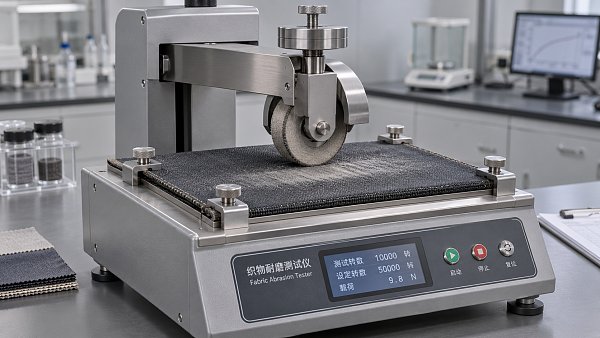
Rotary-platform abrasion, commonly associated with ASTM D3884 for textile fabrics, exposes a mounted specimen to rotating abrasive wheels. Wheel type, load, specimen preparation and the way wear is reported all matter. It may help reveal surface coating loss, but wheel wear and clogging can also affect results, so maintenance and replacement practices belong in the report.
Flex abrasion, addressed by methods such as ASTM D3885 for textile fabrics, is worth considering when repeated bending and rubbing occur together. A flat abrasion result alone may miss damage caused by yarn fatigue at a fold. For seams, edges and finished assemblies, a tailored fixture or application trial may be more informative than testing only a flat swatch.
These methods are not interchangeable. A cycle count from one cannot be converted reliably into a cycle count from another, nor into months of service, without a validated relationship for the specific application. Even within one method, changing the abradant or endpoint can change the ranking of candidates.
Define failure before the specimens are tested
“No visible damage” sounds straightforward until two evaluators disagree about what counts as damage. Set the acceptance criterion in terms of the function the textile must retain, and distinguish an observation point from actual failure.
For a coated splash guard, coating breakthrough may matter before the reinforcing yarns are damaged. If the coating provides a liquid barrier, agree on a separate, suitable barrier test after abrasion rather than assuming that a visually worn surface still protects. For a load-bearing strap or sling component, residual strength after abrasion may be more relevant than appearance, although the complete assembly and applicable product requirements must also be assessed.
Other possible endpoints include the first broken yarn, a hole of a defined size, mass loss, or failure to retain a specified mechanical property. Each answers a different question. Mass loss, for example, can help compare surface wear, but it may be misleading if loose fibers, coating fragments or retained debris affect the measurement. State how specimens are cleaned and conditioned before weighing, and whether the method permits that procedure.
Where a test is stopped at a fixed number of cycles without failure, report that result as surviving at least that exposure—not as the number of cycles to failure. Preserve photographs or written observations at agreed intervals: the progression from surface fuzzing to yarn damage can be more useful than the final number alone.
Compare reports on equal terms
Supplier datasheets often make abrasion performance look easy to rank. In practice, the number is only meaningful alongside the conditions that produced it. Before comparing two results, request the following:
- The standard and edition, including any deviations or optional procedures.
- The abradant or wheel, applied load, motion and test duration or cycle count.
- Specimen construction, tested face, conditioning and, where relevant, warp and weft orientation.
- The number of specimens, individual results or variability, and the exact failure criterion.
- Whether the material was new, aged, washed, contaminated or otherwise preconditioned.
A report for a similar fabric is not evidence for the construction being purchased. Fiber blend, yarn size, weave, coating formulation and finishing can all alter wear behavior. Ask whether the sample represents current production and whether the tested face is the face exposed in the finished installation.
If two suppliers used different methods, avoid declaring a winner from their published numbers. Arrange a side-by-side test using the same laboratory, sample conditioning, equipment settings and endpoint. This does not remove every source of uncertainty, but it makes the comparison more defensible. Retain a reference material in repeat evaluations where practical; it helps identify whether a change in results may be associated with the test setup rather than the candidate fabric.
Look beyond the surface result
Fabric weight is a useful construction detail, not a guarantee of abrasion resistance. A heavier textile may contain more material to wear away, but yarn architecture, fiber properties, surface finish and coating adhesion also influence how damage develops. A tightly constructed fabric may resist snagging in one contact condition while becoming less compliant around a sharp bend.
Inspect both faces and the cross-section when possible. In a coated textile, determine whether abrasion removes only the finish, exposes the base cloth, or causes the coating to separate. In woven constructions, look for broken yarns, yarn displacement and damage concentrated at crossover points. A surface that appears intact can still conceal a weakened reinforcement; destructive examination and residual-property testing may be warranted for consequential uses.
Do not treat abrasion in isolation from the rest of the specification. A candidate with excellent dry-rub performance may be unsuitable if it loses flexibility in cold conditions, degrades after cleaning, fails a required flame test or cannot be fabricated into reliable seams. Conversely, choosing solely on the highest cycle count can add cost and stiffness without addressing the actual failure location.
Add environmental exposure and assembly details
Service conditions often act in sequence. A textile may be exposed to sunlight or a cleaning agent, then rubbed while wet; a laboratory test on a new, dry specimen may miss that interaction. Where exposure is credible, compare unaged samples with specimens conditioned using an agreed, documented procedure. Avoid combining treatments arbitrarily: the order, concentration, duration and recovery period can affect the result and must reflect the use case.
Test the assembly where practical. Stitching, folded hems, welded joints, fasteners and backing layers change local stiffness and contact pressure. A seam that is strong in a straight tensile test may still suffer thread abrasion when it sits directly on a guide. Moving the seam away from the contact line or adding a replaceable wear strip may be more effective than changing the entire base fabric.
For abrasive bulk materials, particle shape and accumulation deserve attention. Fine dust can work into a weave; larger angular particles can cut or snag. If a bench fixture cannot reproduce those effects, document the limitation and use a controlled application trial rather than overstating what the laboratory number proves.
Turn the assessment into a purchasing decision
A practical evaluation moves from screening to confirmation. Use a standardized test to eliminate unsuitable candidates, then examine the leading materials under application-relevant contact and environmental conditions. If failure would create a safety or operational risk, involve the relevant engineering and safety teams in setting the acceptance criteria and reviewing the complete assembly.
For a field trial, define the installation location, inspection intervals and removal criteria in advance. Record operating conditions and inspect the same wear points on each candidate. Service observations are valuable, but a trial with different loads or contact surfaces cannot support a clean comparison. Keep retained samples and batch details so an unexpected result can be traced back to the supplied construction.
The final specification should identify the material construction, relevant test method and conditions, acceptance endpoint, and any required verification on production lots. It should also state how changes in fiber, coating, manufacturing site or finishing are to be communicated and assessed. From a sourcing perspective, as Global Supply Review emphasizes, a useful technical comparison depends on information that remains traceable across suppliers and production runs.
Before approving a fabric, ask one final question: does the evidence address the place and manner in which this assembly is likely to wear? If the answer rests only on an isolated cycle count, the next step is not another ranking exercise. It is a test that reproduces the contact more closely, with an endpoint tied to the function the textile must keep performing.
Recommended News
 Garment MfgUS August Apparel Spending Rises 4.8% as Inflation and Tariff Uncertainty Cloud Cotton OutlookUS apparel spending rose 4.8% in August 2026. Explore what inflation and tariff uncertainty could mean for cotton buyers and apparel businesses.Textile Industry AnalystNov 22, 2026
 Fabrics & YarnsHow to assess abrasion resistance in heavy-duty industrial textilesAssess heavy duty industrial textiles for abrasion resistance with practical test methods, clear failure criteria, and tips for confident sourcing decisions.Textile Industry AnalystNov 22, 2026
 Garment MfgBangladesh's National Circular Textile Strategy Enters Final ConsultationBangladesh's National Circular Textile Strategy enters final consultation. Explore what the draft could mean for sustainable textiles and garment makers.Textile Industry AnalystNov 21, 2026
 Smart LightingHow much energy can smart street lighting save?Discover how much energy smart street lighting can save, compare LED and control upgrades, and learn how to build a reliable business case.Commercial Tech EditorNov 21, 2026