Industry News
Curation by industry experts
Hot Articles
Popular Tags
How to improve supply chain resilience through supplier diversification
Improve supply chain resilience by identifying the supplies that would stop production, tracing the dependencies behind them, and qualifying alternatives that can deliver usable capacity when the primary source is disrupted. Start with the parts and materials that have no practical substitute or take the longest to replace. Then establish a workable allocation between sources and test the process for shifting orders.
Two suppliers do not automatically provide two independent supply routes. They may purchase the same raw material, rely on the same subcontractor, or ship through the same port. Effective diversification separates the dependencies most likely to interrupt supply while keeping quality, cost, and delivery requirements under control.
Find the dependencies that matter most
Begin with the bill of materials and production schedule, then identify which purchased items could constrain output. A low-cost fastener, printed label, or specialized adhesive can halt an assembly if the finished product cannot ship without it. Conversely, a high-spend item with several interchangeable sources may present less disruption exposure than its purchase value suggests.
Assess each critical item against the time needed to restore supply. Include not only the quoted production lead time but also the time required to obtain materials, book capacity, transport goods, complete incoming inspection, and approve any change. Compare that total with usable inventory and confirmed consumption. Inventory that is already allocated to other orders should not be counted as freely available coverage.
The size of a disruption also matters. A supplier with delayed shipments for one week creates a different problem from a facility that cannot operate for an extended period. Map both the immediate shortfall and the period during which an alternative would have to sustain deliveries. This distinction prevents a small emergency order from being mistaken for a durable backup arrangement.
Prioritization becomes clearer when each item is evaluated through a few connected questions:
- Production impact: What stops if the item is unavailable, and is there an approved substitute?
- Recovery time: How long would it take a different source to deliver material that passes inspection?
- Concentration: Does the current source control unique tooling, a proprietary process, or access to a scarce input?
- Demand exposure: Which customer commitments and finished products depend on the same component?
A shared component used across several product lines deserves particular attention. Its total exposure may be hidden when purchase orders are reviewed separately by product or business unit.
Map beyond the supplier name
Record the actual manufacturing site for each critical item, rather than relying only on the contracting company’s address. A supplier with several offices may produce a part at one plant. Equally, two differently named suppliers may use the same factory or finishing subcontractor. Ask where key materials originate, where processing takes place, and which transport routes are used.
For textiles, apparent alternatives may depend on the same yarn source or dyeing facility. In packaging, different converters can rely on a common paper mill, coating material, or printing plate provider. For hardware, the forging or machining site may be separate from the facility that performs heat treatment or surface finishing. These upstream and downstream links determine whether two sources are exposed to the same interruption.
Complete visibility is rarely available immediately. Begin with the processes and inputs that cannot be replaced quickly, and document the limits of the information received. A supplier’s refusal or inability to disclose a dependency should be recorded as an unresolved risk, not silently treated as evidence of independence.
Geographic separation also requires closer examination. Factories in different countries may still use the same shipping corridor, energy source, or specialized material. By contrast, two facilities in the same country may offer useful redundancy if they have independent utilities, equipment, workforces, and inbound routes. The relevant question is whether the same event could disable both sources at once.
Choose a diversification model that fits the constraint
A second source is valuable only if it can supply an acceptable quantity within the time available. The right arrangement depends on how frequently the item is used, how difficult it is to qualify, and how much spare capacity exists.
Splitting orders across two sources keeps both familiar with the specification, but the allocation must be large enough to sustain their interest and production capability. An occasional purchase can reveal whether the secondary route still works, although it does not prove that the supplier can absorb a sudden surge.
For a standby arrangement, agree on the conditions for activation before an emergency. Establish the quantity the alternative source can accept, the lead time from order release, and whether capacity or raw material is actually reserved. A quoted lead time based on open capacity is a weaker commitment than a documented capacity reservation.
Qualify the alternate source for the real application
A sample that looks correct is only the beginning. Define the characteristics that affect assembly, performance, appearance, and service life, then translate them into drawings, tolerances, test methods, and acceptance criteria. Where a specification is incomplete, record the missing requirements before asking several suppliers to quote; otherwise, offers may cover different products.
Qualification should follow the process that will be used for routine production. A hand-finished prototype may pass inspection while production tooling introduces variation. Request samples made with the intended material, equipment, and process settings where feasible, and verify that the supplier can repeat the result across a representative production run.
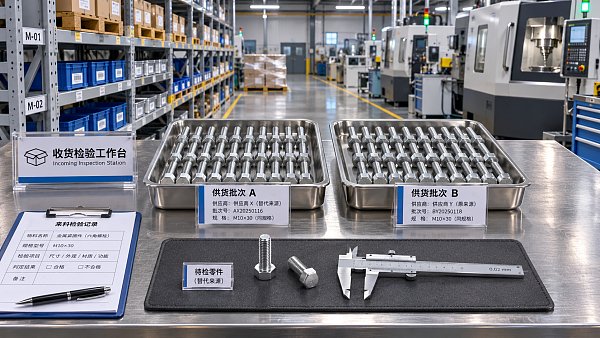
The details differ by item. A substitute fastener may match the nominal dimensions yet perform differently because of material, coating thickness, thread fit, or heat treatment. An alternative packaging material may print well but behave differently on an automated filling line or during transit. For fabric, color approval alone does not establish acceptable shrinkage, seam performance, or consistency between dye lots. Validation should cover the characteristics that affect the finished product and the conditions in which it is used.
Run an assembly or production trial before treating the source as interchangeable. Include incoming inspection, line setup, scrap or rework observations, packaging, and transport protection. If a customer must approve a material or manufacturing-site change, obtain that approval before switching commercial orders. Keep the approved sample, test results, revision level, and any restrictions linked to the supplier and site.
Protect access to tooling and process information
Custom molds, dies, fixtures, printing plates, and test equipment can prevent a rapid transfer even when another factory has suitable capacity. Record who owns each asset, where it is held, its condition, and the practical steps required to move or reproduce it. Ownership language alone does not guarantee immediate access if removal requires a shutdown, refurbishment, or export arrangements.
Where separate tooling is justified, validate it at the alternative site rather than assuming that a duplicate tool produces identical parts. Also retain the current drawings, material specifications, approved process parameters, and inspection methods under agreed access arrangements. A backup supplier cannot act quickly if the information needed to make the item is unavailable or out of date.
Compare the cost of readiness with the cost of interruption
A diversification decision should use the total delivered cost of each route. Include tooling, qualification, freight, duties where applicable, inspection, inventory, and any capacity reservation alongside the quoted unit price. Different minimum order quantities and payment terms can also change the comparison.
Then examine what each arrangement actually protects. A lower-priced alternative with a long production queue may do little for an item that must be replenished quickly. A more expensive local source may cover an immediate gap but lack the capacity to support a prolonged disruption. Both routes can have a role if their limits are explicit.
Inventory and supplier diversification address different timing problems. Stock can cover demand while an alternative ramps up; a qualified source provides a route to replenish that stock. Calculate coverage using usable inventory and realistic consumption, including demand from all products that share the item. If the backup source needs longer to deliver than the available stock will last, the plan has a gap even though a second supplier is approved.
Demand variability matters as well. A reserve based on average consumption may be exhausted early during a seasonal peak or a concentrated customer order. Test the plan against the demand conditions that would cause the largest credible shortfall, and identify which orders would be prioritized if full supply cannot be restored immediately.
Turn the alternative into an executable switch
Document the point at which orders should move, who can authorize the change, and how information will reach the alternative source. A late shipment alone may not justify a switch if the primary supplier can recover faster than the backup can start. Useful triggers include a confirmed production outage, a missed recovery milestone, or a projected inventory shortfall that exceeds the time needed to activate the alternate route.
The switch plan should connect commercial and operational details: current purchase terms, approved part numbers, available tooling, forecast requirements, shipping instructions, and receiving controls. Confirm whether the alternative supplier has already committed its capacity elsewhere. During a widespread disruption, an unreserved slot may disappear just when it is needed.
Maintain traceability between supplier, manufacturing site, material lot, and finished product. If an alternative source introduces a quality issue, that record makes it possible to isolate affected stock without stopping every shipment. Where different sources require different inspection plans or labeling, include those requirements in the order and receiving instructions.
Test the handover periodically through a controlled order or an agreed simulation. Measure the time from the activation decision to confirmed capacity, production, shipment, receipt, and release for use. A simulation can expose missing contacts or outdated specifications, while a physical order is needed to verify production and delivery performance. Update the plan whenever a site, process, material source, or product specification changes.
Review diversification when demand shifts or supplier capacity changes. An approved alternative that no longer makes the material, has moved production, or cannot meet current volumes is a historical approval rather than reliable available capacity.
Recommended News
 Eco PackagingVietnam Briefing Checklist Highlights EU Packaging Rules for BuyersEU packaging rules affect buyers sourcing from Vietnam. Explore the Vietnam Briefing checklist and key PPWR questions to verify before placing an order.Packaging Supply ExpertNov 17, 2026
 Commercial LEDHow to check voltage drop when buying 12V neon rope lights wholesaleBuying neon rope lights wholesale 12v? Learn how to test voltage drop, compare supplier claims, and avoid costly brightness issues before placing an order.Commercial Tech EditorNov 17, 2026
 Policy & RegulationsEU Proposal to Restrict Chinese Furniture Imports Draws Strong Industry OppositionEU proposal to restrict Chinese furniture imports faces industry opposition. Explore potential supply chain and cost impacts, and what buyers should watch.Nov 16, 2026
 Supply Chain InsightsHow to improve supply chain resilience through supplier diversificationStrengthen supply chain resilience with a practical guide to supplier diversification, from mapping hidden risks to qualifying alternatives and testing switch plans.Nov 16, 2026