Industry News
Curation by industry experts
Hot Articles
Popular Tags
How packaging affects freight costs for wholesale wicker egg chairs
A lower factory price does not necessarily produce a lower landed cost for wholesale wicker egg chairs. A bulky basket, curved support pole, and circular base can occupy far more shipping space than their weight suggests. Packaging therefore affects freight through the number of complete chairs that fit into a shipment, not simply through the cost of the carton.
The strongest comparison is the total cost per saleable chair delivered to the required destination. Smaller packaging can improve that result, but only if it preserves product condition, keeps all components together, and does not introduce excessive assembly or handling costs. A compact packing proposal is valuable when its loading quantity and protective performance can be demonstrated—not merely quoted.
Freight follows the packed chair, not the product dimensions
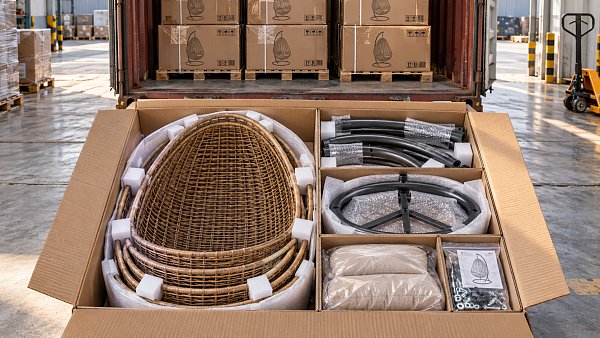
The assembled dimensions shown in a furniture specification are insufficient for a freight calculation. A hanging egg chair may travel as a basket, stand, base, cushion, and hardware pack distributed across one or several cartons. The relevant measurement is the combined external shipping volume of every package needed to supply one complete unit.
For rectangular cartons, volume in cubic meters is calculated as:
Carton length × width × height in meters × number of cartons.
If one chair requires two cartons, both belong in the calculation. A quotation that lists only the basket carton can materially understate shipping requirements. The same applies when cushions are packed separately or bases are consolidated into shared cartons.
The way that volume becomes a charge depends on the transport arrangement:
- Full-container load: Much of the transport cost is allocated across the number of chairs loaded. Improving capacity lowers the freight allocation per unit, provided the additional chairs can actually be ordered and shipped.
- Less-than-container load: Charges commonly depend on a weight-or-measure basis, subject to the forwarder’s tariff, minimums, and local fees. Lower volume can reduce volume-rated charges, but not every charge falls proportionately.
- Air freight and parcel delivery: Dimensional weight and package-size thresholds can make carton dimensions especially expensive. The applicable divisor and oversize rules must come from the carrier’s quotation.
For a lightweight but bulky chair, reducing packaging weight alone may achieve little. Removing empty space can be more valuable, particularly when the shipment remains volume-constrained.
Why a smaller carton does not guarantee more chairs per container
Container capacity is a three-dimensional loading problem. Dividing nominal container volume by carton volume produces a theoretical quantity, not a dependable loading commitment.
Carton dimensions must work with the container’s internal width, height, length, and door opening. An apparently efficient carton may leave an unusable strip along the sidewall or prevent another layer from being loaded. A slightly different carton footprint may fit more effectively despite having similar cubic volume.
Orientation also matters. A carton that fits on its side may not be safe to ship that way if the basket rim takes the stacking load or the stand presses against the woven surface. Loading assumptions must respect the packaging’s permitted orientation and stacking limits.
Ask for a loading layout showing the placement of baskets, bases, poles, cushions, and any shared cartons. The quantity should represent complete chair sets, rather than the maximum number of baskets that can be fitted inside. Photographs of a previous load can support the proposal, but only when the product, carton specification, and loading method match the order.
Small dimensional changes can have disproportionate effects near a fit threshold. Conversely, a meaningful reduction in cubic volume may produce no additional container capacity if it does not enable another row or layer. Evaluate both carton volume and the resulting loading count.
Nesting and knock-down construction offer different savings
Nesting reduces the space occupied by multiple baskets by placing them partly inside one another. Knock-down construction reduces the space occupied by the frame or stand by separating structural components. These approaches address different sources of empty space and create different operating costs.
Nesting baskets without damaging the weave
A basket’s curved shell encloses substantial air. Where its shape permits nesting, several baskets can share part of that space. However, the nesting depth must be controlled. Deep insertion can concentrate pressure on the rim, distort the frame, or cause woven surfaces to rub during vibration.
Separators should protect the actual contact points, not merely cover visible surfaces. Soft wrapping may prevent light abrasion while providing little resistance to concentrated pressure. A defined spacer can limit insertion depth and prevent one basket from wedging into another.
Shared packs also change receiving operations. If several baskets arrive in one package, they must be separated, inspected, and matched with their remaining components. That arrangement can suit a warehouse supplying stores, yet create extra work when every chair must leave the warehouse as an individual parcel. Any repacking materials and labor belong in the comparison.
Knock-down stands and baskets
A detachable stand can reduce awkward voids, especially when a curved pole or broad base would otherwise determine the carton’s longest dimension. A sectional basket may reduce volume further, but introduces more joints and assembly work.
The commercial question is whether the saved freight exceeds the added cost of connectors, hardware control, assembly, and service. Structural joints must still satisfy the product’s load and safety requirements; freight savings do not justify an unvalidated design change.
Assembly requirements should be specific. Confirm the tools required, fastening sequence, access to bolts, and whether more than one person is needed. A statement such as “easy assembly” does not establish warehouse labor cost or the likelihood of incorrect installation.
Hardware should be secured in a labeled compartment rather than left loose inside the basket. A missing fastener can prevent the sale of an otherwise undamaged chair, while a loose metal component can damage the finish during transit.
Protection should target the failure points
Reducing protective material indiscriminately can turn a freight saving into a claims cost. Egg chairs combine several vulnerable surfaces: woven strands, coated metal, exposed tube ends, basket rims, and cushions. Each needs protection against a different mechanism.
More cushioning is not automatically better. Material placed in an unused void may add cost without preventing movement. A shaped insert, sleeve, or restraint can be more effective when it keeps a heavy component away from a fragile surface.
Carton strength also depends on the complete pack, not a board description alone. Panel spans, openings, internal supports, humidity exposure, and stacking duration affect performance. A packaging change should be assessed with representative packed products under handling, compression, and vibration conditions appropriate to the intended distribution route.
Compare the savings after assembly and damage costs
A hypothetical comparison shows why the lowest freight figure is not necessarily the best offer. Assume two packing formats for an otherwise comparable chair, with loading quantities supported by their respective loading plans.
The compact pack saves $12.50 in shipment cost per chair. After its additional packaging and assembly costs, the advantage falls to $4.50 before differences in damage, receiving, storage, and final delivery. These figures illustrate the calculation; they are not market freight rates or standard loading quantities.
That remaining $4.50 is the allowance available to absorb any additional operating or quality cost. If the compact format requires individual repacking or creates more missing-parts claims, its apparent advantage can disappear.
Use a consistent cost boundary. Compare quotations with the same origin, destination, equipment, shipment period, and included charges. An FOB product quotation and a delivered quotation cannot be compared by subtracting an ocean freight estimate alone. Packaging premiums may already be included in the product price, so avoid counting them twice.
The strongest measure is:
Total relevant product, packaging, logistics, handling, assembly, and unrecovered quality costs ÷ saleable chairs received.
Where reliable damage data is unavailable, calculate the break-even additional damage cost instead of inventing a damage rate. This identifies how much quality exposure the freight saving can tolerate.
The destination can change the preferred packing format
A packing format optimized for an ocean container may be unsuitable for onward delivery. Bulk nested baskets can provide an inbound advantage, while individual protective cartons may be necessary for a parcel network. The cost of converting between those formats must be visible before placing the order.
Palletization creates a similar trade-off. Pallets and top protection consume space, but can simplify handling and reduce direct carton contact. Floor loading can improve usable container space while increasing unloading labor. Neither option is inherently cheaper once destination operations are included.
Check package-level size limits with the intended delivery provider. Splitting a chair into two cartons may avoid one oversize threshold but introduce a second handling charge and the risk of separated deliveries. The comparison must cover the entire delivery arrangement, not just the international leg.
Make the packing specification part of the order
For wicker egg chair wholesale quotations, request a packing specification tied to the exact model and construction. It should identify external carton dimensions, gross weight, cartons per complete chair, components in each carton, nesting quantity, and any shared packaging. Measurements should come from a fully packed sample, including bulging or protrusions.
Keep the approved packing sample, loading layout, protective-material specification, and labeling requirements under the same revision control as the product. Substituting thinner board, removing separators, or changing the cushion pack can alter both loading performance and damage exposure.
Before shipment, verify that production packing matches the approved arrangement and that the final quantity includes complete sets. A container filled efficiently with unmatched baskets, stands, and cushions has not achieved a useful freight saving.
The defensible choice is the packing format that delivers the lowest supported cost per saleable chair through the actual distribution route. Carton volume and loading quantity establish the potential saving; protection, assembly, and destination handling determine how much of that saving survives.
Recommended News
 Outdoor FurnitureHow packaging affects freight costs for wholesale wicker egg chairsExplore wicker egg chair wholesale packaging strategies to cut freight costs, improve container loading, and protect profits. Compare packing options for lower landed costs.Interior Sourcing LeadOct 19, 2026
 Supply Chain InsightsHow to use supply chain resilience metrics to assess recovery riskUse supply chain resilience metrics to compare recovery time, survival buffers, and financial exposure. Learn how to assess disruption risk and prioritize mitigation that protects service.Oct 18, 2026
 Commercial LEDHow to assess an LED street light exporter’s warranty coverageAssess an led street lights exporter beyond warranty length. Learn how to verify coverage, uncover hidden costs, and negotiate stronger terms before you buy.Commercial Tech EditorOct 17, 2026
 Carton & PlasticsWhen should you heat seal aluminum foil zipper bags for food storage?When should you heat seal aluminum foil zipper bags? Learn when stronger closures matter, how to protect dry foods, and which sealing checks help ensure reliable storage.Packaging Supply ExpertOct 16, 2026