Industry News
Curation by industry experts
Hot Articles
Popular Tags
How much should you pay per T8 LED tube when buying in bulk?
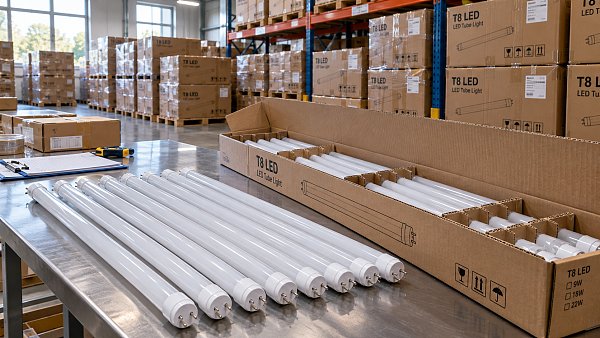
When ordering hundreds or thousands of T8 LED tubes, the right price is the lowest delivered cost for a product that meets your lighting, installation, safety, and warranty requirements—not simply the lowest number on a supplier’s quotation. A cheaper tube can become the more expensive purchase if it requires unexpected rewiring, delivers less usable light, or leaves your maintenance team handling early failures.
To compare the T8 LED tube price across suppliers, procurement teams need a consistent baseline: tube length, lumen output, electrical configuration, required approvals, order quantity, and delivery terms. Without those details, a universal per-tube price would be misleading. The practical approach is to establish a current, specification-matched price range and then determine which premium, if any, your project can justify.
Start with a buying specification, not a target unit price
“T8 LED tube” describes a broad product category, not a standardized purchasing item. T8 refers to a nominal tube diameter of one inch; it does not tell you the lamp’s length, light output, wiring arrangement, or compatibility with an existing fixture.
A quote for a four-foot, ballast-bypass tube is not directly comparable with a quote for a ballast-compatible model, even if both products have similar wattage. Neither is automatically the better purchase. The answer depends on what is already installed and how much electrical work the project can accommodate.
Before requesting prices, define the following minimum requirements:
- Physical format: tube length, base type, and fixture constraints.
- Electrical configuration: ballast-compatible, ballast-bypass, hybrid, or an external-driver system.
- Lighting performance: minimum delivered lumens, wattage, color temperature, color rendering, and any flicker requirements.
- Operating conditions: supply voltage, ambient temperature, enclosed-fixture suitability, and switching patterns.
- Compliance: safety certification and other documentation required in the destination market.
- Commercial terms: quantity by model, delivery location, packaging, warranty, and required shipment date.
If several acceptable configurations remain, request separate quotations for each. That keeps a supplier’s proposed substitution from quietly becoming the basis of your price comparison.
How to establish a defensible bulk T8 LED tube price
For a live purchasing decision, obtain several current quotations against the same specification and delivery basis. Ask suppliers to distinguish their standard product from any alternative they believe could reduce cost. Otherwise, an apparently competitive offer may simply reflect lower light output, different certification coverage, or a shorter warranty.
Build your comparison around three figures:
Your initial negotiating range should come from compliant, comparable quotations—not from the cheapest listing found online. Marketplace prices may apply to a different quantity, omit freight, or describe a product whose documentation has not been verified.
For budgeting, record the quotation date and validity period. Freight, exchange rates, inventory availability, and production schedules can change the final buying position. A price collected for an earlier project is useful background, but it is not a substitute for a current offer.
The installation choice can outweigh the lamp-price difference
The maintenance team often sees a cost that the purchasing spreadsheet misses: what happens when someone actually opens the fixture.
Ballast-compatible tubes: assess the existing equipment
Often called Type A tubes, these operate with specified compatible fluorescent ballasts. They may reduce initial installation work where the existing equipment is suitable and in serviceable condition. However, compatibility must be checked against the actual ballast models installed—not assumed from a general “plug-and-play” description.
The ballast also remains a potential maintenance item. Compare system power consumption, including ballast losses, rather than assuming that the tube’s stated wattage represents the whole fixture.
Ballast-bypass tubes: include conversion labor
Type B tubes operate directly from the appropriate supply after the fixture is correctly converted. They remove the ballast from the operating system, but installation requires suitable electrical work and compliance with local requirements.
Single-ended and double-ended power arrangements are not interchangeable installation instructions. Confirm lamp-holder requirements, wiring diagrams, labeling, and the qualifications required for installation. A low tube price cannot compensate for an unsafe or incorrectly budgeted conversion.
Hybrid and external-driver options: compare complete systems
Hybrid tubes may support both specified ballast operation and direct-wire use, subject to their instructions. External-driver systems, often called Type C, introduce a separate driver and may suit particular control or maintenance strategies. For these options, compare all required components and labor rather than the tube alone.
Which specifications deserve a premium?
Not every upgraded feature produces a purchasing benefit. Pay more where the difference solves a documented project requirement or reduces a measurable cost.
Usable light output comes before wattage. Two tubes with equal power consumption can produce different lumen output and light distribution. Equally, a lower-wattage tube is not an efficiency improvement if it leaves work areas underlit. For significant retrofits, test representative fixtures and confirm illumination at the working plane.
Higher efficacy can justify a premium in facilities with long operating hours. The annual energy saving per tube can be estimated as:
Annual saving = power reduction in watts ÷ 1,000 × annual operating hours × electricity rate.
Use the measured or adequately documented system-power difference. To establish a simple energy-only premium ceiling, multiply annual savings by your organization’s acceptable payback period. Then assess maintenance benefits separately so that the same saving is not counted twice.
Color consistency, glare control, and flicker performance can also matter, especially in offices, retail spaces, and areas where visual tasks are demanding. Ask for relevant test evidence rather than relying on broad descriptions such as “comfortable light.”
Claims about service life require similar care. A lumen-maintenance projection is not the same as a guarantee that every driver will operate for that period. Review the stated operating conditions and the warranty’s actual coverage.
Safety documentation is a buying condition, not an optional upgrade
A procurement comparison should exclude products that cannot meet the project’s applicable safety and regulatory requirements. Discounting a noncompliant offer does not make it better value.
For North American projects, verify any claimed UL or ETL certification against the exact model and intended application. Where a utility incentive is relevant, check the applicable program’s current eligibility requirements; a supplier’s general statement about rebate qualification is not enough.
For European purchases, request the relevant declaration of conformity and supporting documentation for applicable requirements. CE marking should not be treated as interchangeable with a third-party safety listing. Other destinations have their own requirements, so the procurement specification must follow the receiving market.
Documentation should identify the product being purchased. A test report covering a different driver, wattage, or model family may not establish compliance for your shipment. Resolve mismatches before placing the order, not after customs clearance or installation.
Calculate landed cost without hiding losses in the denominator
A useful purchasing formula is:
Landed cost per accepted tube = total acquisition cost ÷ number of tubes accepted as usable.
Total acquisition cost can include the product invoice, freight, insurance, customs brokerage, applicable duties, inspection, and nonrecoverable taxes or charges. Treat recoverable taxes consistently with your finance team’s accounting policy.
The denominator matters. If tubes arrive damaged and the resulting loss is not reimbursed, dividing the shipment cost by the original order quantity understates the cost of usable stock. Avoid double counting, however: an allowance for breakage should not be added again if the same loss is already reflected elsewhere in the calculation.
Check the named Incoterm and location on every offer. EXW, FOB, and DDP quotations allocate responsibilities differently; they are not alternative labels for the same delivered price. For delivered offers, clarify unloading, access restrictions, and any destination charges that remain your responsibility.
Packaging deserves attention because long, fragile products can be expensive to replace across borders. Specify carton protection and pallet requirements appropriate to the transport route. Ask how transit damage is documented, reported, and resolved.
Volume discounts only help when the inventory gets used
Request price breaks at quantities that reflect real demand. Ask whether discounts apply to each model separately or to the combined order, and whether different color temperatures or electrical configurations create separate minimum order quantities.
A larger order may lower production or handling cost per tube, but it can also increase storage requirements and tie up working capital. Extra inventory is particularly risky when fixtures, wiring standards, or preferred specifications are likely to change.
Where demand is predictable, discuss scheduled releases against an agreed commitment. Confirm whether pricing is fixed, how stock is allocated, when payment becomes due, and what happens if the forecast changes. A blanket order without clear release terms can create more uncertainty than savings.
Negotiate the failure process alongside the price
A warranty has limited purchasing value if claiming under it costs more than the replacement lamp. Before accepting a premium for longer coverage, establish who pays freight, whether failed units must be returned, what evidence is required, and whether replacement labor is excluded.
Also clarify whether replacements will match the original model and color characteristics. In a visible installation, mixed replacement batches can create a problem even when every tube technically operates.
For a substantial order, approve samples in representative fixtures before releasing the full shipment. Agree on inspection criteria and a practical process for handling defective deliveries. Sample approval reduces uncertainty; it does not replace production controls or incoming checks.
A practical rule for the final award
Choose the lowest landed-cost offer that passes your mandatory technical and compliance checks, then adjust the decision for installation, energy use, and credible maintenance exposure. Any premium should have a clear explanation: avoided conversion labor, lower operating cost, better suitability, or stronger and usable after-sales support.
If two suppliers remain close, prioritize the one that provides traceable documentation, confirms compatibility clearly, and accepts precise commercial terms. Those details often matter more than a small reduction in the quoted T8 LED tube price.
The amount you should pay is therefore a project-specific number established through matched quotations and total-cost analysis. The best purchase is not the cheapest tube on paper. It is the compliant tube that delivers the required light at the lowest defensible cost once it is received, installed, and maintained.
Recommended News
 Eco PackagingHigher Fees Urged for Hard-to-Recycle Plastics Under California’s EPR PlanCalifornia’s EPR plan faces calls for higher fees on hard-to-recycle plastics. Explore potential packaging cost impacts and how to prepare while adoption remains unconfirmed.Packaging Supply ExpertOct 20, 2026
 Commercial LEDHow much should you pay per T8 LED tube when buying in bulk?Compare T8 LED tube price quotes for bulk orders and uncover hidden installation, freight, and warranty costs. Learn how to choose compliant tubes at the best total value.Commercial Tech EditorOct 20, 2026
 Outdoor FurnitureHow packaging affects freight costs for wholesale wicker egg chairsExplore wicker egg chair wholesale packaging strategies to cut freight costs, improve container loading, and protect profits. Compare packing options for lower landed costs.Interior Sourcing LeadOct 19, 2026
 Supply Chain InsightsHow to use supply chain resilience metrics to assess recovery riskUse supply chain resilience metrics to compare recovery time, survival buffers, and financial exposure. Learn how to assess disruption risk and prioritize mitigation that protects service.Oct 18, 2026