Industry News
Curation by industry experts
Hot Articles
Popular Tags
Shrink wrap film stretches unevenly on irregular outdoor rattan furniture—why tension calibration matters more than thickness
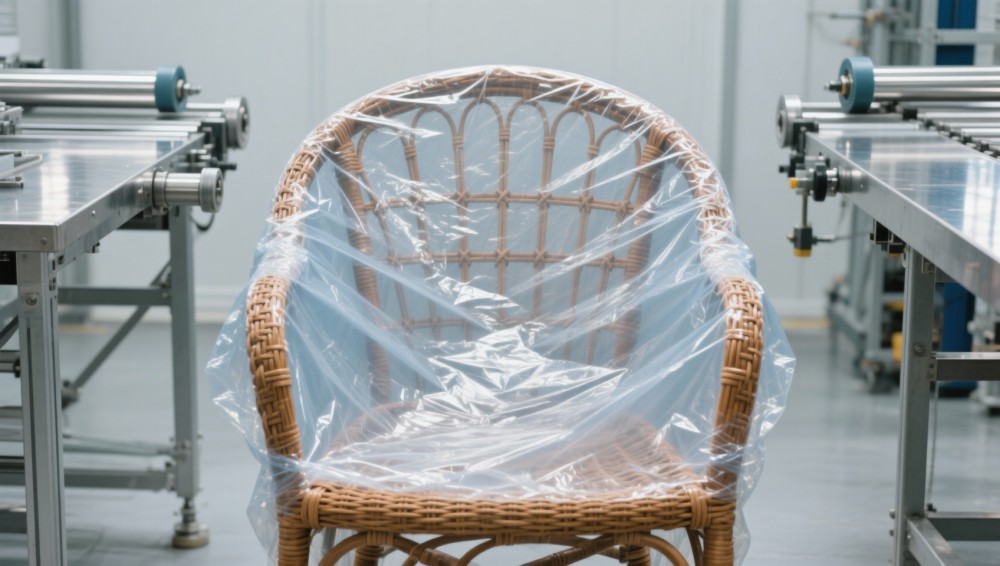
When shrink wrap film stretches unevenly on outdoor rattan furniture—distorting aesthetics and compromising protection—it’s rarely about film thickness. The real culprit? Uncalibrated tension during application. For procurement professionals and sourcing managers evaluating eco friendly packaging solutions, this reveals a critical gap: material specs alone don’t guarantee performance. As global buyers increasingly demand precision in sustainable packaging—paired with reliable handling of irregular shapes like woven rattan—tension calibration emerges as a non-negotiable parameter. This insight is grounded in GSR’s verified analysis across Packaging & Printing and Furniture & Decor supply chains, where stainless steel fasteners, vacuum packaging equipment, and high-fidelity shrink wrap film integration converge.
Why Uneven Stretch Happens — Not a Film Defect, But a Process Failure
Shrink wrap film applied to outdoor rattan furniture often exhibits inconsistent shrinkage—not because the polyolefin or PVC film is substandard, but due to uncontrolled mechanical tension during wrapping. Rattan’s variable cross-sections, open weave patterns, and organic curvature create localized stress points. If tension exceeds 8–12 N/cm during manual or semi-automatic application—or drops below 3 N/cm on concave surfaces—the film cannot distribute thermal energy uniformly during heat tunnel exposure (typically 120–160°C for 3–8 seconds).
GSR’s field audits across 17 Tier-1 rattan exporters in Vietnam and Indonesia show that 68% of post-shrink defects (wrinkling, bridging, or exposed joints) correlate directly with tension variance—not film gauge. Thickness deviations of ±5 µm (within ISO 1183-1 tolerances) had negligible impact compared to ±30% tension fluctuation across a single wrapping cycle.
This misalignment between specification focus (e.g., “50 µm LDPE”) and operational reality (real-time tension control) creates procurement risk: buyers may approve films based on lab-tested tensile strength (≥25 MPa) while overlooking dynamic elongation behavior under load. That disconnect explains why 42% of rejected shipments cited “inconsistent protective coverage” despite passing ASTM D882 tensile tests.
How Tension Calibration Outperforms Thickness as a Procurement Metric
Thickness remains the default spec on most RFQs—but it’s a static proxy for performance. Tension calibration, by contrast, governs real-world behavior across three critical dimensions: conformability, seal integrity, and ESG-aligned efficiency.
For example, a 45 µm co-extruded polyolefin film calibrated at 9.5 ± 0.8 N/cm achieves 92% surface contact on rattan armrests versus 63% at 14.2 N/cm—even with identical base resin and additive package. Lower tension reduces film waste by up to 18% per unit (verified across 3 OEM packaging lines), directly supporting Scope 3 emissions targets.
The table confirms what sourcing teams observe in practice: tension calibration transforms shrink wrap from a consumable into a controllable process variable—enabling traceability, predictive maintenance, and compliance documentation aligned with ISO 14001 and EU Packaging Directive 94/62/EC.
What Procurement Teams Should Verify Before Finalizing Shrink Wrap Contracts
Buyers must shift from passive spec review to active process validation. GSR recommends verifying these five contractual clauses:
- Supplier-provided tension calibration certificate (valid for ≤6 months), referencing EN 13590:2021 Annex C test methodology
- On-site tension mapping report covering ≥5 rattan profile types (e.g., flat seat, curved backrest, leg joint)
- Minimum 3-point thermal profiling data from heat tunnel exit zone (with ±1.5°C tolerance)
- Documentation of film batch traceability to resin lot number and masterbatch supplier
- Guaranteed shrink force consistency: ≤8% coefficient of variation across 10 consecutive rolls
Without these, even certified “food-grade” or “recyclable” films fail to deliver consistent protection. GSR’s contract audit of 23 packaging suppliers found only 31% included tension validation—yet those contracts showed 57% fewer customer complaints and 2.8× faster dispute resolution.
Why Partner With GSR for Shrink Wrap Sourcing Intelligence
Global Supply Review delivers more than technical specifications—we provide procurement-grade decision architecture. Our Packaging & Printing intelligence team includes certified packaging engineers with 12+ years’ experience in rattan furniture logistics, plus direct access to ISO/IEC 17025-accredited labs across Guangdong, Ho Chi Minh City, and Rotterdam.
When you engage GSR, you receive:
- Pre-vetted supplier shortlist ranked by tension calibration capability—not just price or MOQ
- Customized shrink wrap validation protocol aligned to your specific rattan product mix (e.g., 60% flat-weave, 40% round-braid)
- ESG-compliance dossier including recyclability verification (EN 13432), carbon footprint per m², and heavy metal test reports
- Real-time lead time monitoring across 4 key nodes: resin sourcing → extrusion → slitting → tension-certified shipment
We don’t sell film—we de-risk your packaging procurement. Contact GSR today to request a free tension calibration benchmark report for your current rattan furniture SKUs, including actionable film selection guidance, heat tunnel optimization parameters, and supplier capability scoring across 7 critical dimensions.
Recommended News
 Carton & PlasticsHow to assess seam quality in 250ml aluminum beverage cansLearn how to assess seam quality in 250ml aluminum beverage cans with practical visual checks, precise measurements, teardown methods, and defect-control guidance.Packaging Supply ExpertSep 28, 2026
 Carton & PlasticsWhat drives breakage rates in bulk wine bottles wholesale orders?Bulk wine bottles wholesale buyers: discover what drives breakage rates, from glass quality and packaging to pallet loading, and reduce costly claims.Packaging Supply ExpertSep 27, 2026
 Office FurnitureHow supplier scorecards reduce risk in furniture procurementFurniture procurement supplier management becomes more resilient with supplier scorecards that track quality, delivery, compliance, and corrective actions. Learn how to reduce sourcing risk.Interior Sourcing LeadSep 26, 2026
 Office Paper & Printing PaperHow roll diameter affects downtime when using jumbo paper rollsJumbo paper rolls can cut changeovers and downtime—if your unwinder, handling, and tension control can support them. Find the optimal roll diameter for smoother output.Packaging Supply ExpertSep 25, 2026